

- Filed in MIIT’s 410th batch of new-vehicle announcements on August 7, 2026
- Large six-seat plug-in hybrid SUV, flagship of BYD’s Fang Cheng Bao “Tai” line
- 5,270 mm long with a 3,130 mm wheelbase — longer than the Li L9 and the Aito M9
- 1.5T engine + dual motors (≈400 kW combined), 66.48 kWh Blade battery, 310 km WLTC electric range
- Top speed 220 km/h; roof LiDAR points to God’s Eye B driver assistance
- Price unconfirmed; teasers point to a launch in the second half of 2026
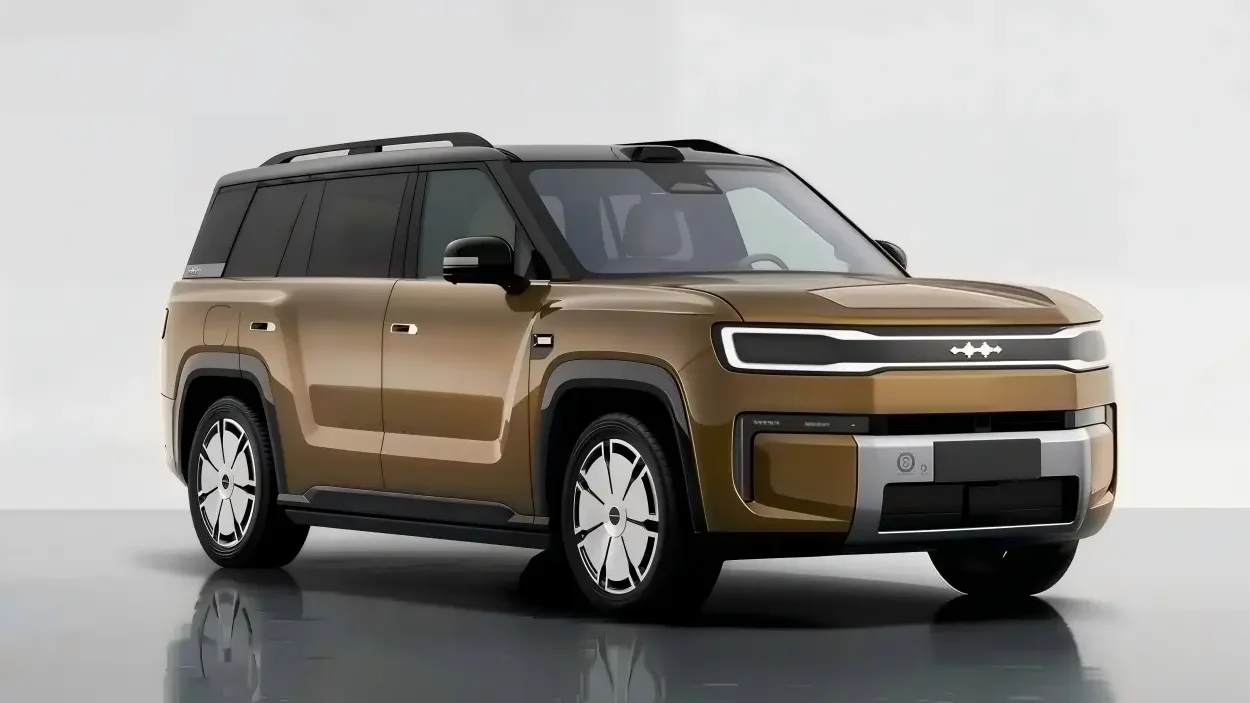
BYD’s personalized off-road brand just put its biggest family SUV yet on the record. On August 7, the Fang Cheng Bao Tai 9 appeared in the Ministry of Industry and Information Technology’s (MIIT) 410th batch of new-vehicle filings — the regulatory green light that normally precedes a launch by a few months. The Tai 9 is the flagship of the “Tai” sub-line, a six-seat plug-in hybrid built to challenge the Li L9, the Aito M8, and Xiaomi’s incoming Pengcheng N90 on home turf.
Dimensions and design
The numbers tell the story. At 5,270 mm long and 1,999 mm wide, with a wheelbase of 3,130 mm, the Tai 9 stretches past every mainstream Chinese large SUV on paper. That wheelbase beats the Li L9 (3,005 mm) and the Aito M9 (3,105 mm), and it seats six in a 2+2+2 layout — two individual captain’s chairs ahead of a walk-through second row.
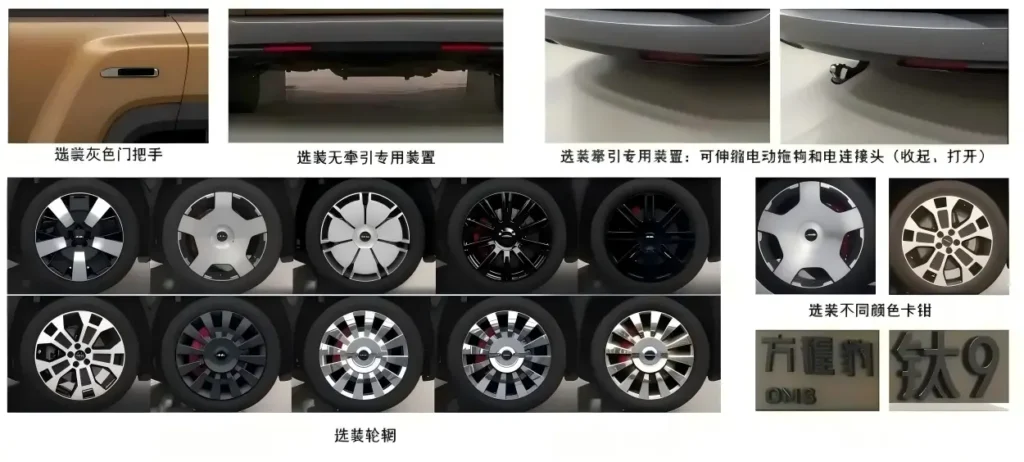
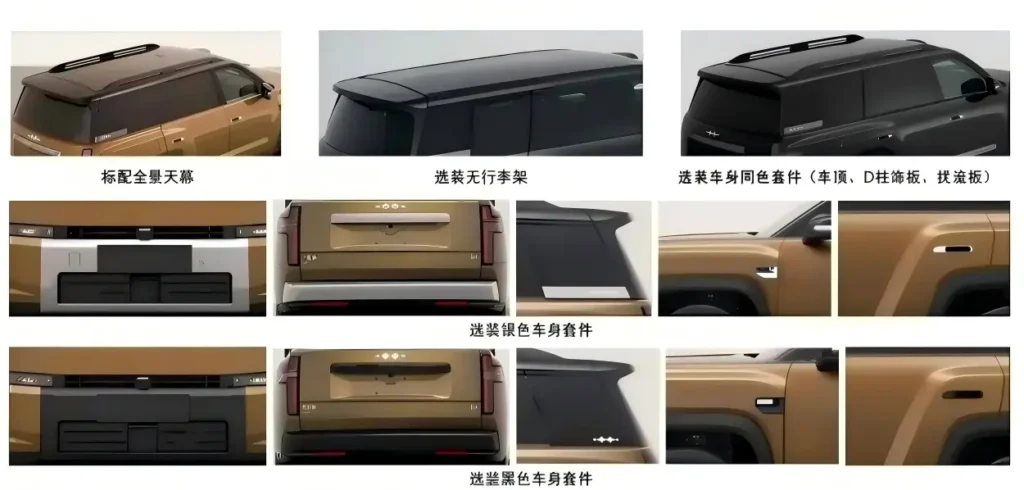
Design stays faithful to the boxy “Tai 7” language: a square footprint, a full-width light bar across the front, split headlights tucked low, and a vertical taillight treatment. A roof-mounted LiDAR pod signals that driver assistance is part of the plan, most likely BYD’s “God’s Eye B” stack. Out back, a split “heaven-and-earth” tailgate opens in two sections, and buyers can spec an electric tow hitch rated for 2,000 kg — a clear nod to the camping and caravan crowd. Wheel choices run 21 or 22 inches.
Powertrain
Under the skin, the Tai 9 pairs a 1.5T engine (BYD code BYD472ZQB, 115 kW) with front and rear permanent-magnet motors, each rated at 200 kW. Combined system output lands at roughly 400 kW. Energy comes from a 66.48 kWh lithium-iron-phosphate (Blade) pack supplied by FinDreams, good for 310 km of WLTC electric range. Top speed is 220 km/h, and depleted fuel use is listed at 6.4 L/100 km on the WLTC cycle.
One detail worth flagging: the filing lists a “DMS” badge on the tail, suggesting a platform distinct from the DM-o and DM-p hybrid architectures already in the lineup. BYD has not detailed what DMS stands for, but the unibody construction — not a hardcore ladder frame — confirms the Tai 9 is tuned for the school run, not the Rubicon. The brand’s recent clearance of China’s new L2 driver-assist national standard also sets the regulatory floor the Tai 9’s assistance suite will have to meet.
Positioning
Fang Cheng Bao has spent three years building a two-track identity: the “Bao” series for serious off-road, the “Tai” series for comfortable family use. The Tai 9 sits at the top of the family ladder. Current Tai models — the Tai 3 and Tai 7 — have given the brand real volume; Fang Cheng Bao moved about 41,000 units in July, the second-highest among China’s new EV makers, at an average transaction price near RMB 224,000 (about $31,000), as we noted in our July 2026 delivery roundup.
The Tai 9’s job is to push that average up. At an expected price somewhere between RMB 240,000 and RMB 400,000 depending on trim, it slots under the RMB 400,000-plus Li L9 and Aito M9 while offering more wheelbase — a classic BYD value play, and one that sits beneath the Yangwang halo without the six-figure price tag (BYD’s broader bet on premium electrification continues across its sub-brands).
Overseas branding: could it become the “BYD TI 9”?
One possibility worth flagging: as BYD streamlines its sub-brand architecture for foreign markets, the “Tai” line could be rebadged internationally as “BYD TI.” The logic fits a pattern already in motion — in July, BYD merged its Dynasty and Ocean lines under a single overseas brand and folded Denza and Fang Cheng Bao back-office operations together (BYD’s overseas brand restructuring). If the TI label holds, this model would reach export showrooms as the BYD TI 9 rather than the Fang Cheng Bao Tai 9. Nothing is confirmed — BYD has announced no renaming, and the “TI” label is, for now, industry speculation rather than policy. We’re noting it because BYD has been simplifying its brand names outside China, and a transliteration like “Fang Cheng Bao” is exactly the kind of thing global marketing teams tend to retire. Treat it as a rumor until the company says otherwise.
Price and timing
Here is where certainty ends. BYD has not published a price. A teaser clip on August 2 promised the Tai 9 “won’t wait long,” and the brand has said the model will debut in the second half of 2026, with pre-sales expected in the fourth quarter and deliveries in early 2027 per earlier guidance. Estimate the starting point anywhere from the mid-RMB 200,000s upward; final numbers will decide whether the Tai 9 disrupts the segment or simply fills a gap.
Author’s Take: The Tai 9 is less a leap in technology than a shrewd piece of portfolio math. BYD already has the batteries, the motors, and the hybrid know-how; what it lacked was a credible large family SUV that doesn’t wear a Yangwang badge and a six-figure price. The 3,130 mm wheelbase is the headline trick — it lets BYD walk into the Li L9’s living room and point at the floor space. The risk is pricing: if the Tai 9 lands too close to the Aito M9, Huawei’s ecosystem advantage wins; if it undercuts aggressively, it cannibalizes the Tang and the Denza N9. Either way, the MIIT filing means the fight is officially on.
Sources & Further Reading
- MIIT 410th batch new-vehicle announcement (August 7, 2026) — miit.gov.cn
- Pacific Auto (PCauto) — Tai 9 filing details: pcauto.com.cn
- Sina Tech / PChome — Tai 9 dimensions and powertrain: sina.com.cn
- NetEase Auto — “Another 9-series: Fang Cheng Bao Tai 9 official”: 163.com
- Fang Cheng Bao official teaser (August 2, 2026) — fangchengbao.com
- Related: BYD clears L2 driver-assist national standard · China EV July 2026 deliveries