
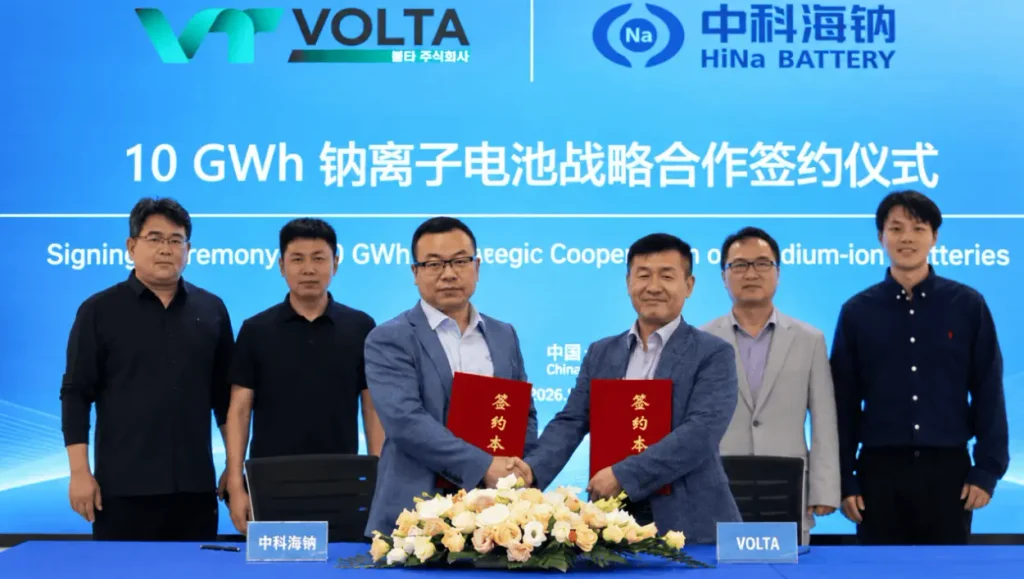
On September 4, 2026, HiNa Battery Technology — the Chinese Academy of Sciences spin-out that was among the first companies on earth to commercialize the sodium-ion battery — signed a five-year agreement to supply 10 GWh of sodium-ion cells to Korea’s VOLTA. It is a sodium-ion battery Korea deal with a twist: the chemistry China has effectively owned is now flowing into the home market of LG Energy Solution, Samsung SDI and SK On, the three companies that still lead the world in lithium-ion batteries.
The agreement was disclosed through Chinese business media on September 4 and carried into the September 5 energy round-ups. It is a long-term supply contract — 10 GWh spread over five years, roughly 2 GWh a year — not a one-off purchase, and no financial terms were published. That structure matters: it signals a repeat, multi-year procurement commitment from a Korean counterpart rather than a pilot, which is exactly the kind of offtake a battery maker needs to underwrite a factory.
A 10 GWh Sodium-Ion Battery Deal That Runs Into Korea
The geography is the story. Korea’s battery industry is defined by three lithium-ion incumbents — LG Energy Solution, Samsung SDI and SK On — that between them supply a large share of the world’s EV cells. Sodium-ion is the opposite of their playbook: a chemistry built on cheap, abundant sodium rather than lithium, cobalt and nickel, developed and scaled almost entirely by Chinese companies. A Chinese sodium-cell maker winning a five-year Korean order is therefore less a single contract than a data point in a larger reversal — the country that dominates lithium-ion batteries is now importing the chemistry designed to undercut it, as reported by Securities Times (证券时报).
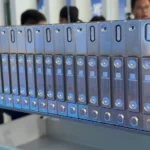
Sodium-ion’s pitch is blunt. Sodium is one of the most abundant elements on earth; the cell contains no lithium, cobalt or nickel; it performs better than lithium-iron-phosphate in cold weather; and it is cheaper to make. CATL, the world’s largest battery maker, has said its sodium-ion cells will ship from September 2026 at a cost 10–20% below the industry average. None of that removes sodium’s core weakness — lower energy density, which caps it in cars — but for stationary storage, where weight and volume matter far less than cost, sodium has become the fastest-moving battery story of 2026.
Why Sodium-Ion Batteries Are Heading to Korea, Not Just China
Korea is not an accidental buyer. The country runs one of Asia’s most ambitious energy-storage buildouts, and its grid, like China’s, is absorbing rising shares of renewable power that need firming. Storage — not electric vehicles — is where sodium-ion is winning its first real orders. In April 2026, CATL signed what was described as the world’s largest sodium-ion battery order; storage integrator HyperStrong then followed with a 60 GWh sodium order from CATL; and Chinese trade press now tallies close to 100 GWh of sodium storage orders announced in a matter of months. HiNa’s 10 GWh Korea deal is the newest tile in that picture — and notable because it crosses a border into a market where the local battery giants have been slow to commit to sodium.
HiNa: The Sodium-Ion Pioneer Behind the 10 GWh Korea Order
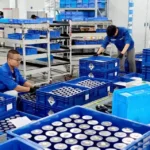
HiNa is not a newcomer. The company spun out of the Institute of Physics at the Chinese Academy of Sciences and was shipping sodium-ion batteries commercially years before the chemistry became fashionable; MIT Technology Review named it to its 2025 “Climate Tech Companies to Watch” list for its effort to commercialize what it called “salt cells.” HiNa has put sodium-ion cells into commercial vehicles and grid-scale storage, and it is building a 20 GWh sodium-ion manufacturing plant — an RMB 8 billion (about US$1.1 billion) project — to match the orders now landing. The VOLTA agreement is HiNa’s clearest overseas anchor yet.
The Sodium-Ion Battery Korea Math: Storage, Not Cars
The honest read is that sodium-ion’s first big market is stationary storage, not electric vehicles. Sodium cells today hold less energy per kilogram than even LFP, which confines them to vehicles with modest range or to grid and commercial-and-industrial storage where footprint is cheap — exactly where the 2026 order wave is concentrated. CleanTechnica has called the chemistry’s development “strangely time-compressed,” a reminder that sodium has gone from lab curiosity to contracted export volume faster than most observers expected.
For Korea, a 10 GWh supply of cheap, cold-tolerant, lithium-free cells is a hedge against lithium price swings and against over-reliance on the very lithium-ion supply chain its own giants control. For HiNa, the deal converts a technology lead into contracted export revenue — the validation the sodium-ion sector has been waiting for since the first lab breakthroughs.
The Bottom Line. HiNa Battery, the Chinese Academy of Sciences sodium-ion pioneer, has signed a five-year, 10 GWh supply agreement with Korea’s VOLTA — a Chinese sodium cell contract landing inside the home market of the world’s lithium-ion leaders. It is the newest piece of a 2026 sodium-ion inflection that has already produced close to 100 GWh of storage orders in China, headlined by CATL. The chemistry’s beachhead is storage, not cars, and its significance is not that it displaces Korean lithium-ion cells but that it opens a second, China-led battery supply chain — now with export volume attached.
Sources & Further Reading
- Securities Times (证券时报) — “HiNa Battery and Korea’s VOLTA sign strategic cooperation agreement” (2026-09-04) — primary Chinese-source report on the deal.
- Sina Finance (新浪财经) — “HiNa Battery and Korea’s VOLTA land 5-year 10 GWh long-term supply agreement” (2026-09-04) — confirms the 5-year / 10 GWh terms.
- Jiemian (界面新闻) — “Energy morning brief: HiNa Battery and Korea’s VOLTA sign 10 GWh supply deal” (2026-09-05) — morning-roundup confirmation of the September 5 coverage.
- Sohu (搜狐) — “HiNa teams with VOLTA: sodium battery exports hit the accelerator” (2026-09-05) — export-angle analysis of the agreement.
- MIT Technology Review — “2025 Climate Tech Companies to Watch: HiNa Battery Technology” (2025-10-06) — English background on HiNa’s “salt cell” commercialization.
- pv magazine India — “Massive 20 GWh sodium-ion battery manufacturing plant announced in China” (2025-11-26) — English background on HiNa’s planned capacity.
- CleanTechnica — “The Strange Time Compression of Sodium-Ion Battery Development” (2025-11-30) — English context on sodium’s rapid industrialization.
- CCTV Finance (央视财经) — “CATL lands world’s largest sodium-ion battery order” (2026-04-28) — sodium storage order context.
- TMTPost (钛媒体) — “HyperStrong and CATL land 60 GWh order” (2026) — storage order-wave context.
- Edgen — “CATL to deliver sodium-ion batteries at 10–20% cost advantage from September” (2026) — CATL cost figures.
Sourcing note: The agreement was signed September 4, 2026 and reported the same day by Securities Times and Sina Finance, then carried into the September 5 energy round-ups; no English-language first-hand report of this specific deal had appeared as of publication, so Chinese high-authority business media (Securities Times, Sina Finance, Jiemian) serve as the primary citations, supplemented by English background on HiNa and the sodium-ion market (MIT Technology Review, pv magazine, CleanTechnica). The Chinese-language release does not detail VOLTA’s business, so this article does not speculate on the Korean counterpart’s end application; “VOLTA” is used as the buyer’s name as it appears in the release. The 5-year, 10 GWh terms come from the release; no financial value was disclosed. Sodium order totals (~100 GWh) are a trade-press aggregation across multiple companies and should be read as an order-of-magnitude indicator, not a single audited figure. CATL’s 10–20% cost advantage is CATL’s own statement, not HiNa’s. USD conversions calculated at RMB 7.25 to the dollar. Analysis and interpretation are original to EVsays.