


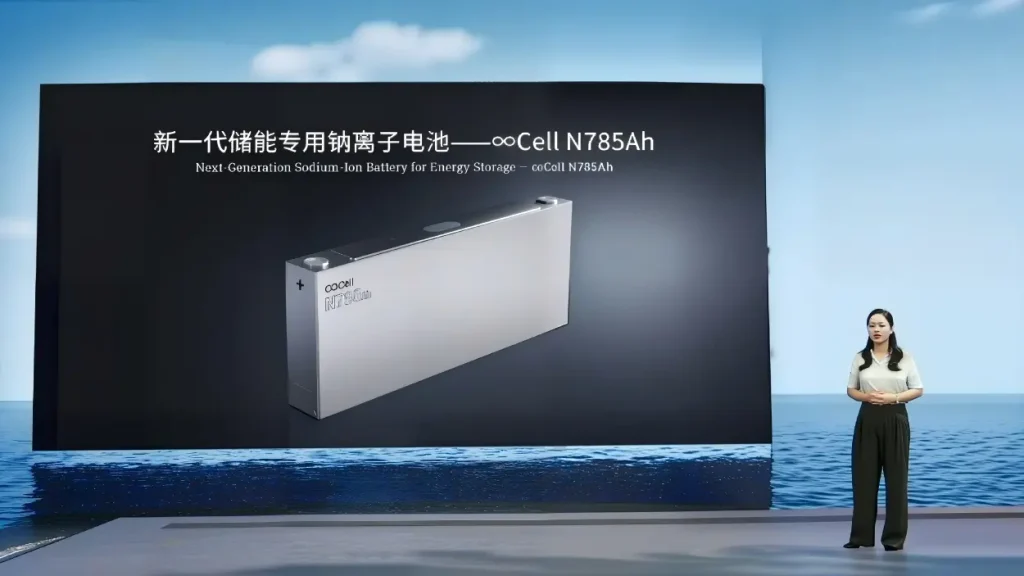
On September 16, Xiamen-based HiTHIUM unveiled the ∞Power N4.0MWh, a 4 MWh sodium-ion energy storage system built around a new 785 Ah cell — and said it will begin full-chain mass production in 2027 using the lithium-ion manufacturing lines it already operates. The headline number is the cell. The number that decides whether this matters is the date.
Hithium Sodium-Ion Battery Launch: What the ∞Power N4.0MWh Actually Is
The product is a pair: the ∞Cell N785Ah cell and the ∞Power N4.0MWh container built around it. HiTHIUM introduced both at an online launch event it called “Powered Day in, Day out”, alongside a plan to extend sodium beyond utility-scale storage into commercial, industrial and residential products.
The system-level numbers are where the engineering shows. HiTHIUM says the system architecture cuts station footprint by 30%; it pairs a stacked-cell design with a dedicated battery management system with state-of-charge estimation accuracy of 2.5% or better, and compatibility with 800–1500 V power conversion systems — so existing PCS hardware can be reused rather than replaced. Rated power utilisation on those converters rises by more than 20% against HiTHIUM’s previous-generation sodium system.
Thermal management is a hybrid air-and-liquid cooling scheme paired with AI control and a built-in weather monitoring module, which switches between cooling modes based on real-time conditions. HiTHIUM says that cuts operating auxiliary power consumption by 30% and standby auxiliary consumption by 50%, while the system holds a 24-hour comprehensive efficiency above 88%.
| Specification | ∞Power N4.0MWh |
|---|---|
| Cell | ∞Cell N785Ah sodium-ion |
| Container capacity | 4 MWh |
| Cycle life | 20,000 cycles (vendor figure) |
| Duration | 2–8 hours |
| Design service life | 30 years |
| BMS accuracy | SOC estimation ≤2.5% |
| PCS compatibility | 800–1500 V |
| Station footprint | −30% vs. previous generation |
| 24-hour efficiency | >88% |
| Auxiliary power | −30% operating, −50% standby |
| Mass production | 2027, full chain |
Why the Hithium Sodium-Ion Battery Went From 162 Ah to 785 Ah
Sodium’s bottleneck has never really been the chemistry. Sodium-ion cells work. The problem is that nobody has been able to manufacture them in large formats at lithium-grade yield, which is why so many sodium products on the market are small cells aimed at niche duty cycles.
HiTHIUM’s answer is to stop treating sodium as a separate industry. The company says the ∞Cell N785Ah is “fully compatible” with its 1,000 Ah lithium-ion manufacturing platform, including both cell and system integration lines. Read that as the actual product: not a sodium cell, but a sodium formulation that runs on tooling already paid for.
The materials work behind it is specific. On the cathode, HiTHIUM co-developed an NFPP (sodium iron pyrophosphate) material with phase purity of 97%. On the anode it developed its own hard carbon, using pore-structure control and surface-defect repair to get low expansion and high rate capability at the same time — the pair that determines calendar life. The electrolyte uses a formulation HiTHIUM describes as “micro-bonding plus targeted repair” to stabilise film formation and suppress consumption.
Manufacturing contributes three changes: an ultra-thick coated electrode to offset sodium’s lower energy density; vent valves and welds designed to survive more than 20,000 breathing cycles without fatigue from accumulated micro-deformation; and wide-format large stacking borrowed from HiTHIUM’s lithium lines, which is the step that makes volume production possible at all.
The generational jump is fast. HiTHIUM launched the ∞Cell N162Ah in December 2024, calling it the first sodium cell designed specifically for utility-scale storage. It showed a ∞Power N2.28MWh sodium system in June 2026. Twenty-one months after the 162 Ah cell, the format has grown almost fivefold.
Hithium Sodium-Ion Battery Cost: A Target That Depends on Lithium
Chief technology officer Dr. Nazar Yi framed the problem in two words: “Energy storage technologies must overcome two barriers to achieve large-scale deployment — affordability and availability.”
Then came the number that deserves more attention than it got. HiTHIUM’s cost target for the new system, Yi said, is “at least to match lithium batteries at a lithium carbonate price of RMB 150,000 per tonne” (about $20,690 at 7.25).
That is not a claim that sodium is cheaper today. It is a claim that sodium becomes competitive at a given lithium price — which means the entire commercial case is contingent on where lithium carbonate trades. Sodium’s pitch has always been resource abundance rather than raw cost, and Yi said so plainly: sodium is widely distributed, which improves supply-chain stability for an industry where Chinese producers still source the majority of lithium battery materials from overseas.
The other number is cost of storage. HiTHIUM is targeting a levelised cost of storage of RMB 0.1 per kWh. At a 7.25 exchange rate that is 1.38 US cents per kWh; the English trade coverage converted it at roughly 1.5 cents using a stronger yuan assumption. Either way it is a target, not a contracted price, and the company disclosed no pricing for the system.
Policy is now pushing in the same direction. The consumption-tax exemption that took effect on September 1, 2026 exempts sodium-ion, solid-state and fuel-cell batteries from consumption tax through the end of 2028. Ten days earlier, the Ministry of Industry and Information Technology and the National Development and Reform Commission listed low-cost, long-life sodium batteries among the key technologies in the electronics manufacturing plan for the 15th five-year period. Sodium is also arriving into a storage market where cell prices have already been through a violent repricing — the subject of our earlier look at the storage cell price swing.
Hithium Sodium-Ion Battery vs CATL: Two Routes to One Market
The competitive picture is clearer than it was a year ago, and there are two distinct strategies in it.
CATL’s approach is platform commonality: its storage sodium cell uses the same shell as its 587 Ah lithium cell, exceeds 300 Ah, claims 97% round-trip efficiency and more than 15,000 cycles, and ships inside the Tianheng system. CATL also said it would begin first sodium deliveries in China in September 2026, with 1 GWh of output targeted for the year. More importantly, it has already converted the technology into contracted volume — a three-year, 60 GWh sodium-ion storage agreement with HyperStrong that stands as the largest sodium storage order on record, part of more than 67 GWh of sodium orders the company says it has signed. We covered the European end of that push separately in CATL’s sodium plan for Europe.
HiTHIUM’s approach is the opposite bet on format. Its cell is more than twice CATL’s capacity and rides on a larger manufacturing platform, which should mean fewer parts and lower integration cost per kWh — if the yield holds. What it does not yet have is announced sodium orders.
| Player | Storage sodium cell | Claimed cycles | Commercial status |
|---|---|---|---|
| HiTHIUM | 785 Ah (∞Cell N785Ah) | 20,000 | Mass production targeted 2027; no orders disclosed |
| CATL | >300 Ah, 587 Ah shell | >15,000 | First deliveries September 2026; 60 GWh order with HyperStrong |
| Chu Neng | 165 Ah, NFPP + hard carbon | >20,000 | Certified for frequency regulation |
| EVE Energy | 155 / 175 / 355 Ah matrix | Varies by model | NF155L in commercial operation at Jingmen |
| BYD | Polyanion sodium | 10,000-cycle product developed | GWh-scale storage production since 2025 |
The market these products are entering is still small but is compounding quickly. Industry researcher SPIR puts global sodium battery shipments at 9 GWh in the first half of 2026, up 143.2% year on year, with storage accounting for 67.4% of that — making stationary storage the single largest sodium application. SPIR expects more than 20 GWh for the full year and projects global sodium shipments of 1,051 GWh by 2030, of which 580 GWh would be storage.
Against that, sodium’s supply chain is attracting capital on the system-integration side too, from storage asset acquisitions such as Qualitas Energy’s purchase of Cero Generation to European projects like the Masdar–Luxcara storage pact in Germany — demand that any sodium entrant has to plug into, not displace.
What Has to Be True for the Hithium Sodium-Ion Battery to Ship in 2027
Two numbers in this launch are worth putting side by side. HiTHIUM says the cell lasts 20,000 cycles and the system has a 30-year design life — which Dr. Aileen Wang, who runs HiTHIUM’s Battery Research Institute, put as: “30 years means 10,950 days of validation, a long-term commitment to our customers.” Thirty years is indeed 10,950 days. Divide one by the other and you get 1.83 cycles per day.
That is an important constraint, not a flaw. A 2–8 hour duration asset on a daily arbitrage cycle typically runs about one cycle a day, so 30 years and 20,000 cycles are arithmetically consistent — provided the operator does not cycle it twice a day. Any developer counting on two cycles daily gets closer to 27 years. The 30-year figure is a design and accounting claim, and it should be tested against the duty cycle, not quoted as a guarantee.
What HiTHIUM did not provide is equally telling: no pricing, no exact availability date beyond 2027, and no disclosed customers. Its competitor’s sodium volume is already contracted. HiTHIUM’s counter is manufacturing readiness — a line that exists today rather than one that has to be built — and it has also launched an “∞Edge” pioneer programme that will test batteries and systems in extreme environments over three years and publish the results, which reads as an acknowledgement that field validation is the next hurdle rather than a finished task.
The 2027 date itself invites comparison. Every major battery chemistry roadmap now converges on the same year — as we set out in the solid-state battery race to 2027, the pattern is a pilot line today and a production claim two years out. Sodium is running the same playbook, with one advantage: it does not need a new factory.
The Bottom Line: HiTHIUM’s 4 MWh sodium system puts a 785 Ah cell with 20,000 cycles and a 30-year design life into a container that talks to existing PCS hardware, and plans to build it on lithium lines from 2027. Sodium’s ceiling is no longer technical — it is whether lithium prices stay high enough to make the arithmetic work, and whether buyers sign before a competitor’s order book fills up.
Accuracy note: All performance figures — 785 Ah, 20,000 cycles, the 30-year design life, ≤2.5% SOC accuracy, >88% 24-hour efficiency, the 30% footprint reduction and the auxiliary-power savings — are manufacturer claims presented at the launch, not results from independent testing, and no third-party verification was available at the time of writing. The RMB 0.1 per kWh figure is a stated target, not a price; HiTHIUM disclosed no system pricing and no exact availability date. The 30-year figure is a design service life and does not guarantee outcomes under a given duty cycle. Competitor figures for CATL, Chu Neng, EVE Energy and BYD are drawn from company announcements and industry reporting and are similarly unverified. Currency conversion uses 7.25 CNY/USD, which yields 1.38 US cents per kWh for RMB 0.1; the English trade coverage quoted approximately 1.5 cents using a stronger yuan assumption. Market sizing comes from the Chinese research firm SPIR and is a forecast, not a measurement.
Sourcing note: HiTHIUM’s launch on September 16, 2026 was disclosed on the company’s own newsroom and through an official press release, with the full product specification set carried by The Battery Magazine; English trade coverage of the same launch was published by ESS News and pv magazine International. Chinese-language reporting used for the materials, manufacturing and competitor detail includes Science and Technology Daily (科技日报), Beijing News / Shell Finance (新京报贝壳财经), Huanqiu (环球网), 10jqka (同花顺财经) and Sina Finance (新浪财经). Sodium market data is from SPIR (起点研究院). The launch event was streamed online; EVsays did not attend in person and did not independently test any product.
Sources & Further Reading
- HiTHIUM official newsroom — “HiTHIUM Launches Next-Generation Integrated Sodium-Ion Energy Storage Solution to Accelerate Sodium-Ion Industrialization” (2026-09-16) — the company’s own disclosure of the ∞Power N4.0MWh and ∞Cell N785Ah specification set, and the source of the executive quotations.
- The Battery Magazine — “HiTHIUM Unveils 4MWh Sodium-Ion Energy Storage System” (2026-09-16) — full product specification set as released by HiTHIUM, including the executive quotations attributed to Dr. Nazar Yi and Dr. Aileen Wang.
- Science and Technology Daily (科技日报) — “海辰储能发布新一代钠电储能一体化解决方案” (2026-09-16) — the cost target tied to a RMB 150,000/t lithium carbonate price, plus the system-level efficiency and auxiliary-power figures.
- Sina Finance (新浪财经) — “钠电产业化加速 海辰储能发布新一代钠电储能一体化解决方案” (2026-09-16) — cathode, anode and manufacturing detail, and the NFPP phase-purity figure.
- ESS News / pv magazine International — “Hithium launches 4 MWh sodium-ion BESS with new 785Ah cell” (2026-09-16) — independent trade write-up confirming the specifications and noting that pricing and exact availability were not disclosed.
- Beijing News / Shell Finance (新京报贝壳财经) — “政策加码、龙头抢跑,钠电瞄准储能市场” (2026-09-16) — CATL’s September delivery plan, the 1 GWh 2026 sodium output target and the consumption-tax exemption timeline.
- Huanqiu (环球网) — “海辰储能发布新一代钠电储能系统” (2026-09-16) — the ∞Edge pioneer programme and the plan to extend sodium into commercial, industrial and residential storage.
- SPIR (起点研究院) — sodium battery shipment data for H1 2026 and the 2030 projection of 1,051 GWh global shipments, 580 GWh of it storage.
- Ministry of Industry and Information Technology and National Development and Reform Commission — electronics manufacturing development plan for the 15th five-year period (2026-09-15), which lists low-cost long-life sodium batteries among priority technologies.


[…] front line of the storage argument: a day after BYD’s launch, HiTHIUM made the same case with a sodium-ion cell and a 4 MWh container aimed at the same durations. Scaling the cell changes the arithmetic at the site level. In […]