

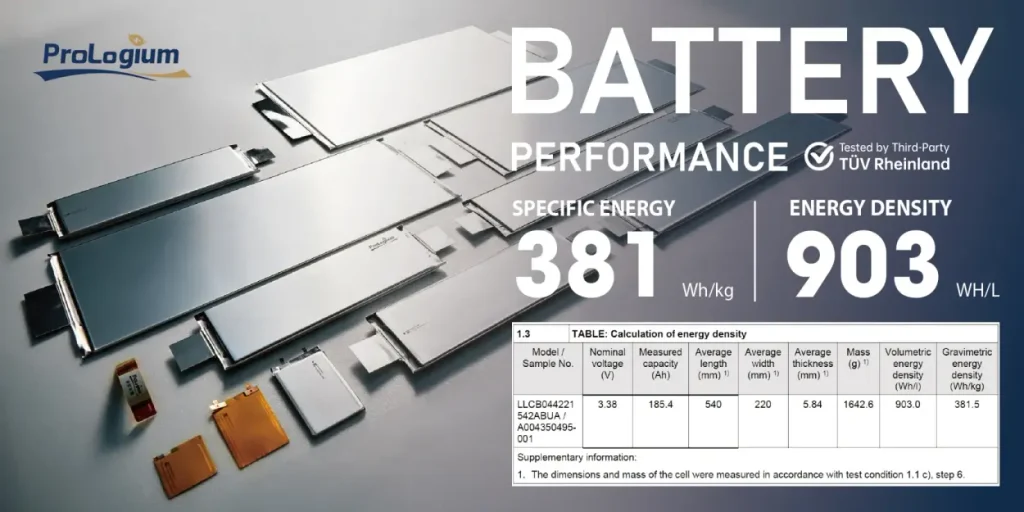
On September 7, 2026, ProLogium Technology — the Taiwanese solid-state battery maker backed by Mercedes-Benz — announced mass production of a high-energy-density all-solid-state cell reaching 381 Wh/kg and 903 Wh/L, per the company’s official release. It’s the milestone rivals keep postponing: Toyota says 2028, and most Chinese and Korean giants say 2030.
The ProLogium solid-state battery’s two headline numbers — 381 watt-hours per kilogram and 903 watt-hours per litre — clear the bar carmakers say solid-state must reach to beat today’s lithium-ion cells on range without sacrificing cost.
ProLogium Solid-State Battery at 381 Wh/kg, 903 Wh/L: What “Mass Production” Means
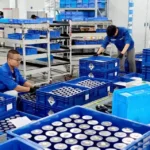
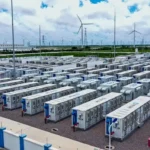
“Mass production” is easily overstated. It means the cell has left the pilot line for a real, repeatable line — it says nothing about volume, yield or the buyer, none of which ProLogium has disclosed, and the density figures are its own, unverified. What is not in dispute is the factory: the company runs what it calls the world’s first solid-state gigafactory in Taoyuan, with a second plant underway in Dunkirk, France, where it broke ground.
Why a Taiwanese Startup Beat the Giants to Solid-State Battery Production
Toyota has pushed solid-state to 2028; CATL, Samsung SDI and LG Energy Solution point to 2030. ProLogium — founded in 2006 and a fraction of their size — claims the milestone first because it spent two decades on a ceramic “lithium ceramic” electrolyte, safer than rivals’ sulfide or polymer routes but long stuck on interface contact and cost. Putting a 381 Wh/kg, 903 Wh/L ceramic cell on a line means it has cracked both scaling and yield.
Mercedes-Benz: The Customer Behind ProLogium’s Solid-State Battery
Mercedes took a stake and signed a tech-cooperation deal in 2022 to co-develop cells for its 1,000-km-range EV goal. That disciplines the reading: a carmaker of Mercedes’ culture does not attach its name without automotive validation, and it will test every cell — so overstating would be self-defeating for ProLogium.
The Solid-State Battery Reality Check: Mass Production Is Not Mass Adoption
“In production” is not yet “in your car.” A 381 Wh/kg, 903 Wh/L cell must still survive cycles, fast charging, temperature extremes and the abuse tests lithium-ion spent a decade passing; ProLogium has not published volume, yield or qualification status. Still, the question has shifted from “who’s first to a working cell” to “who’s first to a million cells a year.”
The Bottom Line. ProLogium, the Mercedes-backed Taiwanese solid-state specialist, says it has begun mass production of a 381 Wh/kg, 903 Wh/L fourth-generation cell — a milestone the giants scheduled for 2028 or later. Volume, yield and validation remain undisclosed, so this is not yet proof that solid-state is cheap or car-ready. But a Taiwan-and-France footprint with a German luxury investor testing its cells has moved solid-state from “first to a working cell” to “first to a million cells a year.”
Sources & Further Reading
- ProLogium Technology (official) — “ProLogium Begins Mass Production of High Energy Density All-Solid-State Battery Reaching 381 Wh/kg and 903 Wh/L” (2026-09-07) — primary source.
- ProLogium Technology (official, FR) — “world’s first solid-state battery gigafactory” — Taoyuan plant description.
- The Electric Viking — “ProLogium Begins Mass Production of 381 Wh/kg Solid-State Battery Cell” (2026-09) — independent English commentary.
- Wikipedia — “ProLogium” — company background.
- PCMag — “Mercedes Eyes Solid State EV Batteries by 2030” — Mercedes timeline and 1,000 km goal.
- GlobeNewswire (official press release) — “ProLogium Breaks Ground on Dunkirk Gigafactory in France” (2026-02-10) — France plant.
Sourcing note: Published September 7, 2026 on ProLogium’s official website and cited here as the primary source; the 381 Wh/kg and 903 Wh/L figures and “mass production” framing are ProLogium’s own statements. Mercedes-Benz’s stake and 2022 cooperation are documented by PCMag. Volume, yield, cycle-life and automotive-qualification data are undisclosed as of publication, so “mass production” is treated as distinct from “mass adoption.” Analysis is original to EVsays.