
SK On, the battery arm of South Korea’s SK Innovation, has landed a U.S. energy-storage order worth roughly $1.1 billion — its clearest step yet out of the electric-vehicle battery slump and into stationary storage.
The deal
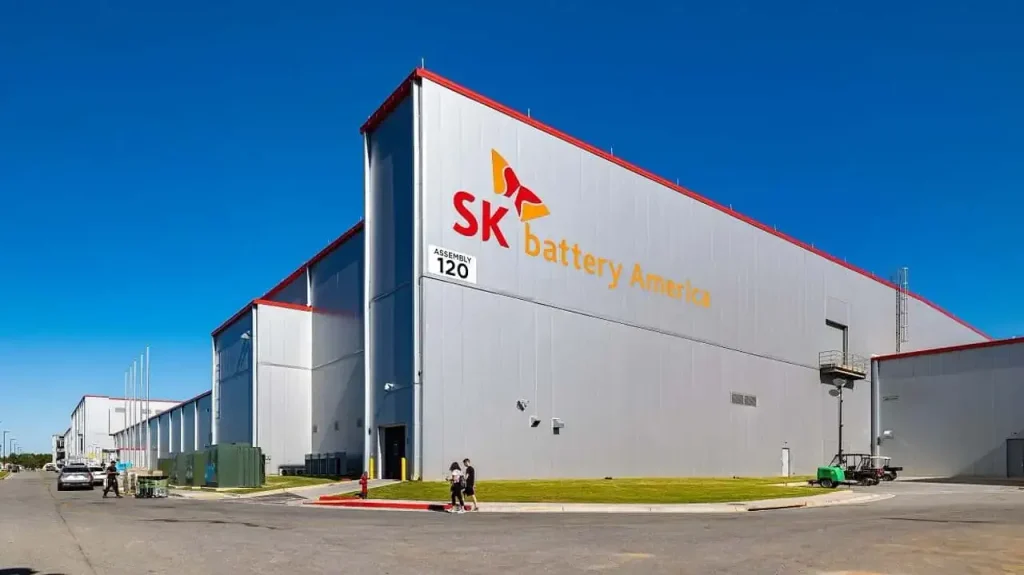
SK On said on August 31 it signed a battery-cell supply agreement with NeoVolta Power on August 27 at its Seoul headquarters. Under the deal, SK On will ship 9 gigawatt-hours of lithium-iron-phosphate (LFP) pouch cells over five years, from 2027 through 2031, all produced at its plant in Georgia. The company did not disclose a value; industry estimates put the contract at about 1.5 trillion won, or $1.09 billion.
NeoVolta Power, a subsidiary of U.S. energy-technology firm NeoVolta, runs a manufacturing facility in Pendergrass, Georgia, and will use the cells for utility-scale and commercial-and-industrial storage systems.
The circular twist
The structure is the unusual part. This is not a one-way sale: SK On supplies the cells, NeoVolta assembles them into packs, and then SK On buys the finished packs back under a tolling arrangement. A separate agreement due later this year adds another 9 GWh, bringing the partnership’s headline total to 18 GWh — even though the same electrons effectively move twice.
The loop serves both sides. SK On keeps its U.S. factories busy, and NeoVolta gets an anchor customer for its pack-assembly lines in a single stroke. It is the kind of capital-light deal that lets a battery maker add storage revenue without having to win a finished-system brand from scratch.
Why LFP, and why now
The move is a deliberate pivot. SK On built its U.S. footprint on high-nickel NMC chemistry for electric vehicles; the Georgia plant was designed around that. Now it will convert part of those lines to LFP for energy storage, joining South Korean peers LG Energy Solution and Samsung SDI, which are running the same playbook — shifting idle EV capacity into stationary storage as EV demand cools and subsidies thin out.
Storage is where the growth has migrated. LFP cells are cheaper and tolerate more charge cycles than high-nickel cells, which matters more to a grid operator than to a car buyer. SK On is targeting more than 20 GWh of global ESS orders this year, and this single deal accounts for nearly half of that goal.
The American angle
Producing in Georgia matters beyond logistics: it positions the cells for Inflation Reduction Act-compliant systems at a moment when Washington’s clean-energy credits are shaping where batteries get made. SK On already holds roughly 100 GWh of U.S. capacity across its standalone plants and a Hyundai Motor Group joint venture, and has supplied U.S. renewable developer Flatiron Energy as an early storage customer.
The deal also widens SK On’s customer base beyond automakers at a time when its EV order book is under pressure — a hedge that converts a factory from a cost center into a diversified revenue stream.
The Bottom Line
SK On signed a roughly $1.09 billion, 9 GWh LFP cell-supply deal with NeoVolta Power for U.S. energy storage, with an add-on that takes the partnership to 18 GWh. Made in Georgia, the cells mark SK On’s strategic shift from EV high-nickel batteries to storage-grade LFP — the same hedge its Korean rivals are running as electric-vehicle demand slows.
Sources & Further Reading
- Yonhap News Agency — SK On signs ESS battery deal with U.S. firm NeoVolta Power
- BusinessKorea — SK On wins $1.1 billion U.S. ESS battery deal
- The Elec — SK On to supply 9 GWh of LFP batteries to NeoVolta Power
- ESS News — SK On secures massive LFP supply and offtake deal with NeoVolta Power
- Related: Global EV battery market share — CATL 40.2%, BYD 14.4%
- Related: Solid-state vs liquid EV battery technology, explained