


Sunwoda’s battery unit has a 15C flash-charging pack, a solar-plus-storage charging platform and a plan for 10,000 megawatt charging stations in China by the end of 2027. Only one of those three things is really new — and it is not the battery.
The company, Sunwoda Electric Vehicle Battery, presented all three at the New Energy Battery Industry Development Conference in Zaozhuang, Shandong, on September 17, as Xinhua’s account of the event sets out through the official release text. The announcement has been reported since, and the battery specifications are the part most coverage has focused on. The interesting part is the network.
The station target is a change of role. Sunwoda has spent years as a cell supplier — the company says it has shipped 4.5 billion consumer cells and led global installations of lithium batteries for hybrid vehicles in the second quarter of 2026. Building 10,000 charging stations would put it in the business of owning the infrastructure its customers depend on.
What the Battery Actually Promises
The published figures, at room temperature with a 98 kWh pack: 10% to 70% in five minutes, 10% to 97% in nine minutes, and one minute of charging worth 100 km of range. The system supports more than 700 km of claimed range, retains above 90% of that at −20°C, and uses cells rated at 460 Wh/L or 190 Wh/kg with system volume utilisation of at least 80%. Peak charge rate is 15C at a maximum current of 1,800 amps.
On durability, the claim that matters commercially is the warranty framing: for vehicles not used commercially, Sunwoda says ultra-fast charging sessions are unlimited within a 10-year or 300,000 km warranty. That is a promise about battery life under exactly the conditions that normally shorten it, and it is the kind of claim a customer can hold a supplier to. The company also says the pack achieves no thermal propagation through a high-temperature water-clamp design with multi-point triggering.
The intelligence layer is where the marketing has moved industry-wide, and Sunwoda’s version is specific: smart cells 3.0 with a custom chip, an energy domain controller with microsecond safety response, and an AI cloud platform that the company says draws on more than 2 million vehicles and six years of operating data to identify over 20 fault types two to ten days ahead, with 99.77% accuracy and state-of-health error within 2%. It says cycle life improves by about 15% against a conventional flash-charging pack. All of those are manufacturer figures, tested in the company’s own laboratory conditions, and none has been independently verified.
Note on one specification: the low-temperature figure differs between accounts of the same event. Xinhua’s report and other outlets carrying the official release text state −30°C, 12 minutes, 20% to 97%. Securities Times (证券时报), and the English trade coverage that followed it, state −20°C, 15 minutes, 10% to 97%. We could not obtain a specification sheet from the company. The two accounts describe different tests — the second starts at a lower state of charge — so they may both be true, but they are not interchangeable and we are not going to merge them into one number.
15C Is a Peak, Not a Pace
The rate label deserves a closer look, because it is where most of the headlines went.
Charging from 10% to 97% is 87% of a pack’s capacity in nine minutes, which works out at an average of roughly 5.8C across the session. The 15C figure describes the peak the cells can accept, not what the car takes for the whole charge, and no vehicle holds a peak rate from low to high state of charge. This is not a criticism of Sunwoda; it is how every flash-charging claim in China is now written.
What is worth noting is the comparison. The room-temperature intervals Sunwoda published — five minutes for 10% to 70%, nine minutes for 10% to 97% — are the same figures BYD gave when it launched its second-generation Blade Battery in March. Sunwoda’s headline 15C is a higher peak rate than BYD’s 10C, but the charge curves the two companies chose to publish are identical. On the numbers presented, this is a match rather than an advance.
Others are moving too. A battery developed by Hongqi with China Automotive New Energy Battery Technology charged from 10% to 70% in three minutes and 41 seconds at 25°C in July testing, with no production date attached. Dongfeng showed a 1,500-kilowatt ultrafast charger prototype at the end of July. Xpeng opened its first X-Energy megawatt station in Hong Kong on September 15, with 400 kWh of on-site storage and access for all brands.
| Company | Charge claim | Network position |
|---|---|---|
| BYD | 10% to 70% in 5 min, 10% to 97% in 9 min (second-generation Blade, March) | 10,000th flash charging station completed on August 28; 20,000 targeted by end-2026 |
| Sunwoda | Same room-temperature intervals, 15C peak, 1,800 A | 10,000 megawatt-class stations targeted by end-2027 |
| Hongqi with CNET | 10% to 70% in 3 min 41 s at 25°C (July test) | No production timetable disclosed |
| Dongfeng | 1,500 kW per connector (prototype, July 29) | Prototype stage |
| Xpeng | 1 MW station output | First X-Energy station operating in Hong Kong from September 15, open to all brands |
Why a Battery Maker Is Building the Network
Deng Jie, who runs Sunwoda’s flash-charging ecosystem business, gave the clearest answer to the obvious question — why a cell supplier would take on a charging network — and it is a structural argument rather than a commercial one.
Automakers, he said, are separated by brand boundaries and partly proprietary charging protocols. A battery company supplies many of them. That makes a cell maker a more natural builder of a cross-brand public fast-charging network than any single carmaker, and it is the same logic that has put several battery companies into partnerships with vehicle manufacturers on shared platforms.
The commercial structure follows from that. Sunwoda is offering partners four ways in: supply of individual components, delivery of a complete system, co-building a network, or joint investment and operation. It says the 10,000 stations will be a mix of self-built and partner-built, chosen first in areas with dense flash-charging vehicle populations and high-frequency refuelling demand, with highways a priority, and with the conversion of existing stations as a second route.
The company’s own executive is candid about where the difficulty sits. Deng said the technical challenge of rolling out flash-charging stations is not especially large; the hard part is operations, and he put the payback period on urban passenger-car charging stations at five to six years. That is the honest version of the announcement, and it explains why the strategy is wrapped in an ecosystem rather than presented as a construction programme.
The Hardware That Makes Megawatt Charging Possible
One part of the platform is more interesting than the marketing around it. Megawatt-class charging is a problem for the site, not just the car: a station that draws 1.5 MW on demand usually needs a transformer upgrade, which is expensive, slow and often impossible inside a city. It is the same problem BYD works around in the architecture of its own megawatt stations, and flash charging is already shipping on production cars: Denza markets the Z9S on flash charging and a claimed 1,100 km of range.
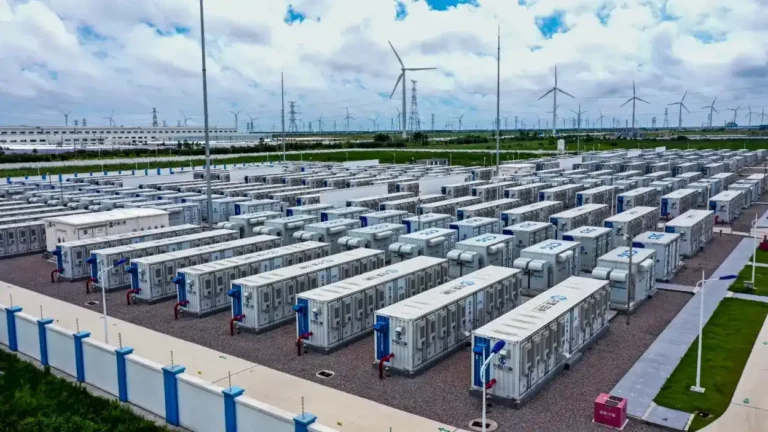
Sunwoda’s answer is to ship storage with the station. Its backup-storage units use in-house high-rate cells — 268 Ah, 4C peak discharge, more than 5,000 cycles — in three combinations: 176 kWh with 0.7 MW, 352 kWh with 1.4 MW and 528 kWh with 2.1 MW. The footprint is about one parking space, and the storage buffers the vehicle’s demand so the site draws far less from the grid than the car takes from the charger. The charging host and liquid-cooled terminals are modular between 0.8 MW and 2.4 MW, with a single gun rated up to 1.5 MW and compatibility across battery brands.
Put that together at network scale and the arithmetic is the point: 10,000 megawatt-class stations, each buffering its own peak, is a distributed-storage portfolio as much as it is a charging network. China is pushing the same idea from the other end of the wire, with a 50 GW vehicle-to-grid target for 2030 that would turn cars themselves into part of the buffer. The company has not published how much storage the full network would carry, and we have not estimated it.
What Sunwoda Did Not Say
The announcement leaves the commercially decisive details open. There are no station locations, no investment figure, no named first vehicle models and no mass-production timetable for the battery. There is a warranty policy but no published warranty document with the conditions attached. The fault-prediction accuracy figure is a laboratory number, not a field result. The 700 km range claim is not tied to a vehicle or a test cycle.
And the competitive position deserves a plain statement. BYD reached its 10,000th flash-charging station on August 28 and is aiming for 20,000 by the end of this year. Sunwoda is targeting the same order of magnitude fourteen months later, from a standing start, in a business its own executive describes as having a five-to-six-year payback. This is not a race it can win on station count. It only makes sense if the network exists to sell battery packs and storage systems, which is precisely how the company has framed it.
Sources & Further Reading
- Xinhua (新华网) — “Sunwoda EVB releases smart flash-charging battery system solution and the ‘All-capable, Boundless’ solar-storage-flash-charging open ecosystem platform” (2026-09-21, covering the September 17 conference) — the battery specifications, the low-temperature figure of −30°C and 12 minutes in the official release text, the platform description and the remarks by founder Wang Mingwang.
- Securities Times (证券时报) — coverage of the 2026 New Energy Battery Industry Development Conference in Zaozhuang (2026-09-18) — the alternative low-temperature figure of −20°C and 15 minutes, and the conference detail.
- Southern Plus (南方+) — “Sunwoda EVB plans to build 10,000 megawatt-class flash charging stations by the end of next year” (2026-09-17) — the 10,000-station target, the self-built and partner-built split, and the company’s description of its own transition from battery supplier to platform builder.
- The Chinese charging-industry outlet 充换电研究院 — the detailed account of the platform hardware and its interview with Deng Jie on operational economics, including the storage capacity and power combinations.
- CnEVPost (2026-09-17) — the competitive comparison used in the table above: BYD’s second-generation Blade figures and its 10,000th station, Hongqi’s joint test with CNET, Dongfeng’s 1,500 kW prototype and Xpeng’s X-Energy station in Hong Kong. Cited by name.
- EVsays — related coverage: BYD’s 10,000th flash charging station, how BYD’s megawatt station is put together, flash charging on a production model, flash charging from a driver’s perspective and China’s vehicle-to-grid target.
Accuracy note: The battery specifications, the storage combinations, the station target and the partnership models are as stated by Sunwoda Electric Vehicle Battery and its executives at the September 17 conference, reported by the outlets above. Every performance figure in this article is a manufacturer claim, including the 99.77% fault-prediction accuracy, the 2% state-of-health error and the 15% cycle-life improvement, and none has been verified by us or, as far as we can establish, independently by anyone else. The 5.8C average is our calculation from the company’s own published intervals of 10% to 97% in nine minutes, and it describes the average across that window rather than any instantaneous rate. The low-temperature specification is contradictory in the sources and we have set out both versions rather than choosing one. The comparison with BYD’s March figures, and the competitive positions in the table, come from trade coverage, not from the companies. Sunwoda has not published station locations, an investment figure, a mass-production timetable or a warranty document.
Sourcing note: This article is based on the official release text as carried by Xinhua, which we read directly, together with the reporting by Southern Plus and Securities Times and the interview material published by the charging-industry outlet 充换电研究院. The comparison set is from CnEVPost. Chinese-language sources were read in the original and rendered into English by us. We did not attend the conference, and no first-hand observation is claimed. Our standards are set out in our editorial policy and errors are handled under our correction policy.