

On 8 October the US Patent and Trademark Office published Tesla’s application US 2026/0310299 A1, a 28-page document on manufacturing curved robot tactile sensor arrays that wrap around fingers, thumbs and palms, filed in September 2025 with priority to an April 2025 provisional and credited to twelve inventors. Two days later, a Chinese company that makes exactly this class of component filed for pre-IPO tutoring with the Beijing securities regulator, and its published price for a multi-dimensional tactile sensor starts at 199 yuan. The gap between those two events is the story: one side is patenting the method, the other is selling the part.
What Tesla’s Robot Tactile Sensor Patent Actually Claims
The title is “Three-Dimensional Soft Compliant Array Tactile Sensor with Multi-Modal Sensing and Scalable Manufacturing Methods.” The first drawing shows a five-fingered robot hand carrying three sensor patches: one along the thumb, one covering most of the palm, one on the index finger. Tesla’s stated problem is straightforward — conventional touch sensors are rigid, flat and two-dimensional, so they cannot follow the curve of a fingertip, while the soft sensors that can bend lack the mechanical stability a working robot needs.
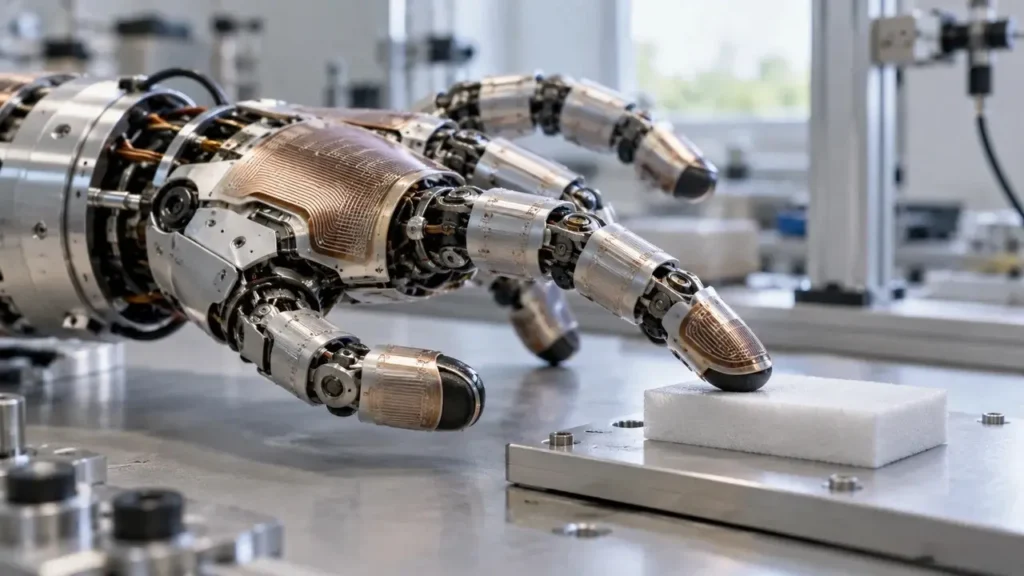
The design is a sandwich. Two thin flexible plastic sheets, each printed with a grid of conductive traces, separated by a deformable layer. Where a trace on the top sheet crosses one on the bottom sheet, the filing says, you get a sensing point — it calls them “pixels,” each independently readable. Pressing a pixel squeezes the middle layer. If that layer insulates, the conductive traces move closer together and the capacitance between them changes. If it is piezoresistive — carbon-loaded silicone, a conductive elastomer, conductive foam — its resistance falls instead. Readout electronics wired to the traces pick up the change either way.
Substrates can be thermoplastic polyurethane, PET or polyimide; the traces silver, carbon or copper inks; the finished sensor can be mounted on hard plastic, metal, foam or silicone and covered with a protective layer. The claimed manufacturing route is the interesting part. Claim 1 starts flat: screen-print conductive ink through a stencil onto flat sheets, stack them around the separator, heat the stack past the point where the plastic softens, then press it into a mould shaped like a finger or a palm — thermoforming — so that when it cools it holds the curve. A second route reverses the order: form the substrate first, then add the conductive pattern to the curved surface by dispensing ink with a positioning system, by pad printing, or by laser pre-treating selected areas before plating.
What the Filing Does Not Say
Three gaps are worth stating plainly, because the patent is being read as more than it is.
The word “multi-modal” overpromises. It is in the title, but the specification only describes capacitive and resistive versions measuring force, touch and pressure. There is no separate sensing described for shear, slip, temperature or proximity — which are the modalities that decide whether a hand can tell a slipping object from a gripped one.
There are no performance numbers. No measured sensitivity, no durability figure, no production cost. A patent application is a description of a method, not a result.
It never names Optimus. The document says the sensors can go on “fingertips, palms, end-effectors, or other portions of a robot” and can be shaped into a tactile “skin” for a humanoid, which makes Optimus the obvious inference and nothing more. It was filed in September 2025, so what published this month is roughly eighteen months of engineering behind. It also does not establish that this design solves any of the problems the programme has actually hit.
The Hand Is Where the Programme Stalls
That context matters more than the patent. Elon Musk has said human-level dexterous manipulation is “harder than Cybertruck or Model X,” placed it “between Model X and Starship,” and estimated the hand accounts for about 60% of the overall Optimus challenge — partly because no supply chain for precision tendon hardware exists yet. In an earlier conversation he described an attempt to mount actuators directly in the hand, which produced what he called weird, oversized hands.
The engineering answer visible in Tesla’s filings is to move the actuation out. A separate application titled “Machine-Driven Robot Hand” describes tendons rather than motors in the hand: actuators relocated to the forearm, roughly four degrees of freedom per finger plus two at the wrist, and three thin flexible tendons per finger running from the forearm drive points through the wrist into channels in the phalanges. Companion filings cover the forearm-palm-finger assembly and a joint design using curved mating surfaces and composite compliant members to keep motion smooth under tension. The published summary of that configuration puts the hand at 22 degrees of freedom plus the wrist. The specific problems being solved are the ones that kill tendon hands in service: guide wear, accumulated slack, and loss of independence between joints.
And the reported reality is still behind the design. The Information reported that Tesla was building several hundred robots a week in August, largely for internal testing, training and data collection, while working through hand-assembly difficulties and touch-sensor durability problems. Musk has said he halved the RAM allocation on the AI5 chip and cut AI6 by a third to secure enough memory for Optimus production. Tesla has told JPMorgan that the Gen 3 design is finalised, the supply chain essentially locked in, and that a production line is being installed in the former Model S and Model X space at Fremont, with external commercial sales “as early as” the second half of 2027 and long-term capacity ambitions of roughly one million units at Fremont and ten million in Texas.
Read against that, a tactile sensor patent is a signal about where the difficulty sits. It is not evidence the difficulty is solved.
The Chinese Side of a Robot Tactile Sensor
The contrast is not abstract. On 10 October, PaXini — 帕西尼, the tactile-sensing company that BYD invested in and works with, and which we covered in September when the two agreed to open car factories as robot training grounds — filed IPO tutoring registration with the Beijing bureau of the securities regulator, with Guotai Haitong as the tutoring institution, according to Xinhua. The filing shows a company that raised RMB 1 billion in a Series B in August, added several hundred million more in September, counts BYD and JD.com among its industrial investors, and states a valuation above RMB 10 billion. Its three product lines are multi-dimensional tactile sensors, tactile dexterous hands, and humanoid robots, and Xinhua reports it already works with BYD on data collection, robotics and industrial manufacturing.
The technical claim on the other side is a 6D Hall-effect array that resolves 15 dimensions of human-like touch from a single sensor, with fine force control down to 0.01 newtons, and a product family that also includes a six-axis force sensor and a three-axis joint torque sensor. Working with BYD, TCL, JD and a list of robot builders, it supplies industrial precision lines, warehousing sortation and commercial deployment.
The number that matters most, though, is the price. According to the Tianjin Hexi district government’s briefing for the World Intelligence Industry Expo, the unit price of this class of sensor has come down from the tens of thousands of yuan to 199 yuan, the company has achieved full domestic content, and its shipments are said to be first globally with a share of around 80% of the market. The same briefing describes a data factory in Tianjin of nearly 12,000 square metres with 150 collection units producing close to 200 million training data records a year.
What the Price Gap Actually Tells You
Two caveats belong here, because the numbers are being used carelessly in both directions.
These are not the same sensor. Tesla’s application describes a conformable array that wraps a finger or a palm using capacitive or piezoresistive layers; the Chinese product cited above uses a Hall-effect array. They solve an overlapping problem with different physics, and comparing a claimed price with a patent’s silence on cost is not a like-for-like comparison. What can be said is narrower and still useful: tactile sensing for robot hands is a commercial product category in China with published entry pricing, published customers and an IPO process, while in this filing it is still a manufacturing method.
The market-share figure is a claim, not a measurement. “Around 80% of the global market” comes from a district government briefing restating the company’s position. There is no independent audit of tactile sensor shipments, and the company’s own IPO filings — which would be the first third-party-reviewed disclosure of revenue and volumes — have not been published yet.
There is also a question the price collapse raises that nobody has answered. A sensor is not a hand. A 199-yuan sensor still has to be integrated into a tendon-driven mechanism with the wiring, signal routing and durability to survive automotive-grade duty cycles, and that is the part every humanoid programme is struggling with, Tesla included. Cheap sensing lowers one line in the bill of materials. It does not lower the assembly problem.
The Bottom Line: Tesla’s published robot tactile sensor application US 2026/0310299 A1 describes a curved, conformable array for robot hands, made by screen-printing conductive inks onto flexible sheets and thermoforming the stack over a mould, with capacitive or piezoresistive readout and individually readable “pixels.” It is a manufacturing method, not a product: no performance data, no cost, no confirmation it is in Optimus, and a title that promises multi-modal sensing while the text describes only force, touch and pressure. Two days after it published, the Chinese tactile-sensor company PaXini filed IPO tutoring registration, having raised RMB 1 billion in August with BYD and JD.com as investors and a stated valuation above RMB 10 billion, and with published sensor pricing from 199 yuan. Different physics, different maturity, one shared unresolved problem: the hand.
Notes: The patent details are taken from the published application as reviewed by patent-focused trade coverage and from the publication number, filing and priority dates it reports; the full text is the primary source and we have described only what the application itself states. Tesla has not confirmed any connection between this application and the Optimus programme, and the document does not name Optimus. Performance and durability figures, prices, market-share claims and valuation figures on the Chinese side are company or government statements and have not been independently verified; the roughly 80% market share figure originates in a district government briefing and is explicitly a claim. The 199-yuan figure is an entry price for one product line, not an average selling price, and it describes a different sensing technology from Tesla’s. The comparison between the two sensing technologies, the reading of where the remaining difficulty sits, and the framing of the price gap are our analysis, not disclosed figures. EVsays has not inspected either company’s products and has no relationship with Tesla, PaXini or any company named. See our editorial policy and correction policy.
Sources & Further Reading
- Humanoids Daily — “Tesla Patent Application Details Flexible Touch Sensors for Robot Hands” — the full review of the 28-page publication, including the publication number, the 11 September 2025 filing date, the 4 April 2025 priority claim, the twelve inventors, the absence of Optimus in the text, the missing performance data, and the manufacturing-method focus.
- Tesla North — “Tesla Wants to Give Optimus a Skin That Can Feel” (8 October 2026) — the sensor stack in detail: the two conductive sheets and separator layer, the “pixel” geometry, TPU, PET and polyimide substrates, silver, carbon and copper inks, the piezoresistive material options, and the two claimed manufacturing routes including thermoforming under claim 1.
- Xinhua — “具身智能帕西尼启动IPO 估值已过百亿” (10 October 2026) — the primary source for the IPO tutoring registration with the Beijing regulatory bureau, the Guotai Haitong appointment, the RMB 1 billion August Series B, the September follow-on, the BYD and JD.com investor list, the stated valuation above RMB 10 billion, and the three product lines.
- People’s Daily Tianjin — “天津市河西区在具身智能领域抢占先机” (20 May 2026) — the district data bureau’s briefing: 15 dimensions of touch, 0.01-newton force control, 199-yuan entry pricing, full domestic content, the roughly 80% global shipment share claim, and the Tianjin data factory with 150 collection units and close to 200 million training records a year.
- Tianjin Hexi District Government — “参展企业说——帕西尼” — the product line and customers: the PX-6AX-GEN3 multi-dimensional tactile sensor, the PX6D six-axis force sensor, the PX3Q three-axis joint torque sensor, the tactile dexterous hand and the TORA humanoid series, with deployment at BYD and TCL precision lines, JD warehousing, subway security and medical rehabilitation.
- Patent publication US 2026/0310299 A1, United States Patent and Trademark Office, published 8 October 2026 — the primary document. No stable public link resolved for this publication number at the time of writing, so it is cited by number.
- EVsays — BYD PaXini Tech Tie-Up Turns Car Factories Into Robot Training Grounds — the September agreement on using manufacturing sites for robot data collection and validation.
- EVsays — BYD’s Humanoid Robot Patent Has No Face in It — the design registration BYD filed for the robot itself, and why the first piece of public intellectual property was an appearance right rather than an engineering one.
- EVsays — Humanoid Robot Battery: Solid-State’s First Real Market — on the other component that decides whether a humanoid ships, and why a robot can absorb a cell cost a car cannot.
- EVsays — XPeng Robot Funding — the capital going into Chinese humanoid programmes and what it is being spent on.