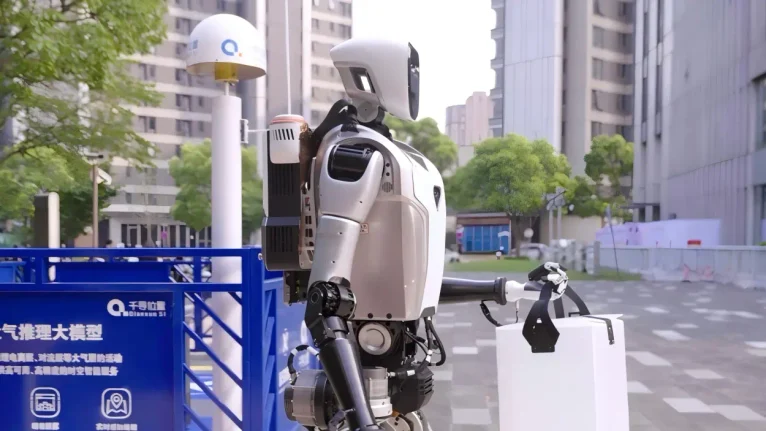

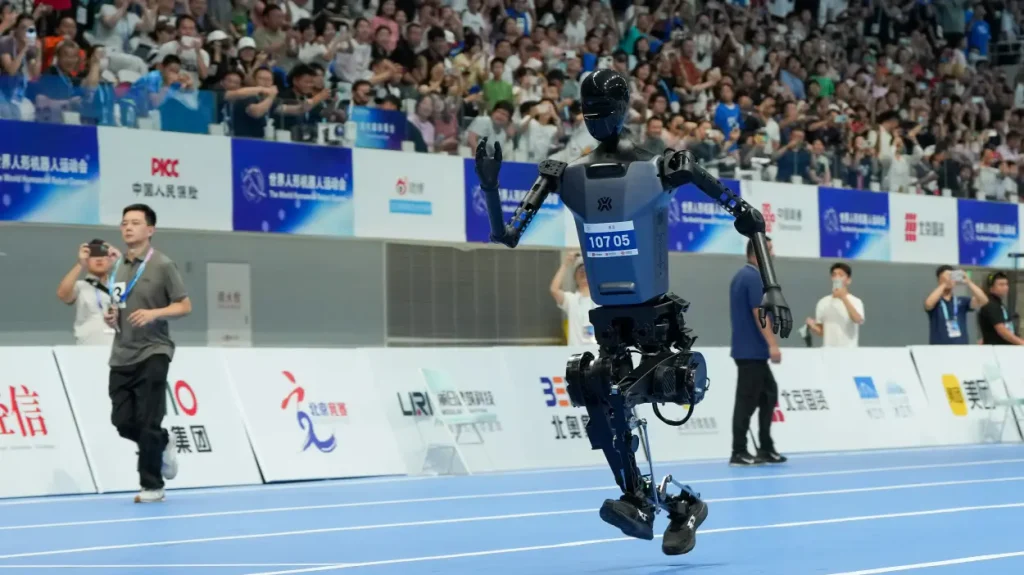
China’s Tiangong Ultra humanoid robot ran 100 meters in 8.86 seconds at the World Humanoid Robot Games in Beijing on August 25, Reuters reported — more than seven-tenths of a second faster than Usain Bolt’s 9.58-second human world record.
The race
The time came in the semifinal of the large-size division at the National Speed Skating Oval. Tiangong Ultra, developed by the Beijing Humanoid Robot Innovation Center, beat the 9.39 seconds it had set only three days earlier at the event’s opening ceremony. It crossed the line, crashed into a padded barrier and fell, with sparks and a small fire flaring from its torso that officials extinguished, Al Jazeera reported. In another semifinal, a competing robot disassembled mid-race.
How fast that actually is
The 8.86-second mark puts the robot comfortably ahead of the fastest human ever timed. Bolt’s 9.58 seconds has stood since 2009. Tiangong’s own progression tells the story of how fast the field is moving: at last year’s inaugural games it won the 100 meters in 21.50 seconds. This week it opened at 9.39 seconds, then ran 9.32 seconds two hours later, before the 8.86-second semifinal. Smartphone maker Honor’s “Lightning” robot posted 9.47 seconds, also under Bolt’s mark.
Tiangong’s full medal haul
The sprint is only one entry on Tiangong’s sheet. The Beijing Humanoid Robot Innovation Center says its robots have now beaten four human world records: the 100 meters in 8.86 seconds, the 400 meters in 38.15 seconds, the 1,500 meters in 2 minutes 21.64 seconds, and a 2.88-meter high jump. The center’s shareholders include state-owned enterprises, investment funds, Baidu, and Xiaomi’s robotics unit, according to corporate data provider Qichacha.
Why it matters
Running a bipedal machine at this speed is harder than it looks. “As speed increases, balance, control, impacts, actuator performance, and mechanical robustness all become much more challenging,” Dennis Hong, a mechanical and aerospace engineering professor at UCLA, told CNA. The event itself — more than 2,000 robots from 666 teams across 51 events including football, dancing and industrial tasks — has become a showcase for how quickly China is converting advances in AI, motors and sensors into physical machines.
The crash is the point
The most instructive moment was not the sprint but the finish. Tiangong ran through the line, hit the barrier and caught fire; another robot fell apart mid-race. Hong noted that the fall raises the harder questions that will actually determine usefulness: whether robots can move and stop safely, recognize unexpected obstacles, recover from mistakes and keep working. Speed is the headline, but reliability and safety are the real test — the same gap the industry’s public-demo accidents have begun to expose.
The Bottom Line
Tiangong Ultra ran 100 meters in 8.86 seconds at the World Humanoid Robot Games, lowering its own opening-day record and beating Usain Bolt’s 9.58-second human mark. It crashed into the barrier and caught fire at the finish — a reminder that raw speed and safe, useful operation are still two very different things.
Sources & Further Reading
- Reuters — Tiangong Ultra clocks 8.86 seconds
- Al Jazeera — sub-9-second 100 meters in Beijing
- CNA — new 100m record, beating the fastest human time
- Global Times — hardware and algorithm upgrades behind the run
- Related: Unitree’s “Superman” humanoid reveal
- Related: China ships 97% of the world’s humanoid robots
- Related: Nearly 20 carmakers are building humanoid robots
- Related: CRAIC 2026 humanoid robot exhibition
- Related: XPeng robot unit raises $900M at $6.3B
- Related: Chery robot unit begins IPO preparations
- Related: Leapmotor confirms robotics plan, stays profitable in H1
- Related: BYD’s humanoid robot and battery bets