

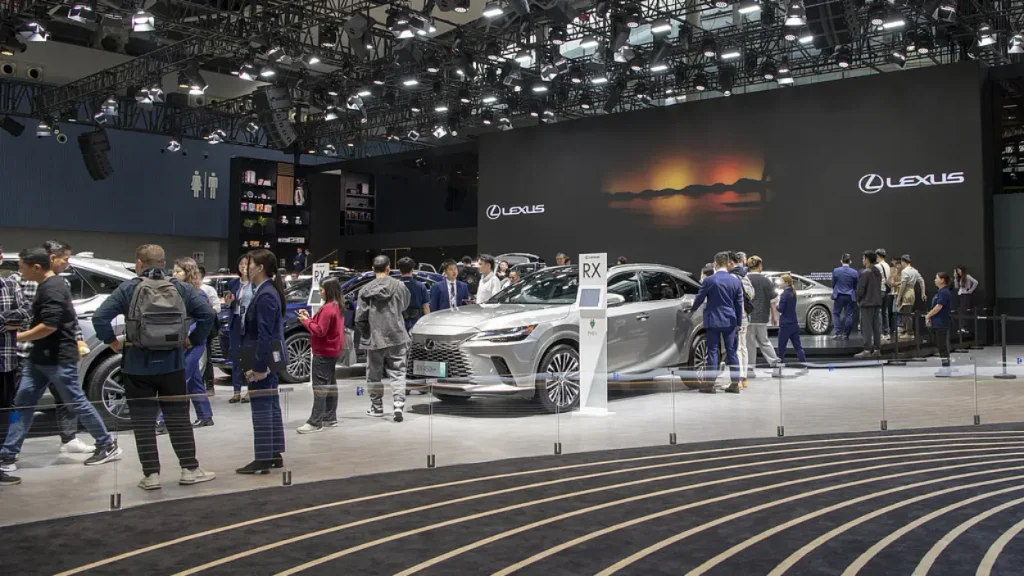
Toyota will build its next-generation Lexus electric SUV in Shanghai from late 2027, the first time the company has put a next-generation EV with advanced technology into production outside Japan — a direct break with the decades-old “Japan first” rule, and the latest sign that China’s automotive engineering has overtaken Japan.
The plant
The factory sits in Shanghai’s Jinshan district and is Toyota’s first wholly-owned EV plant in China, following Tesla’s lead after Beijing lifted foreign equity caps in the passenger-car sector. Ground broke in June 2025, with completion expected in August 2026 and the first mass-production vehicle in 2027. Total investment is around 14.6 billion yuan ($2 billion), with annual capacity planned at 100,000 vehicles, expandable with demand. Initial output is roughly 1,000 units a month, rising to tens of thousands a year after 2028.
Why China, why now
The decision is a frank admission of where the EV fight is won. China accounted for 60% of global EV sales in 2025 — 8.57 million units, nearly three times Europe and more than 100 times Japan, according to GlobalData, with 11.41 million projected by 2030. Toyota’s own China sales tell the pressure story: 114,700 vehicles in July, down 24.3% year on year, part of a broad slump for Japanese brands as local EV makers take share.
Toyota had been developing a low-slung coupe-style next-gen EV in Japan, but halted it this spring and switched to an SUV after reading Chinese demand. The China-built Lexus will use over 95% local parts and fold Chinese customer preferences into the product at “China speed” — the kind of posture that, a few years ago, no Japanese automaker would have admitted publicly.
The technology bet — gigacast
The Shanghai Lexus will be the first Toyota vehicle to use gigacast, large-format die casting that forms multiple aluminum body parts in a single piece. Toyota says that cuts certain body-part weight by up to 20%, adds several percentage points of range, and speeds assembly by reducing parts and joints. It also plans to put a self-developed L2++ driver-assist system in passenger cars by 2028, with wider rollout by 2030 — a rare case of Toyota bringing its own software in-house rather than buying it from a supplier.
What it means
For two decades Lexus sold in China as a pure import brand. Building locally ends that, and building the most advanced version locally ends something bigger: the assumption that Japan is where Toyota’s future is invented. It mirrors a shift already visible across the industry — foreign makers are no longer just localizing finished cars, they are localizing the R&D and the flagship tech. As we noted when Nikkei documented China’s lead in engine technology, the center of gravity in automotive engineering has moved, and Toyota’s most conservative rival is now racing to catch up through Chinese-speed product cycles the locals set.
The Bottom Line
Toyota will produce its next-generation Lexus electric SUV in Shanghai from late 2027, breaking a decades-old “Japan first” tradition as China’s 60% share of global EV sales resets where carmakers invent the future. Initial output is ~1,000 a month, scaling after 2028.
Sources & Further Reading
- AJU Press — Toyota to Produce Next-Generation EVs in China, Breaking Tradition (reprints Nikkei Asia report)
- Battery Industry — Lexus begins construction of first wholly-owned EV plant in China
- C114 Pro — Breaking the ‘Japan First’ Tradition, Toyota to Produce Next-Gen Electric SUV in China First
- Related: Chinese engine tech surpasses Japan (Nikkei)
- Related: BYD overseas brand restructuring
- Related: China EV July 2026 deliveries