
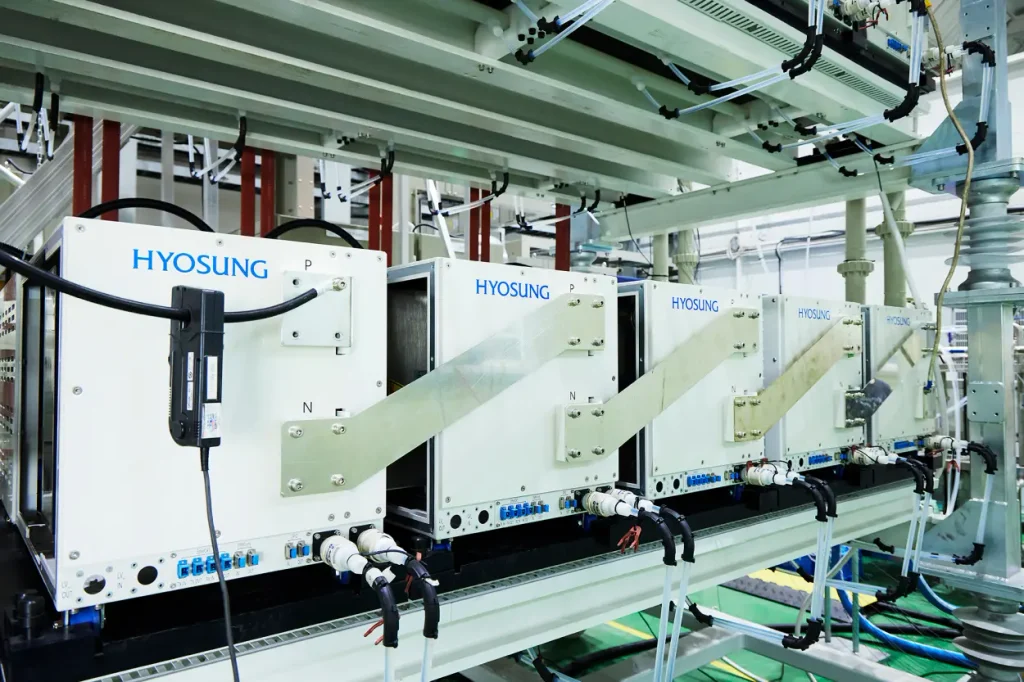
Korean industrial group Hyosung Heavy Industries is taking aim at the most crowded bottleneck in American electricity — AI data-center power — with a Hyosung solid-state transformer it calls a “semiconductor transformer.” Chairman Cho Hyun-joon is fronting the push personally.
The Hyosung Solid-State Transformer: Silicon Meets the Grid
A conventional transformer is a century-old machine of copper windings and an iron core. It steps voltage up or down and does little else. A solid-state transformer (SST) replaces part of that passive hardware with power electronics: it can regulate voltage actively, correct harmonics, switch between AC and DC, and report its own health in real time — in a package that is smaller and lighter than the equipment it replaces. Hyosung’s unit is rated at 22.9kV, and the company describes it, in a deliberate nod to the chip industry, as a “semiconductor transformer.”
Why AI Data Centers Need a New Transformer
Data centers are now the fastest-growing load on the US grid, and the transformer supply chain is one of the industry’s worst bottlenecks, with lead times that have stretched to years. A data center also wants exactly what a passive transformer cannot give: stable, clean voltage as server loads swing, space efficiency inside expensive real estate, and grid-friendly behavior as utilities push back on new hyperscale connections. Hyosung’s bet is that a product answering those three demands at once can open a market conventional equipment makers serve only slowly.
Hyosung’s US Play: From Supplier to Grid Solution Provider
The announcement, reported by The Korea Times on September 8, frames the SST as the spearhead of a broader American expansion: Hyosung is growing its US energy-equipment production and repositioning itself as a “total solution provider” for the US power grid rather than a component vendor. Chairman Cho Hyun-joon has made the US AI power market a personal priority — an unusual level of executive focus for what is, technically, one product line.
The Catch: World-First Claims vs. Grid Reality
The company calls its SST the world’s first to reach commercialization, but “world-first” is Hyosung’s own framing, and the product is at the pre-commercial door rather than through it. No US orders, revenue figures or utility pilot names have been disclosed, and the “semiconductor transformer” label is marketing language, not an engineering classification. Utilities are famously slow adopters: a new transformer must prove decades of reliability before it displaces equipment that has already done so. Hyosung’s official newsroom announcement emphasizes the ambition; the orders will have to follow.
The Bottom Line. Hyosung Heavy Industries is bringing a 22.9kV solid-state transformer — marketed as a “semiconductor transformer” — to the US AI data-center power market, with Chairman Cho Hyun-joon leading the push and US production expanding. The “world-first commercialization” claim is the company’s own, and no orders or pilots have been disclosed. But the timing targets the grid’s worst bottleneck, and that is where the opportunity actually is.
Sources & Further Reading
- Hyosung (official newsroom) — US AI power market announcement (2026-09) — primary source.
- The Korea Times — “Hyosung eyes US AI power market with next-gen solid-state transformer” (2026-09-08) — independent coverage.
- The Investor — “Hyosung bets on AI power boom with US grid expansion” (2026-09) — US expansion context.
- The Korea Herald — Hyosung US grid expansion coverage (2026-09) — secondary confirmation.
Sourcing note: Based on Hyosung’s official newsroom release (September 2026) and independent coverage by The Korea Times (2026-09-08), The Investor and The Korea Herald. The 22.9kV rating, the “semiconductor transformer” branding, and the “world’s first to commercialize” framing are Hyosung’s own statements; no US orders, pilots or revenue figures have been disclosed as of publication. The SST’s technical benefits (active voltage regulation, harmonic control, AC/DC capability, smaller footprint) are industry-standard descriptions of solid-state transformer technology, not test results for this specific unit. Analysis is original to EVsays.

[…] The case for storage in Germany is not complicated. Renewable generation keeps growing, electricity demand is rising with electrification and with the load that data centres and AI infrastructure are adding to the grid, and the gap between the two has to be closed by something flexible. Storage is the cheapest fast answer. That is precisely the bottleneck we looked at when grid equipment for AI-era power demand became a constraint in its own right. […]