

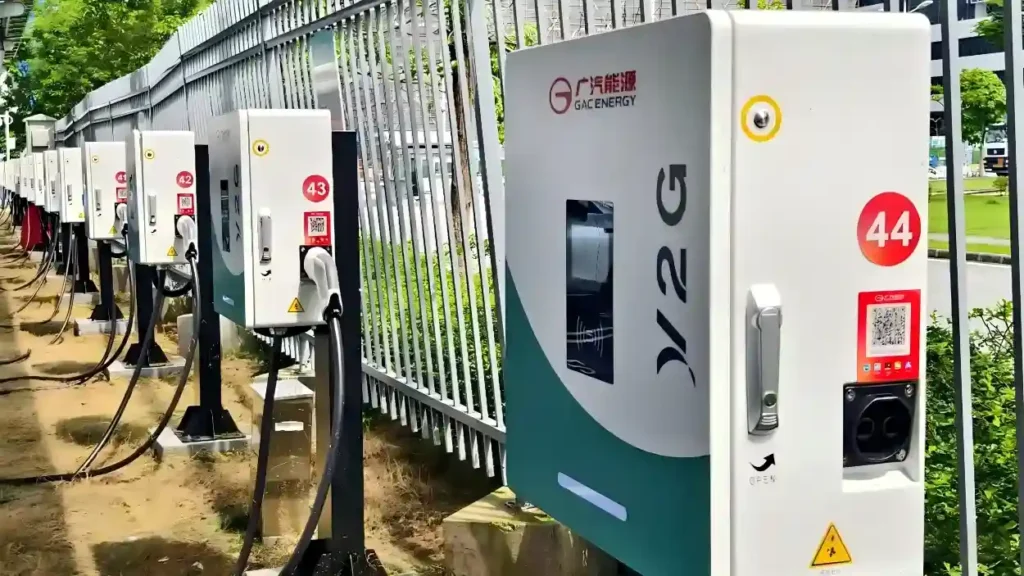
Beijing issued its 15th Five-Year energy plan on 28 October, and its numbers only make sense read together: 2.4 million electric cars on the road by 2030, 600 MW of new-type storage, demand response equal to 5% of peak load, 650,000 charging points and 71 TWh of imported green power. The Beijing energy plan is the clearest municipal statement yet that a city’s biggest battery is not a battery plant — it is the car park. It is also silent on the one thing that decides whether any of that storage earns a yuan.
What the Beijing Energy Plan Actually Sets
The document is 京政发〔2026〕31号, approved on 24 October and published four days later. Its headline goal is to have the city’s new energy system essentially built by 2030, with incremental electricity demand met mainly by green power. The targets that matter to anyone in the vehicle or storage business are these:
| Target | 2030 figure |
|---|---|
| New wind and solar added during the period | 2 GW |
| Renewable utilisation rate | above 95% |
| New-type storage installed | 600 MW |
| Demand response capacity | 5% of maximum load |
| Green power imported from outside the city | 71 TWh |
| Electric vehicle parc | 2.4 million |
| NEV share of new vehicle registrations | 65% |
| Charging points | 650,000 |
| High-power charging facilities | 1,500 |
| Public battery-swap stations | 300 |
| Hydrogen refuelling stations | 30-plus |
| Fuel-cell vehicles | 10,000 |
| Renewable share of heating area | 15% |
| Green share of freight tonnage | 13% |
| Green power for new data centres | 100% |
| Power usage effectiveness, existing data centres | 1.35 or better |
The Cars Hold 120 Times the Batteries
Two of those figures are usually reported separately and should not be. Take 2.4 million cars with an average 60 kWh pack — a conservative assumption for a fleet that will include everything from small hatchbacks to large SUVs — and the fleet carries 144 GWh of storage. The city’s entire planned new-type storage build is 600 MW; at a typical two-hour duration that is 1.2 GWh.
So the vehicle fleet holds roughly 120 times the energy of the stationary storage Beijing intends to build. Even if only 1% of those cars were plugged in and available at the same moment, they would hold 1.44 GWh — more than the whole storage target. That is the arithmetic behind the plan’s interest in vehicle-to-grid: a city with 2.4 million cars does not need to buy much stationary storage if it can borrow a fraction of what is already parked.
Which is also why the 600 MW figure is less timid than it looks. Beijing is a dense city with expensive land; 600 MW of grid-side batteries is roughly what fits. The plan is not betting on batteries. It is betting on coordination.
Five Per Cent of Peak Is Bigger Than 600 MW
The demand-response target is the tell. Five per cent of maximum load is, on any plausible peak figure for Beijing, well above 600 MW — the city’s peak has long been in the tens of gigawatts, so 5% is measured in gigawatts, not hundreds of megawatts. Read together, the two numbers say something specific: the plan expects more flexibility from buildings, industry and vehicles than from the storage it is paying to install.
The document names the sources explicitly — building air conditioning, industrial loads and aggregated vehicle-to-grid resources — and puts them all through virtual power plants, with market-based incentives rather than mandates. That is a different model from the province-level storage quotas that have driven most of China’s battery build. Beijing is trying to buy flexibility instead of hardware.
The Fast Chargers Are Also a Load
Here is the number that rarely appears in the summary press releases. The plan calls for 1,500 high-power charging facilities. At 250 kW each that is 375 MW of connected demand; at 480 kW it is 720 MW. Either way it is the same order of magnitude as the entire stationary storage target — and unlike a battery, a charger is a load that arrives when the driver decides, not when the grid prefers.
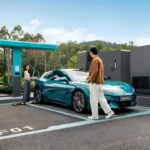
The plan’s answer is the ordering rule rather than the hardware: it supports building chargers with orderly charging functions, which lets the operator shift a session by minutes or hours, and it lists a four-tier charging architecture — slow charging in residential areas, fast charging in commercial and office car parks, high-power charging at roadside and motorway filling stations, with hydrogen and mobile charging as the supplement. Whether orderly charging is actually used depends on price signals, which brings us to the gap.
What the Plan Does Not Set: A Price
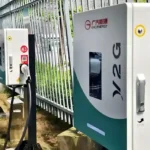
Vehicle-to-grid appears in the Beijing energy plan exactly once in the form that matters: as a business model to be explored, alongside virtual power plants. There is no V2G capacity target, no payment mechanism, no guarantee of a tariff for discharging into the grid. The plan can require a charger to be bidirectional-ready. It cannot make discharging profitable.
That is decided somewhere else. Beijing sits inside the North China grid and has no spot market of its own; the revenue a parked car can earn depends on regional market rules, on whether aggregated vehicles are admitted as participants, and on whether the provincial price band leaves room for arbitrage. The Southern regional market that went into formal operation this month shows what that architecture looks like when it exists — including the staged admission of storage and virtual power plants, which start by reporting volumes without bidding on price. Beijing’s plan is a demand-side document waiting for a market document.
Compare the compensation model that makes residential virtual power plants work in the United States: capacity payments, not energy arbitrage. Beijing’s plan has the aggregation architecture for that — 5% of peak is a capacity product in all but name — but it has not written the payment.
The Green Power Ledger
The other half of the plan is a supply ledger. Beijing will import 71 TWh of green power, build out the Songliao and Hunshandake corridors, run point-to-point green trades and pilot direct green-power connections. Against that, the vehicle fleet’s annual consumption is not trivial: at 15,000 km a year and 15 kWh per 100 km, 2.4 million cars need about 5.4 TWh, or roughly 8% of the imported green power, before a single new data centre is counted.
And the data centres are counted. New facilities must run on 100% green power, and existing ones must reach a PUE of 1.35 or better. In a city where land for generation is scarce, those three demands — cars, computing and buildings — compete for the same imported electrons. That is the real constraint the plan is managing, and it is why the storage number stays modest while the flexibility numbers do not.
Author’s Take: Most city energy plans are procurement lists. This one is closer to an operating instruction: 2.4 million cars, 650,000 plugs and 5% of peak demand treated as one system. The insight is correct — a municipal grid with that many batteries on wheels does not need to buy much storage — and the arithmetic is brutal in the plan’s favour, since 1% of the fleet already outweighs the entire storage build.
The gap is that hardware targets are enforceable and prices are not. Beijing can require 1,500 high-power chargers and 650,000 plugs; it cannot decide what a discharged kilowatt-hour is worth. Until the North China market pays for flexibility the way the plan assumes, the 5% target will be met by factories and air conditioners turning down, and the cars will keep charging whenever their owners plug them in.
The Bottom Line: The Beijing energy plan targets 2.4 million EVs, 600 MW of new-type storage, demand response at 5% of peak and 71 TWh of imported green power by 2030. The car fleet would carry about 144 GWh — 120 times the planned stationary storage — and even 1% of it plugged in at once would exceed the storage target. What the document does not contain is a price for that flexibility, which is the one number the plan cannot set by itself.
Sources & Further Reading
- Beijing Municipal People’s Government — “北京市人民政府关于印发《北京市’十五五’时期新型能源体系规划》的通知” (京政发〔2026〕31号, issued 24 October 2026, published 28 October 2026) — the official notice issuing the plan; the plan itself is attached as a PDF.
- 《北京市”十五五”时期新型能源体系规划》 — the plan document — as summarised in detail by Securities Times (证券时报) and International New Energy Network on 28 October 2026: the 2 GW of new wind and solar, 600 MW of new-type storage, 71 TWh of imported green power, 2.4 million EVs, 65% NEV share of new registrations, 650,000 charging points, 1,500 high-power chargers, 300 swap stations, 5% demand response, 15% renewable heating, 13% green freight, 30-plus hydrogen stations and 10,000 fuel-cell vehicles. The PDF itself was not accessible to EVsays from our network.
- EVsays — China’s 50 GW vehicle-to-grid target — the national programme Beijing’s 2.4 million cars sit inside.
- EVsays — the Southern regional power market — what a market that pays for flexibility actually looks like, including the staged admission of storage and virtual power plants.
- EVsays — Sunrun and Tesla’s residential virtual power plant — the capacity-payment model Beijing’s aggregation architecture implies but has not priced.
Notes: All targets are the Beijing municipal government’s own, taken from the plan document as published on 28 October 2026; the PDF attachment was not downloadable from our network, so the figures rely on the official notice plus detailed contemporaneous summaries by Chinese official and trade media. The 144 GWh fleet figure, the 1.2 GWh storage comparison, the 1% and 120-times calculations, the charger load range and the 5.4 TWh annual vehicle demand are our own arithmetic, built on stated assumptions (60 kWh average pack, two-hour storage duration, 15,000 km a year at 15 kWh/100 km) and not on government data. EVsays has not reviewed the full plan text. Our editorial policy and correction policy apply.