
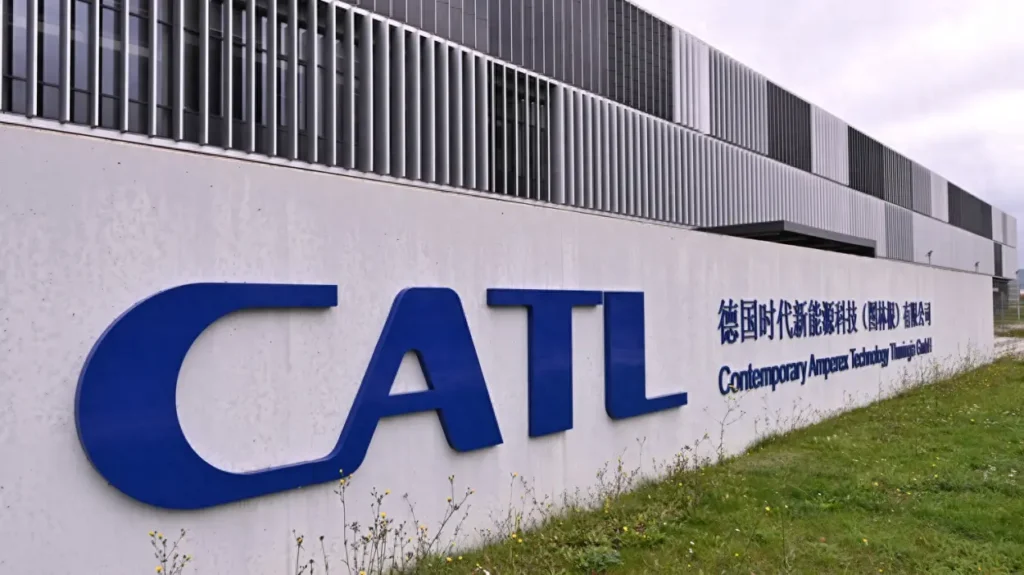
CATL signed a memorandum of understanding with German storage developer Intilion on 27 October to deploy 3 GWh of sodium-ion energy storage across Germany, Switzerland and Austria over five years. Add the two deals it signed in July — 5 GWh with Alfen in Western Europe and 2 GWh with Solarpro in Eastern Europe — and the company has now put 10 GWh of sodium-ion storage under memorandum in Europe inside a single year. None of it is a purchase order yet, and that distinction is the whole story.
What CATL Actually Signed
The announcement is short and standard for this kind of agreement: an MOU, a capacity figure, a region and a product name. CATL’s own release frames it as the scale-up of sodium storage exports, and puts the product as its TENER (天恒) system — the containerised storage product it first showed in 2024 and reworked into a sodium version earlier this year.
| Element | Detail |
|---|---|
| Counterparty | Intilion GmbH, German storage solutions provider |
| Capacity | 3 GWh over five years |
| Markets | Germany, Switzerland, Austria |
| Product | CATL TENER sodium-ion storage system |
| Applications | grid-scale and commercial & industrial |
| Claimed performance | more than 15,000 cycles, 25 years of stable operation, high discharge power at −20 °C |
| Existing relationship | more than 30 storage projects in Germany since 2022 |
| Binding? | No. A memorandum, with no price, volume schedule or take-or-pay terms disclosed |
Two things are worth noting before the numbers get exciting. Intilion has not published its own release on the deal — its press page still ends at a 100 MWh co-located project announced on 6 October. And CATL’s release describes the TENER platform’s cycle life and temperature performance without separating which of those figures are specific to the sodium chemistry and which carry over from the lithium version. Assume the platform numbers, not sodium-specific ones, until CATL publishes a datasheet.
The Ten Gigawatt-Hour Figure Nobody Has Added Up
Each of the three European sodium agreements was reported on its own. Together they describe something larger than any single one:
| Announced | Partner | Capacity | Market |
|---|---|---|---|
| July 2026 | Alfen | 5 GWh | Western Europe, including the Netherlands, from 2027 |
| July 2026 | Solarpro | 2 GWh | Eastern Europe |
| October 2026 | Intilion | 3 GWh | Germany, Switzerland, Austria |
| Total | 10 GWh |
For scale: European lithium-ion storage battery shipments reached 72.7 GWh in the first half of 2026, up 74% year on year, according to SNE Research. Annualised that is roughly 145 GWh, which makes 10 GWh of sodium-ion energy storage memoranda about 7% of one year’s European market — and about 14% of a single half-year. A year ago the number was zero.
Then apply the discount. Three gigawatt-hours spread over five years is 600 MWh a year, or roughly 0.4% of annualised European shipments in this one deal. That is not a market share; it is a beachhead.
Why Sodium-Ion Energy Storage Fits the Grid and Not the Car
Sodium-ion’s weakness is energy density: it stores less per kilogram and per litre than lithium iron phosphate. In a car that is close to disqualifying, because every kilogram spent on cells is a kilogram not spent on range. In a shipping container next to a substation, nobody cares. What the grid does care about is how many times the thing can cycle before it degrades — and this is where sodium’s chemistry is comfortable.
The cycle claim is worth converting into a rate. 15,000 cycles over 25 years is 600 cycles a year, or about 1.64 a day. That is almost exactly the duty of a battery doing daily frequency regulation and arbitrage on a European grid: one full cycle a day, sometimes two. CATL is not claiming a laboratory record here; it is claiming the pack will still be working at the end of the warranty period under a realistic operating pattern.
The cold figure is the one aimed at this specific customer. At −20 °C a lithium-ion pack loses a large share of its discharge capability and needs heating before it can deliver full power; sodium-ion’s wider operating window is the main reason it is being marketed into northern Europe rather than, say, the Middle East. Germany, Switzerland and Austria in January is the test case, not the showroom.
The commercial argument is diversification. Sodium removes lithium, cobalt and nickel from the bill of materials, which decouples a storage project’s cost from the lithium carbonate price — a price that has fallen sharply this year and could just as sharply reverse. CATL also says the sodium container is dimensionally compatible with its lithium product, so a developer does not have to redesign the site to switch. That is the detail that makes a memorandum plausible: the customer’s civil works do not change.
What a Memorandum Is Worth
Intilion’s largest publicly disclosed project is a 100 MWh co-located storage system at the Kloddram wind farm in Jesow, announced on 6 October. Three gigawatt-hours is thirty of those. That is a serious pipeline for a company of Intilion’s size, and it is also a reminder that an MOU is an intention, not a schedule: the capacity is not allocated by year, no cell volumes are committed, and no price is attached.
This is how the storage industry has always signalled intent — framework agreements first, firm orders as projects reach financial close. The question is not whether the MOU is real, but whether it converts. Alfen’s 5 GWh was announced in July with deliveries starting in 2027; that is the one to watch first, because if it turns into purchase orders, the other two follow a known path. If it quietly slips, the 10 GWh stays a press-release number.
There is also a competitive context that makes the timing logical. European storage demand is being pulled by grid services and, increasingly, by data centres, and Chinese suppliers are competing hard on price. Sodium gives CATL a product its Chinese competitors cannot immediately match at scale, in a market where the buyer cares about cycle life and cold performance rather than gravimetric density. It is a defensible niche rather than a volume play.
The Real Test Is January
The technical claims will be settled in the field, not in Ningde. A storage system rated for high discharge power at −20 °C either delivers it in a Bavarian January or it does not, and the operator will know within one heating season. If it does, sodium’s first durable market is settled: not cars, not consumer electronics, but grid storage in cold climates — a segment where energy density is irrelevant and cycle life is everything. If it does not, the product retreats to the lithium platform and sodium waits for the next cost cycle.
Author’s Take: Sodium has finally found the market where its weakness does not matter. The tell is that CATL is selling it as a container rather than a chemistry — same footprint, same site design, same civil works as the lithium product, which is exactly how you sell a new cell technology to an industry that does not want to re-engineer anything.
But keep the 10 GWh in perspective. It is memoranda, signed in a year when European storage demand grew 74%, by a company with a 27% share of the global storage cell market. The number says sodium has arrived in the sales deck. It will have arrived in the ground when Alfen’s 2027 deliveries show up as revenue.
The Bottom Line: Three European sodium-ion energy storage agreements in 2026 — Alfen 5 GWh, Solarpro 2 GWh, Intilion 3 GWh — add up to 10 GWh, roughly 7% of a year’s European storage market and none of it yet a purchase order. The Intilion deal covers Germany, Switzerland and Austria over five years with a TENER system CATL says runs 15,000 cycles, 25 years and full discharge power at −20 °C. That is 1.64 cycles a day — a grid duty cycle, not a car one.
Sources & Further Reading
- CATL — “3GWh!INTILION与宁德时代签约,钠电储能规模化出海” (27 October 2026) — the MOU, the 3 GWh over five years, the three markets, the TENER product name, the 15,000-cycle and 25-year claims, the −20 °C discharge figure, and the more than 30 German projects since 2022.
- Intilion — press releases — the counterparty’s own announcements, including the 100 MWh co-located project at Jesow announced on 6 October 2026. As of publication Intilion had not issued a release on the sodium agreement.
- SNE Research — European lithium-ion storage battery shipments of 72.7 GWh in the first half of 2026, up 74% year on year, and CATL’s 125.0 GWh of global storage cell shipments with a 27.1% share. Cited by research firm; not independently verified by EVsays.
- EVsays — the Alfen 5 GWh sodium deal — the first of the three European agreements, signed in July 2026.
- EVsays — Hithium’s 785 Ah sodium cell — the competing Chinese sodium product, and what a 30-year life claim looks like.
- EVsays — China’s regional power market — why storage revenue depends on market design, not only on cell chemistry.
- EVsays — CATL on storage reliability — the company’s own argument that the cell is not the weak link in a storage system.
Notes: All performance figures — 15,000 cycles, 25 years, −20 °C discharge — are CATL’s own claims for the TENER platform and have not been independently tested; the release does not separate sodium-specific figures from platform figures. The 10 GWh total, the annualisation of European shipments, the 600 MWh a year and the 1.64 cycles a day are our own calculations. Memoranda of understanding are non-binding and carry no disclosed price or delivery schedule. EVsays has not seen the agreement. Our editorial policy and correction policy apply.