

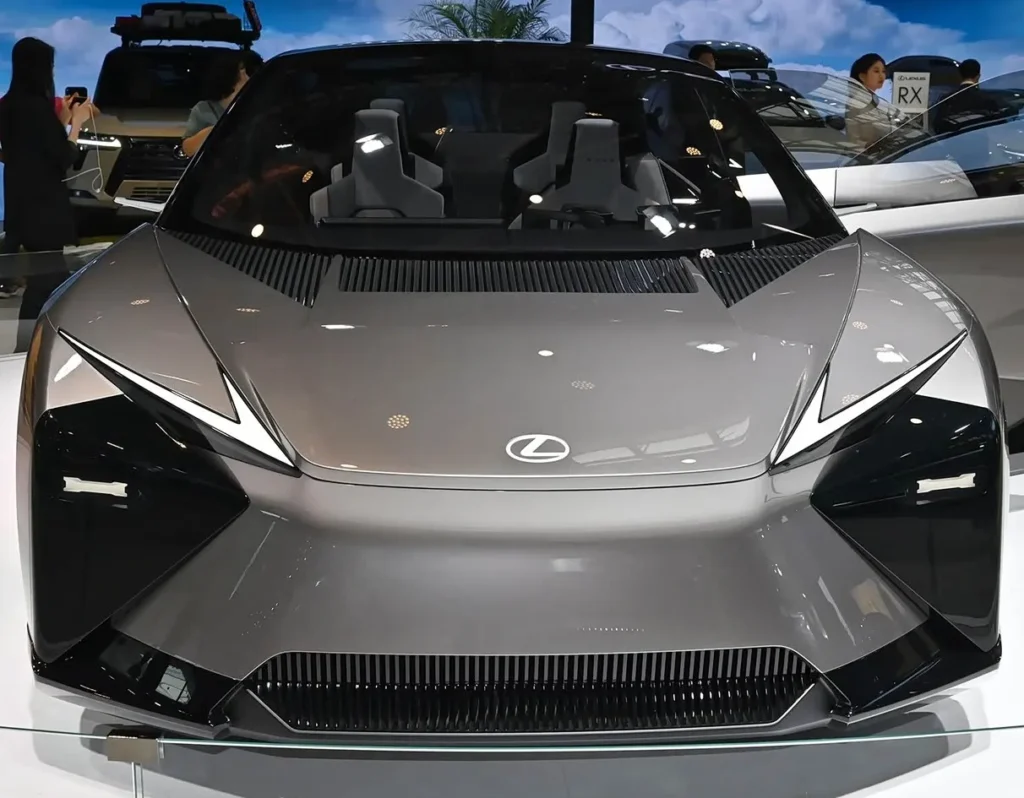
Lexus has confirmed that its first China-made model will arrive in 2027: a battery-electric SUV, built at a wholly owned Toyota plant in Shanghai’s Jinshan district, the first Lexus factory the brand has built from scratch outside Japan. The Lexus China plant was planned at 100,000 vehicles of annual capacity on an initial investment of about 5 billion yuan, with local content targeted above 95%. Year one will be far smaller — roughly 1,000 cars a month, according to Chinese trade press. Set that capacity against the brand’s 182,458 deliveries in China last year and the arithmetic explains the decision better than any press release.
What the Lexus China Plant Will Be
The project was announced in February 2025 as a strategic cooperation agreement between Toyota and the Shanghai municipal government, and Lexus has now put a product and a date against it. The company will build battery-electric Lexus models and batteries in Jinshan, using a structure no Japanese carmaker has used on the mainland before: full foreign ownership, rather than a joint venture with a Chinese partner. Shanghai has permitted exactly one such arrangement previously — Tesla.
| Element | Detail |
|---|---|
| Location | Jinshan district, Shanghai |
| Ownership | wholly owned by Toyota / Lexus; a separate battery company on the same site |
| Investment | about 5 billion yuan initially, per Chinese media at announcement |
| Capacity | 100,000 vehicles a year planned; about 1,000 a month in the first year, then ramping |
| Start of production | 2027, reported as autumn |
| First product | battery-electric SUV, developed for China |
| Process | aluminium gigacasting of front and rear structures; conveyor-free assembly with vehicles moving between stations |
| Localisation | above 95% local parts targeted |
| Export | reported at announcement as intended for China and, later, overseas markets |
The Duty Math Comes First
Lexus has imported every car it sold in China since 1994. That made sense while buyers queued and paid premiums; it stopped making sense when the premium disappeared. Imported passenger cars carry a 15% tariff, so on a 400,000 yuan vehicle the duty alone is roughly 60,000 yuan — the same order as the discounts Lexus dealers have been offering. Localising does not require a new brand strategy. It requires removing a line from the cost sheet.
The sales record explains the urgency. Lexus peaked at about 227,000 vehicles in China in 2021 and has drifted since: 176,000 in 2022, then around 181,000 to 182,000 in each of the following three years. In the first eight months of 2026 the ES, its volume model, was down about 26% year on year at roughly 57,800 cars. A brand that once sold at a premium over German rivals is now discounting by more than 50,000 yuan to hold volume.
A Hundred Thousand Cars for a 182,000-Car Brand
This is where the plan gets interesting, and where it is most exposed. A plant planned at 100,000 units is sized at 55% of Lexus’s entire 2025 China volume. That is not a hedge; it is a bet that local production can win back share from NIO, Zeekr, Li Auto and the German premium brands that have already localised.
But the first year tells a more cautious story. At about 1,000 cars a month, output would be roughly 12,000 units — 6.6% of last year’s volume, and less than a tenth of the plant’s planned capacity. A ramp from 12,000 to 100,000 is a manufacturing problem Lexus has never had to solve in China, because it has never built cars there. It is also why the announced export intention matters: a plant that size needs buyers outside China to fill it.
The Plant Is the Technology Statement
The process choices inside the Lexus China plant are more revealing than the product. Gigacasting front and rear structures consolidates dozens of stamped parts into two castings, cutting weight and assembly time — the technique Tesla popularised and Chinese manufacturers have adopted at scale. A conveyor-free layout, with vehicles moving autonomously between stations, is the kind of line Toyota has been reluctant to build anywhere, let alone abroad.
Put together with 95% local content and a battery company on the same site, the logic becomes clear: this is not a Chinese assembly plant for imported kits. It is a full-stack manufacturing base, built to Chinese cost structures, using Toyota’s process discipline. That is a different proposition from the joint-venture era, when foreign brands supplied the product and Chinese partners supplied the plant.
What Has Not Been Announced
Almost everything a buyer would want to know. There is no model name, no price, no battery capacity, no supplier, no range and no confirmation of chemistry — reports point to prismatic ternary or LFP cells without confirmation. Chinese trade press has floated the possibility of solid-state batteries in the plant’s future products; Toyota’s sulfide programme with Idemitsu targets 2027–28 for practical application, but nothing links those cells to this SUV, and the claim should be read as an aspiration rather than a specification.
The domestic-versus-export split is also undisclosed, as is the ramp schedule beyond the first year. Those two numbers decide whether this plant fills a demand gap or creates an overcapacity problem.
Author’s Take: Thirty years of refusing to build in China was not stubbornness; it was arithmetic that worked while Lexus could charge a premium on an imported car. When the premium went away, the 15% duty became the largest single line item a dealer had to discount around. Localisation is the cheapest way to get it back.
What makes this more than a cost story is the size of the bet and the ownership structure. A wholly owned 100,000-unit plant with 95% local content turns Lexus into a China-cost manufacturer that happens to sell luxury — and a plant that big cannot be filled by a brand selling 182,000 cars a year at declining prices. Either Lexus takes share back from the domestic premium brands, or this plant exports. The export line in the original announcement is the tell.
The Bottom Line: The Lexus China plant will build a battery-electric SUV in Jinshan, Shanghai, from 2027, with 100,000 vehicles a year planned, more than 95% local content and about 5 billion yuan of initial investment. Year-one output is expected near 1,000 cars a month. The 15% import duty on a 400,000 yuan car is roughly 60,000 yuan — about the size of the discounts Lexus is already paying. This is a cost decision dressed as a product decision, and its success depends on exports as much as on China.
Sources & Further Reading
- Lexus China — “丰田与上海市达成共同助力绿色低碳发展相关战略合作意向 计划新设LEXUS雷克萨斯纯电动汽车及电池的研发·生产公司” — the official announcement of the wholly owned vehicle and battery company planned for Jinshan, Shanghai, and the 2027 production date.
- Autohome (汽车之家), 30 October 2026 — Lexus’s confirmation that the first China-made model arrives in 2027 as a battery-electric SUV, production reported for autumn 2027, about 1,000 vehicles a month in the first year before ramping to tens of thousands, gigacasting, and the plant being wholly Lexus-owned. Cited by name; the page was not reachable from our network.
- China Economic Net and China Automotive News, February 2025 — the initial investment of about 5 billion yuan, first-phase capacity of 100,000 vehicles, roughly 1,000 local jobs, a local-content target above 95%, and the intention to export from the plant in addition to serving the Chinese market. Cited by name; pages not reachable from our network.
- China Passenger Car Association and company disclosures — Lexus China deliveries of about 227,000 in 2021, 176,000 in 2022, around 181,000–182,000 in 2023–2025, and ES deliveries of about 57,800 in January–August 2026, down roughly 26% year on year.
- EVsays — Audi’s China-only E7X — what a German premium brand does when it localises a model for China rather than importing it.
- EVsays — Volkswagen’s China-built cars and Europe — the reverse flow: China as an export base for a foreign brand.
- EVsays — Xiaomi’s European dealer plan — the domestic competition that made the imported Lexus uneconomic.
Notes: The plant, ownership structure, product type and 2027 start come from Lexus’s own announcement; capacity, investment, local-content target and year-one output come from Chinese media reporting and have not been confirmed in a single Lexus document. The duty calculation, the 55% capacity-to-2025-sales ratio, the 6.6% year-one ratio and the 26% ES decline comparison are our own arithmetic from those figures. Model name, price, battery chemistry, supplier, range and the domestic/export split are undisclosed. Any solid-state reference is speculative and not confirmed for this vehicle. EVsays has not seen the plant. Our editorial policy and correction policy apply.