

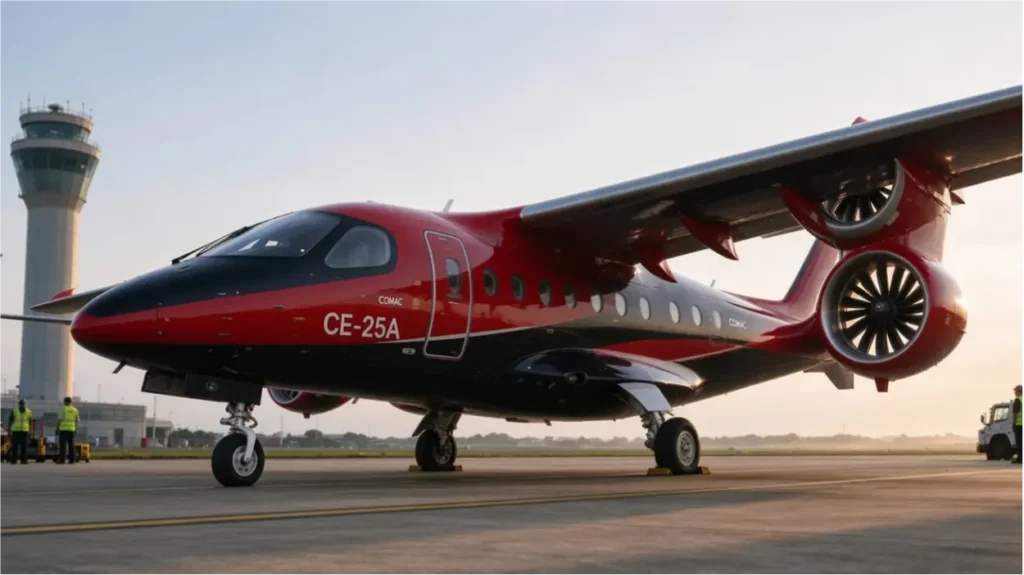
COMAC flew its 10-tonne electric regional aircraft CE-25A with people on board for the first time on 14 November, from Binzhou in Shandong. Two pilots and a flight-test engineer were aboard; the aircraft was airborne for 16 minutes 38 seconds and covered 60.4 km. It is the largest all-electric aeroplane to have carried a crew so far, by both seat count and all-up weight. The specification is the interesting part: 19 passengers, 300 km/h cruise, 2,400 m cruise altitude, 400 km range — and, by our arithmetic, a 800–950 kWh battery that weighs about as much as every person on board.
What Actually Flew
This was not a first flight. The CE-25A flew unmanned and autonomously on 2 February 2026, and COMAC has since run 19 unmanned autonomous flights before putting pilots in it, following taxi tests in late October. The company’s framing is deliberate: the validation sequence mirrors a crewed space programme, unmanned first, crewed later. The Civil Aviation Administration of China has accepted COMAC’s application for a type certificate, which starts the certification process without promising when it ends.
Read the flight numbers plainly and they describe a handling-qualities sortie, not a mission demonstration. The elapsed test was 57 minutes 46 seconds but the wheels were only off the ground for 16 minutes 38 seconds, and 60.4 km works out to an average of 218 km/h — about 73% of the design cruise speed, and 15% of the design range. Nothing here shows the aircraft can fly 400 km; it shows that it flies, with a crew, and that the systems behave.
Everything else COMAC has said is design intent. There is no launch customer, no price, no production rate, no route pair and no entry-into-service date. The aircraft exists in the way a flight-test article exists: as a vehicle for generating data.
Ten Fans, Five a Side
CE-25A does not look like an airliner because it is not propelled like one. Instead of two turboprops it carries ten electric ducted fans, five embedded in each wing, in what the industry calls a distributed electric propulsion layout. The logic is redundancy by division: lose one fan and you lose a tenth of the thrust, on one side, with nine others still running. Lose a turboprop on a 19-seater and you are dealing with an asymmetric-thrust emergency and a diversion.
That architecture has costs the brochure does not list. A duct produces useful static thrust and shields the blades — which matters for noise and for ground debris — but at 300 km/h it is not the most efficient way to accelerate air, and the ducts and their supporting structure are weight that a bare propeller does not carry. Ten fans also mean ten motors, ten inverters and a cooling path for each, all inside a wing that now has to be designed around holes in its own lifting surface. Fan-in-wing layouts couple propulsion to aerodynamics: a fan that stops changes the local flow over the wing it sits in.
None of that is a reason the aircraft will not work. It is the reason certification will be slow, because every one of those couplings is a new means of compliance rather than a page in an existing rulebook.
The Electric Regional Aircraft Is Two Tonnes of Battery
This is where the numbers get interesting. Take the published figures at face value: 10 tonnes at take-off, 19 seats, 300 km/h, 400 km. Cruise a 9.5-tonne aircraft at 300 km/h with a lift-to-drag ratio of about 14 — a reasonable figure for a clean, unpressurised twin-fan aircraft with ducts — and the drag is roughly 6.7 kN. That needs about 650 kW electrical at the motors, and 80 minutes of it is about 870 kWh. Add the climb, the descent and taxi and the pack lands somewhere between 800 and 950 kWh.
Weight it. At 400 Wh/kg at pack level — generous for a pack that must also survive a thermal-runaway event, which is not optional in the air — that is two tonnes, or a fifth of the maximum take-off weight. Nineteen passengers at 84 kg including baggage, plus three crew, is 1.87 tonnes.
| CE-25A, by the published numbers | Figure | Note |
|---|---|---|
| Maximum take-off weight | 10 t | Heavier than a Cessna SkyCourier (8.8 t) at the same seat count |
| Payload: 19 passengers + 3 crew | 1.87 t | At 84 kg per passenger with baggage |
| Estimated pack energy | 800–950 kWh | Our calculation from drag and cruise time |
| Estimated pack mass | ~2.0 t | At 400 Wh/kg pack level |
| Battery as share of take-off weight | 20% | Compared with roughly 15–18% fuel on a regional turboprop |
| Take-off power implied | 1.6–2.4 MW | About 1.8–2.7C from the pack |
| 30-minute hold reserve | ~240 kWh | About 26% of the pack, or 105 km of the 400 |
The reserve line is the one that changes the sales pitch. A transport-category aircraft carries fuel for a diversion and a hold, and on electricity that reserve is a quarter of the pack. So a 400 km brochure figure is a 295 km airline figure if those reserves are being carried — roughly one hour of flying, which is shorter than most turboprop sectors. COMAC has not said whether 400 km already includes them. That single unanswered question is worth more than any of the performance claims.
One thing the arithmetic does settle: the battery is not power-limited. A 2C discharge for take-off is nothing for a modern lithium cell — BYD sells an LFP pack rated at 30C for a road car. Aviation’s binding constraint is Wh/kg, not kW/kg, which is the opposite of the eVTOL problem we looked at two weeks ago, where a 350 Wh/kg system had to pass a thermal-runaway test before anyone would talk about range.
The Battery Is a Consumable, and the Rulebook Is Not Written for That
A 400 km sector at 300 km/h is 80 minutes of flying plus a 25-minute turnaround: a 105-minute block. An eight-hour operating day is four sectors, and 300 days a year is 1,200 cycles. Over a 15-year airframe life that is 18,000 full cycles.
Car packs are warranted to 1,500–3,000 cycles. At the top of that range, an electric airliner needs six packs over its life — one every two and a half years, which turns the battery into a scheduled maintenance item on the scale of an engine overhaul, including the downtime to change it.
Worse for certification than the cost is the performance drift. Part 25 performance — take-off distance, climb gradient, single-failure range — is guaranteed for the life of the type, with margins for engine deterioration. A battery does not deteriorate like a turboprop; it loses 20% of its capacity and gains internal resistance. If COMAC must guarantee 400 km at end of life, the aircraft has to be designed to fly 500 km when new, and the reserve case has to be computed on the worst pack that will ever be installed. No transport-category rule was written with that assumption in it.
2,400 Metres Is the Spec That Decides the Route Map
The cruise altitude tells you what kind of machine this is. At 2,400 m — about 7,900 ft — the cabin does not need to be pressurised, which saves weight, structural complexity and bleed-air systems the aircraft no longer has anyway. A Beech 1900D, the classic 19-seat commuter, is pressurised to 25,000 ft. CE-25A is a fair-weather, low-terrain aircraft by design.
That single number writes the route map. Summer convective weather in eastern China tops out between 6,000 and 10,000 m, and an aircraft that cruises at 2,400 m cannot climb over it — it flies around it or waits. Neither can it cross the terrain that covers most of western China, where the plateau sits above its ceiling entirely. What is left is the flat, densely populated east: the Yangtze Delta, the Pearl River Delta, the North China Plain, the Sichuan basin — which is precisely where China already built high-speed rail.
And there the comparison is unkind. A 400 km trip is about 80 minutes in the air plus the better part of an hour at each airport. The same 400 km is 90–120 minutes on a high-speed train, city centre to city centre, with no security queue. Electricity makes the flight cheaper; it does not make it faster, and speed was already the losing argument. The honest market for this electric regional aircraft is thin routes where the train does not go — and most of those are in the terrain it cannot overfly.
What CAAC Has to Invent
CE-25A is being certified to CCAR-25, China’s transport-category rule and the counterpart of FAR-25 and CS-25. Note the “25” in the name: COMAC is putting it at the same safety standard as the C919, not at the light-aircraft level used for the small electric trainers certificated so far. No all-electric aircraft has ever been certificated to a transport-category standard anywhere, which means CAAC is writing the means of compliance as the applicant generates the data — special conditions for energy reserve, for thermal-runaway containment in flight, for the state of charge at dispatch, for what a fan failure does to the wing.
The published energy density is worth flagging. Chinese reports put CE-25A’s cells at 500 Wh/kg — CATL’s 2023 figure for its condensed-matter cell. That is a cell-level laboratory number, and CATL’s own aviation system, the one that went through a CAAC-witnessed thermal-runaway test, is rated at 350 Wh/kg. COMAC’s release does not state a battery specification at all. Treat 500 Wh/kg as the design target the aircraft is sized around, not as a certificated article.
The programme structure is a joint venture: Shanghai COMAC Times Aviation, registered in the Lin-gang free-trade zone on 19 July 2023 with RMB 600 million of capital, held 47% by COMAC, 47% by CATL and 6% by Shanghai Jiao Tong University’s enterprise arm. That split is the interesting part of the story — the airframer did not buy a battery, it bought half a battery company.
Author’s Take: The achievement is real and it is narrow. COMAC has shown that a ten-tonne aeroplane can fly on batteries with people in it, which nobody had done at that size, and it has done it nine months after the aircraft’s first unmanned flight — a fast cadence by flight-test standards. But every number that would make this a business is missing: no customer, no price, no production plan, no answer on whether the 400 km includes reserves.
The reason to watch CE-25A is not Chinese regional aviation. It is that this is the first airframe built around a battery whose energy density is close to what cars will have in the 2030s, and it shows what that buys: a 19-seat aeroplane with a two-tonne consumable in the belly and a route map bounded by weather. That is the shape of electric flight for the next decade, everywhere, not just in China.
The Bottom Line: COMAC’s CE-25A, a 10-tonne electric regional aircraft carrying 19 passengers, flew with two pilots and a flight-test engineer aboard on 14 November at Binzhou, airborne for 16 minutes 38 seconds over 60.4 km. By our arithmetic it needs an 800–950 kWh pack weighing about two tonnes — as much as its payload — and roughly a quarter of that pack is reserve, which turns a 400 km brochure range into about 295 km in airline service. CAAC has accepted the type certificate application. There is no customer, no price and no entry-into-service date.
Sources & Further Reading
- Xinhua, via CCTV English — “China’s independently developed 10-tonne electric aircraft completes first piloted flight” (15 November 2026) — the flight, the crew, the 10-tonne maximum take-off weight, 19 seats, 300 km/h, 2,400 m and 400 km, the 19 unmanned validations, and CAAC’s acceptance of the type certificate application.
- CCTV — “飞得远、成本低,更智慧!航空产业‘飞’出亮眼‘成绩单’” (14 November 2026) — the configuration: wing-mounted distributed electric ducted fan propulsion, and the note that 19 unmanned flights preceded the piloted one.
- China News Service — “中国10吨级电动商用飞机完成首次有人驾驶智能飞行” (14 November 2026) — the 57 min 46 s test, 16 min 38 s airborne over 60.4 km, and the CCAR-25 basis implied by the aircraft’s designation.
- IT Home, via Sina Finance — “中国商飞 10 吨级电动商用飞机 CE-25A 有人驾驶首飞成功” (14 November 2026) — the ten ducted fans, five per wing; the reported 500 Wh/kg condensed-matter cells; the October taxi tests; and the joint venture’s shareholding.
- China National Radio — “新能源飞机来了!宁德时代牵手中国商飞” (23 July 2023) — the formation of Shanghai COMAC Times Aviation with RMB 600 million of registered capital, and CATL’s 500 Wh/kg condensed-matter cell announcement.
- EVsays — CATL’s condensed-matter battery and the eVTOL it was certified for — the 350 Wh/kg aviation system and what the same chemistry is planned to do in cars.
- EVsays — what EV battery life actually looks like in service, and what solid-state chemistry would change — the two constraints that set the ceiling on an aircraft like this.
Notes: The performance figures — 10 tonnes, 19 seats, 300 km/h, 2,400 m and 400 km — are COMAC’s own and have not been independently measured; the first piloted flight did not demonstrate cruise speed or design range. The battery energy, pack mass, reserve fraction, cycle counts and energy cost in this article are our calculations from those published figures and stated assumptions, not company data, and COMAC has published no battery specification. The 500 Wh/kg figure is a cell-level number reported by Chinese media and attributed to CATL’s condensed-matter announcement, not a certificated pack figure. EVsays did not attend the flight and has not seen flight-test data. For how we handle corrections, see our correction policy; for our sourcing standards, our editorial policy.