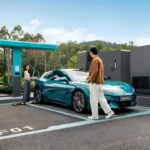


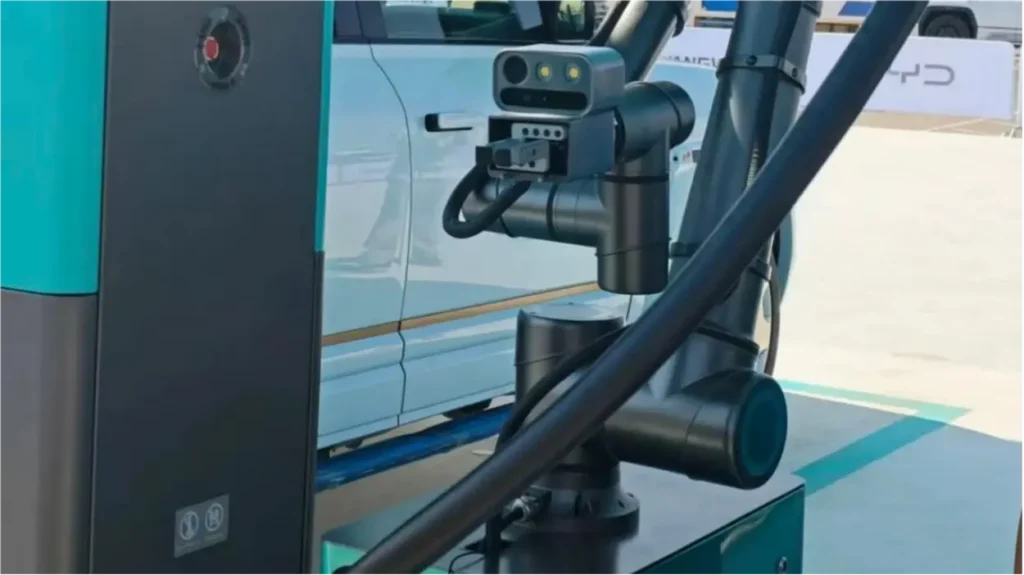
BYD demonstrated robotic EV charging in the United Arab Emirates over the weekend: an arm that locates the charge port of a parked car, opens the flap, takes the connector, inserts it, charges, withdraws it and closes the flap again — with the driver never leaving the seat. The site ran at 1,000 kW in the demonstration, and it was built as solar, storage and charging in one compound. BYD has not said when it goes on sale, what it costs, or how many stations will get one. It has also not said the number that decides whether this works for a robotaxi fleet: how many seconds the arm takes per car.
What BYD Actually Showed
The demonstration was part of the same Abu Dhabi media event that produced the 503.17 km/h run on 1 November and the Yangwang Altior unveiling on 7 November. It went almost unreported next to those two, which is a shame, because it is the one with a business model attached.
| BYD robotic flash charger | Detail |
|---|---|
| Sequence | Locate port, open flap, take connector, insert, charge, withdraw, close flap |
| Sensing | Machine vision plus force feedback — the arm adjusts angle while inserting |
| Connector compatibility | Several overseas specifications, so the same station serves different standards |
| Site architecture | Photovoltaic generation, battery storage, high-power charging |
| Power shown | 1,000 kW |
| Paired with | Second-generation Blade battery: 10–70% in five minutes, 10–97% in nine |
| Companion feature | One-tap park and charge: the car drives itself into the bay, then hands over |
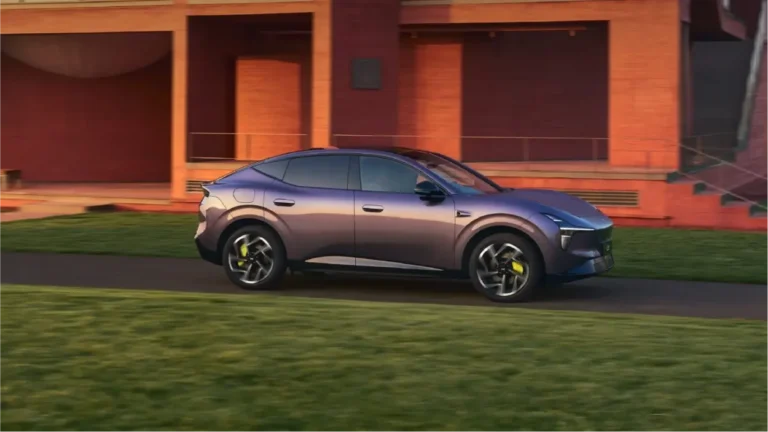
| Demonstration vehicle | A Yangwang U8 |
| Price / availability | Not announced |
One clarification that Chinese coverage made and English coverage mostly did not: 1,000 kW is the site’s demonstrated output, not the hardware’s ceiling. BYD rates the flash charger at up to 1,500 kW per connector. The compound in the UAE was configured for 1,000 kW around its solar and storage. Those are different claims, and mixing them is how a demonstration becomes a specification.
Why Robotic EV Charging Is Really a Robotaxi Problem
For a private car, an arm is a convenience. It saves the driver from standing in 45 °C heat, which in the Gulf is not a trivial thing, and it removes the heavy, stiff, liquid-cooled cable that megawatt charging requires — a cable that is genuinely awkward for many drivers to handle.
For a driverless fleet it is a different category of problem. A robotaxi that can navigate a city but cannot refuel itself is not autonomous; it is a taxi with a remote employee attached. The industry has two answers in play. Tesla has been pursuing the humanoid route, with Optimus handling the plug as a stopgap before wireless charging matures. The other answer is a fixed arm bolted to the charger.
The arm is the cheaper answer by a wide margin — one mechanism serving hundreds of cars a day, instead of one biped per vehicle — and it does not need to walk, balance or open a door. What it cannot do is charge a car parked badly. That is why the one-tap park-and-charge demo matters as much as the arm: the car has to arrive in a known position before a fixed arm is useful.
One Megawatt Does Not Come Out of a Wall
The part of this station that will decide whether it can be built at scale is not the robot. It is the container behind it.
Most sites do not have a megawatt of spare grid capacity sitting idle. If a station can draw 250 kW from the local network and must deliver 1,000 kW to a car, the storage cabinet supplies the other 750 kW. A five-minute session at that differential moves 62 kWh out of the battery — our arithmetic, from the power figures shown.
| Storage sizing, our arithmetic | Result |
|---|---|
| Grid connection assumed | 250 kW |
| Storage must supply | 750 kW |
| Energy per five-minute session | about 62 kWh |
| 215 kWh cabinet | about 3.4 sessions before it needs recharging |
| 500 kWh cabinet | about 8 sessions |
That is the whole economic argument for solar-plus-storage at a fast-charging site, and it is also its limit: the station’s throughput is set by how fast the cabinet refills, not by how fast the car can accept power. A site with a weak connection and a small cabinet will have a queue regardless of what the charger is rated at.
Huawei Got There First
BYD is not the first Chinese company to put an arm on a charger. Huawei demonstrated one in January 2025 alongside the Maextro S800, on a 600 kW supercharger: the car drove itself to the station, parked, and the arm plugged in and later disconnected. That was 18 months ago, and it has not become a product either.
So what BYD has done is raise the power by roughly two-thirds, add storage and solar to the site, and integrate automatic parking so that the car positions itself. That is real progress, but it is progress along a route someone else opened, and the honest headline is “second at higher power”, not “first”.
The Number Nobody Published
BYD has described the sequence but not its duration. That single missing figure determines whether the economics close.
Take a generous assumption of five minutes of charging plus two minutes of overhead — arm approach, flap, insertion, withdrawal, departure. That is a seven-minute cycle, or 8.6 cars an hour per bay, or about 206 cars a day if the bay ran flat out. At a realistic 50% utilisation it is about 103 cars a day per bay. A thousand-vehicle robotaxi fleet doing 250 km and roughly 37 kWh a day each would need about ten bays.
Ten bays is nothing. That is the argument for the arm in one line: the expensive part of a robotaxi depot is the vehicles and the land, not the plugging. But if the arm takes ninety seconds rather than twenty, the same fleet needs more bays or longer dwell, and the arithmetic moves by 10–20% — which at fleet scale is a rounding error. If it takes four minutes and frequently fails on a mis-parked car, the whole thing collapses into a supervised charging site with a robot on it.
20,000 Stations Is the Real Bet
The arm matters because of what BYD is already building underneath it. The company has said it will have 20,000 flash-charging stations in China by the end of 2026, and it built its 10,000th station in August. In Europe it plans 100 flash chargers by the end of 2026 and 3,000 by the end of 2027.
Ten thousand stations built, ten thousand to go — and no robotic EV charging in any of them. That raises the question BYD has not answered: is the robot a line item on new stations, or a retrofit onto the megawatt architecture it has already deployed? A retrofit is a different product, a different cost and a different installation schedule. The company has talked about automated charging for years, starting with automated guided vehicles inside factories before moving to passenger-car parks, and its published patents describe the arm also reading state of charge and tyre pressure, locating a valve and inflating a tyre without modifying the car.
Those patents are the most interesting thing here, because they describe a service bay rather than a charger: a machine that does several jobs to a parked car with nobody present. That is a plausible business. It is also entirely unannounced as a product.
What Is Missing
No price per arm, no price per station, no launch date, no station count, and no statement on whether the system will be offered outside the UAE. No cycle time, no failure rate, no statement of how the arm handles a car that parks 30 cm off centre, and no indication of whether it works with the three different connector standards now in play in Europe, or only the ones present in the Gulf.
And no charging curve from the demonstration. The car in the video was a Yangwang U8; the reports do not say what state of charge it started at, what rate it actually accepted, or what the ambient temperature was — in a Gulf summer, those three numbers matter more than the peak figure on the poster.
Author’s Take: The robot arm is not the interesting claim; the container behind it is. A 1,000 kW charger that depends on 750 kW of battery buffer is a statement that BYD has stopped waiting for grid upgrades and started shipping the grid with the charger. That is the same logic behind its solar-and-storage flash stations in China, and it is why the technology can travel to markets where the local network cannot support megawatt charging. The arm is a good demo and probably a real product for fleets. But watch the cabinet, the cycle time and the retrofit plan — those three numbers decide whether this is infrastructure or a trade-show video.
The Bottom Line: BYD demonstrated robotic EV charging in the UAE: a vision-and-force-feedback arm that opens the flap, plugs in, charges, unplugs and closes the flap on a Yangwang U8, at a solar-plus-storage site delivering 1,000 kW. The hardware is rated to 1,500 kW per connector; 1,000 kW was the site’s configuration. Huawei showed a comparable arm at 600 kW in January 2025. BYD has not published the cycle time, the price, the station count or a launch date — and with 10,000 of a planned 20,000 Chinese stations already built, whether the arm is new-build or retrofit is the question that matters.
Sources & Further Reading
- Wangtongshe (网通社) via Phoenix Auto (凤凰网汽车) — “比亚迪闪充机械臂在阿联酋完成首秀” (9 November 2026) — the full sequence including closing the flap, the vision-plus-force-feedback method, connector compatibility, the solar-storage-charging site, the 1,000 kW site figure, and the one-tap park-and-charge function.
- NetEase — “比亚迪发布闪充机器人:车主全程不用下车,机器人自动开盖插枪,还是兆瓦级闪充” (9 November 2026) — the distinction between the 1,000 kW site output and the 1,500 kW per-gun rating, the force-feedback adjustment during insertion, the storage buffer’s role in avoiding peak grid draw, and the patent-derived tyre-pressure and inflation functions.
- BYD statements and demonstration footage, UAE media event, 6–8 November 2026 — the arm’s function, the Yangwang U8 used in the demonstration, the second-generation Blade battery pairing, and the five-minute and nine-minute charging claims.
- BYD’s previously published patents on automated charging — state-of-charge and tyre-pressure reading, valve identification, inflation, and operation without vehicle modification. These describe possible functions, not features confirmed for this system.
- BYD’s European charging plans — 100 flash chargers by the end of 2026 and 3,000 by the end of 2027; 20,000 stations in China by the end of 2026.
- Huawei’s robotic charging arm demonstrated with the Maextro S800 on a 600 kW supercharger, January 2025 — the earlier precedent for this approach.
- EVsays — the megawatt flash-charging station architecture — what a 1 MW site needs from the grid, and why storage is part of the design rather than an add-on.
- EVsays — BYD’s 10,000th flash-charging station — the build rate behind the 20,000-station target, and the arithmetic of how fast that network is actually going up.
- EVsays — Sunwoda’s megawatt charging stations — a cell maker building charging infrastructure of its own, and why the two businesses are merging.
- EVsays — Waymo’s Zeekr-built robotaxi and the tariff — the fleet model that needs a plug nobody has to hold.
- EVsays — the Yangwang U9 Xtreme at 503.17 km/h — the same Abu Dhabi event, and the reason the robot arm was buried.
Notes: Every performance figure here — 1,000 kW at the site, 1,500 kW per connector, five minutes to 70%, nine minutes to 97% — is BYD’s own or as reported from its demonstration; EVsays did not attend and has not seen test data, a cycle time or a failure rate. The 62 kWh per session, the session counts per cabinet size, the seven-minute cycle, the 103 cars per bay per day and the ten-bay estimate for a thousand-vehicle fleet are our arithmetic, built on assumptions the company has not published — treat them as magnitude, not measurement. The 1,000 kW versus 1,500 kW distinction is drawn from Chinese coverage and is the one number most English reports conflate. All figures were cross-checked across Chinese-language reporting of the demonstration. Follow our correction policy for amendments, and our editorial policy for sourcing standards.