

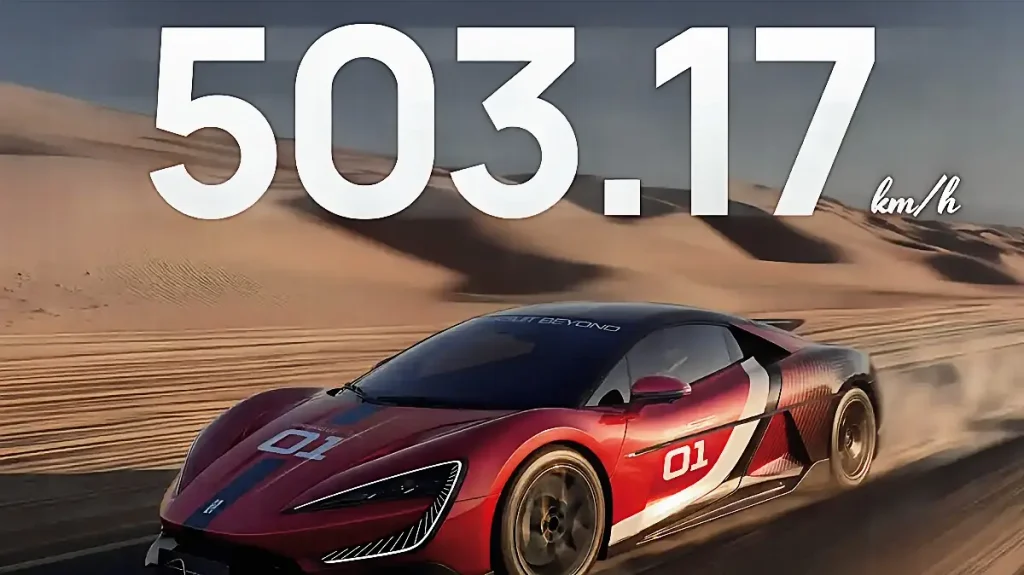
Yangwang, BYD’s ultra-premium brand, announced on Friday that its Yangwang U9 Xtreme hit 503.17 km/h (312.66 mph) on a closed public road in Abu Dhabi — the first production car past 500 km/h, and 6.95 km/h beyond the 496.22 km/h it set at a German proving ground last year. The speed has been covered everywhere. The detail worth stopping on is what is moving the car: a track-grade Blade pack, which is to say a lithium-iron-phosphate battery, rated for 30C discharge on a 1,200-volt platform. LFP is the cheap, safe, long-lived chemistry that the industry uses when it is not asking for power. BYD just asked it for three megawatts.
What the Yangwang U9 Xtreme Just Did
The number was released on 6 November, but the run itself took place on 1 November on a temporarily closed section of the E11 highway in Abu Dhabi’s Al Dhafra region, with German driver Marc Basseng at the wheel — the same man who drove the 496.22 km/h run at ATP Papenburg in September 2025. That continuity is deliberate: same car, same driver, different surface. The venue is the unusual part. Previous attempts were staged at closed proving grounds; Papenburg’s high-speed ring is 12.3 km around with two four-kilometre straights joined by banked corners of up to 49.7 degrees. A public road offers no banking, and the company frames the Gulf as the harder test — ambient heat, crosswinds and desert dust instead of a prepared oval.
Yangwang also says the result was verified by the FIA and ratified by Guinness World Records, and a Guinness certificate dated 1 November was displayed at the event. That is a stronger verification claim than the earlier Papenburg run carried, and if it holds, it settles the obvious objection to a manufacturer-announced speed record. Evsays has not seen the FIA verification document itself, only the certificate as photographed by Chinese media, so we are reporting the certification as claimed rather than as confirmed.
| Yangwang U9 Xtreme | Figure |
|---|---|
| Top speed, Abu Dhabi (Nov 2026) | 503.17 km/h |
| Previous record, ATP Papenburg (Sept 2025) | 496.22 km/h |
| Earlier U9 test car, ATP (Aug 2025) | 472.41 km/h |
| Nürburgring Nordschleife (Sept 2025) | 6:59.157 — first EV production car under 7 minutes |
| Peak system output | 2,220 kW / 3,019 PS / 2,977 hp |
| Motors | four, 555 kW each, up to 30,000 rpm |
| Power-to-weight | 1,217 PS per tonne |
| Price / build | more than ¥20 million / 30 units |
The Battery Is the Unlikely Part
Every other car in this league runs nickel-rich chemistry. Rimac, Pininfarina and the various Bugatti successors use NMC or NCA cells because the job demands energy density and power density at the same time, and LFP has historically been the compromise you accept when cost and cycle life matter more.
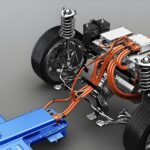
BYD’s Blade pack is LFP. The company says this track-grade version supports 30C discharge — thirty times its capacity, which for a pack in this class is several megawatts of instantaneous output — on what it describes as the first mass-produced 1,200V full-domain architecture. BYD has been building the pieces for this in public: 1,000V silicon-carbide modules with 5.5 nanohenries of stray inductance, and the e4 quad-motor system with torque vectoring that adjusts up to 100 times a second.
Two caveats. “30C” is a manufacturer’s rating for a hand-built, track-only cell, not a production pack you can buy; and the figure describes a peak, not a sustained rate. But the direction matters. If BYD can pull 30C from LFP in a halo car, the same chemistry’s ceiling in ordinary cars — particularly for megawatt charging and for the brief, violent power demands of a hybrid — is higher than the industry has been assuming.
What 503 km/h Actually Proves
At 503 km/h a car covers 140 metres a second. Nothing about that transfers to a Seal or an Atto. What transfers, in principle, is the validation work underneath: tyres, a GitiSport e·GTR 2 PRO semi-slick co-developed with Giti and certified for 500 km/h, which the company calls China’s first. Brakes. A titanium-alloy carbon-ceramic system. Thermal management that keeps a pack and four motors alive at continuous maximum. A 3D-printed integrated body around a carbon monocoque. And body control — the DiSus-X active suspension, working against aerodynamic load rather than a bumpy road.
That is a legitimate engineering argument, and it is also a well-worn marketing one. Every hypercar programme since the Veyron has made it. The honest version is: this proves BYD can integrate extreme subsystems and can validate them; it does not prove anything about the cars most people will buy.
What is new is the venue. Doing it on a public road in the Gulf rather than at Papenburg is a choice with an obvious commercial reading — the UAE is a market where the brand is already building a reputation for stunts, and where a 500 km/h number is a showroom argument rather than a specification.
Thirty Cars and a Falling Home Market
The U9 Xtreme costs more than 20 million yuan, roughly USD 2.98 million, and thirty will be built. It was the most expensive car at the Beijing auto show in April. Nobody at BYD expects it to earn money.
Which is why the timing is interesting. This is a halo play landing in a year when BYD’s domestic business is contracting: deliveries in China were down 27.8% in the first ten months, and the group’s growth has come entirely from exports. A 503 km/h record does not fix a demand problem. It does something narrower and more useful — it moves the brand conversation from price to capability, in the markets where BYD is now trying to sell at a premium.
The risk is that the number reads as noise. Chinese carmakers have spent three years competing on charging speed, range claims and Nürburgring lap times, and buyers have learned to discount all of it. A record that fewer than thirty people will ever experience has to work harder than one that shows up in a showroom.
Author’s Take: The interesting sentence in this announcement is not 503.17. It is “track-grade Blade Battery” — because Blade means LFP, and the entire pitch for LFP over the last five years has been that it is the cheap, safe, boring chemistry you use when you have stopped caring about power. BYD has now built a car that does 140 metres a second on it. Whether or not you care about the record, that is a claim about the ceiling of the chemistry the company has bet its volume business on, and it is the one thing here that could matter to a customer buying a 100,000-yuan car in 2029. The rest — the Guinness certificate, the Abu Dhabi backdrop, the 30-unit build — is brand theatre, competently executed. Watch whether a version of this cell shows up in something with a price tag and a warranty. That would be the real announcement.
The Bottom Line: The Yangwang U9 Xtreme reached 503.17 km/h on a closed section of the E11 in Abu Dhabi on 1 November, with Marc Basseng driving, and the result was announced on 6 November: the first production car past 500 km/h, and 6.95 km/h beyond its own 496.22 km/h record. Yangwang says the FIA verified it and Guinness ratified it; we have seen the certificate, not the FIA document. It costs more than 20 million yuan, thirty will be built, and it runs a 30C lithium-iron-phosphate Blade pack on a 1,200V platform — the genuinely surprising part.
Sources & Further Reading
- Yangwang announcement, 6 November 2026 — the 503.17 km/h figure, the Abu Dhabi public-road venue, the earlier 496.22 km/h record at ATP Papenburg, the 2,220 kW output from four 555 kW motors, the 1,217 PS per tonne power-to-weight ratio, the 1,200V platform, the 30C track-grade Blade battery, the DiSus-X system, and the 30-unit build.
- Guancha (观察者网) via Tencent News — “比客机起飞还快!仰望U9X以503.17km/h刷新世界纪录” (6 November 2026, Zhou Shengming) — the 1 November run date, the closed E11 highway in Al Dhafra, Marc Basseng as driver, the FIA check, the Papenburg ring’s 12.3 km length and 49.7-degree banking, the 800V-to-1,200V platform upgrade, and the tyre and suspension changes.
- Jimu News (极目新闻) — “503.17km/h!仰望U9 Xtreme再破全球汽车极速纪录” (6 November 2026) — the FIA and Guinness certification claim, the certificate’s 1 November date, the 2024 U9 test at 309.19 km/h in Wuhan, the sub-30-average-age engineering team, and Li Ke’s statement.
- Sohu — “503.17km/h!仰望U9 Xtreme再破全球汽车极速纪录|快讯” (6 November 2026) — the 3,019 PS and 1,217 PS per tonne figures, the 30C track-grade Blade pack, the 3D-printed body with carbon monocoque, and the three-year, seven-attempt programme.
- Phoenix Tech (凤凰网科技) — “比亚迪副总裁李柯现场官宣:仰望U9X以503.17km/h刷新世界极速纪录” (6 November 2026) — Li Ke’s on-site announcement, the 6.95 km/h improvement, the 2,220 kW output and the 30-unit limit.
- Hu Xiaoqing, general manager of Yangwang’s sales division — advance notice of the top-speed challenge in the UAE.
- Nürburgring Nordschleife lap of 6 minutes 59.157 seconds, September 2025 — the first all-electric production car below seven minutes.
- Beijing auto show, April 2026 — production U9 Xtreme unveiled at more than 20 million yuan, roughly USD 2.98 million, the most expensive car exhibited.
- Car News China reporting of 6 November 2026 — corroboration of the Guinness title and the open-road format. Named as the report of record; not linked.
- Evsays — the Yangwang U7’s 30,000 km endurance run — the brand’s other extreme-endurance exercise, and the pattern it belongs to.
- Evsays — BYD’s 1,000V silicon-carbide module — the component work behind the 1,200V architecture, and why stray inductance is the number that matters.
- Evsays — the megawatt charging station architecture — where high-rate LFP actually earns its keep.
- Evsays — Xiaomi’s YU7 GT at the Nürburgring — the other Chinese performance-marketing programme, and how these claims are priced.
Notes: The 503.17 km/h figure is Yangwang’s own. The run took place on 1 November on a temporarily closed section of the E11 in Al Dhafra, driven by Marc Basseng, and the certification is as the company states it — FIA verification and a Guinness World Records certificate dated 1 November. Evsays has seen that certificate only as photographed by Chinese media and has not seen the FIA verification document, so we report the certification as claimed. The 30C discharge rating applies to what BYD calls a track-grade pack, not to a production cell, and describes a peak rather than a sustained rate. The 139.8 metres per second and the roughly 2.5-tonne implied mass are our arithmetic from the disclosed speed and power-to-weight ratio. China delivery figures are from our own October reporting. Follow our correction policy for amendments, and our editorial policy for sourcing standards.