


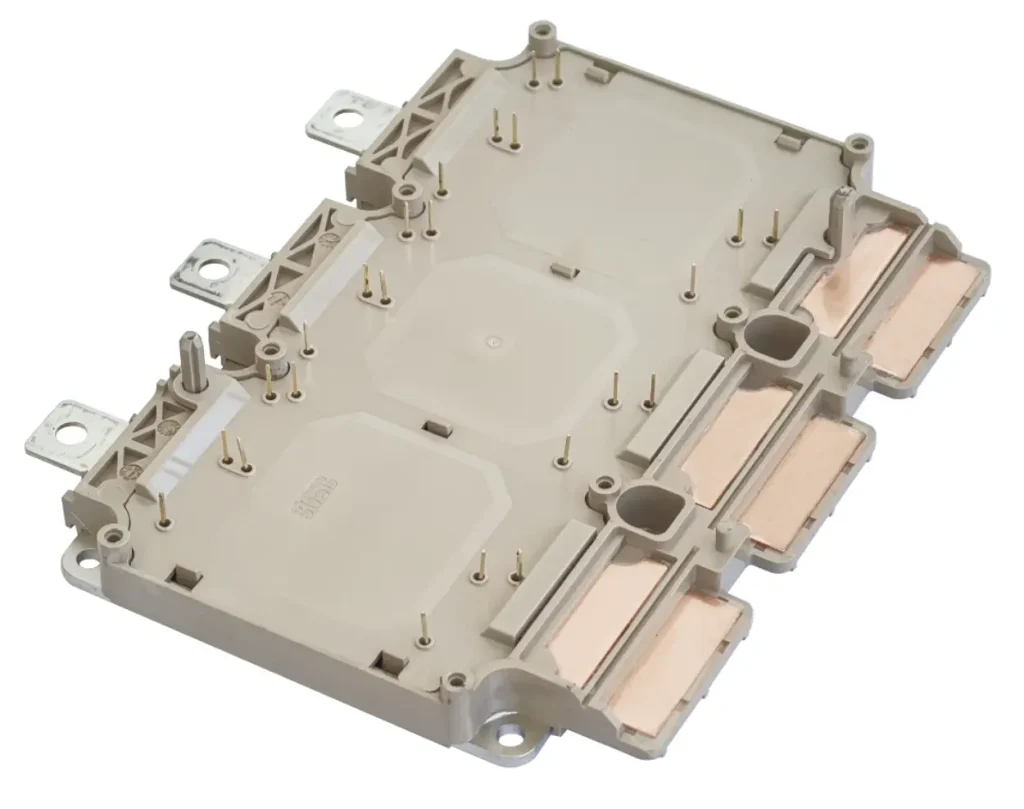
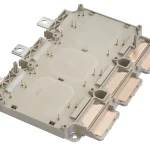
BYD Semiconductor unveiled the V-305B on September 2 — a 1000V silicon-carbide power module whose headline number is not its voltage but its stray inductance: 5.5 nanohenries. That single figure is the quiet enabler behind BYD’s claim that its megawatt flash charging can hold full power continuously, not just spike for a few seconds.
BYD Semiconductor (比亚迪半导体), the power-electronics arm of BYD, released the V-305B through its official WeChat channel on the morning of September 2. The module is the latest iteration of the V-305 family and is built for 1000V-class vehicle platforms — the same architecture that underpins BYD’s super e-platform, second-generation Blade Battery, and megawatt flash-charging stations. Officially, BYD positions it as a building block for the “full-domain 1000V” stack, the vertically integrated electrical layer it has been assembling in public since 2024.
What the BYD 1000V SiC Module Actually Does
A SiC power module is the switchgear of an EV’s inverter. It chops the battery’s DC into the three-phase AC that drives the motor, and it runs the reverse path during regenerative braking. On a 1000V platform, higher voltage means lower current for the same power, which shrinks the copper, cuts resistive loss, and lets the whole drivetrain run cooler. Silicon carbide matters because it switches faster and loses less heat than silicon IGBTs at high voltage — which is exactly why 1000V platforms and SiC travel together. The V-305B is BYD’s answer to the question of who builds that switch: BYD itself, not a tier-one supplier.
Why 5.5nH Makes the BYD 1000V SiC Module Matter for Megawatt Charging
At 1000V and kiloampere charging currents, the killer is not steady-state heat — it is the voltage spike at every switch. The spike magnitude follows V = L × di/dt: stray inductance L multiplied by the rate of current change. When di/dt is brutally steep — a megawatt charger ramps current in microseconds — even a few nanohenries of stray inductance generate an overshoot that can exceed the device’s breakdown rating. Traditional module packages sit at 20nH or higher; BYD claims 5.5nH at the module and under 10nH system-wide. That roughly halves the parasitic inductance versus legacy designs and, BYD states, cuts both the switching overshoot and the switching loss by about 30%. The practical payoff: the module can absorb megawatt-level current without tripping its own protection or throttling power — which is the difference between a charger that peaks at 1 MW for a few seconds and one that holds it.
Analyst Take: The 5.5nH figure is the story, not the “1000V” label. Anyone can rate a module at 1000V; holding full power through a sustained megawatt charge is an integration problem, and inductance is the bottleneck most specsheets hide. BYD is the rare automaker that designs both the module and the charger, so it can close that loop in-house. Competitors buying SiC modules from third parties inherit whatever parasitic inductance the vendor’s package allows — and most sit well above 5.5nH. That gap is why BYD’s “sustained megawatt” claim is hard to copy by procurement alone. The caveat: 5.5nH and the 30% reductions are BYD’s own published numbers, not independently benchmarked. Treat them as vendor claims until teardown data confirms.
Inside the BYD 1000V SiC Module: Materials and Packaging
BYD lists double-sided silver sintering, silicon-nitride AMB (active metal brazing) substrates, ultrasonic welding, and a silicone gel with a 200°C glass-transition temperature (Tg200°C) as the build. Silver sintering and AMB are the premium playbook for high-temperature, high-cycle power modules — they move heat out faster and survive thermal cycling better than older solder-and-alumina approaches. BYD also states the module passed AEC-Q100, the automotive reliability qualification, which matters because a power module lives next to the hottest, most vibration-prone parts of the car. AEC-Q100 Grade 0 covers −40 to 150°C; BYD did not publish the specific grade, so read “passed AEC-Q100” as at least Grade 1 unless a higher grade is confirmed.
The BYD 1000V SiC Module Completes BYD’s In-House 1000V Stack
The V-305B is the missing puzzle piece in a stack BYD has been assembling in public: the second-generation Blade Battery, the full-domain 1000V architecture, and the megawatt flash-charging stations that promise ~1 MW and double-digit-minute top-ups. A 1000V battery is only as good as the electronics that move its current, and a megawatt charger is only as good as the module that survives the spike. With the V-305B, BYD now controls the cell, the voltage platform, and the switch — the three layers that decide whether “megawatt charging” is a marketing number or a sustained specification. It is the same vertical-integration logic BYD applied to its in-house 4D radar chip: own the part competitors buy, and the system-level claim becomes defensible.
The Bottom Line
BYD Semiconductor’s V-305B is a 1000V SiC power module whose 5.5nH stray inductance is the engineering detail that lets BYD’s megawatt charging hold power instead of spiking. It closes the last gap in BYD’s in-house 1000V stack — cell, platform, and switch under one roof. Until teardown data confirms the vendor figures, read the 30% claims as BYD’s own. But the direction is clear: BYD is verticalizing the parts of electrification its competitors still procure.
Sources & Further Reading
- BYD Semiconductor official WeChat — “比亚迪半导体发布V-305B封装1000V SiC功率模块” — primary official Chinese source, published September 2, 2026 (08:30). All specifications above are drawn from this release.
- BYD Semiconductor corporate site (bydmicro.com) — V-305B article mirror — same content as the WeChat release. EVsays server-verified this URL returns HTTP 200; some user networks cannot reach the Huawei-cloud-hosted page, so the WeChat link above is the reliable primary.
- EVsays — BYD megawatt flash-charging architecture breakdown — context on the charging side the V-305B enables.
- EVsays — BYD’s in-house 4D radar chip — parallel example of BYD’s vertical-integration playbook.
- Xueqiu (雪球) — investor teardown noting V-305B as a V-305 iteration paired with the super e-platform, second-generation Blade, and full-domain 1000V; supplementary context, not a primary source.
Sourcing note: This article is based on an official Chinese-language release (BYD Semiconductor’s WeChat channel, mirrored on bydmicro.com). As of publication, no English-language first-report on the V-305B had appeared; specifications are taken directly from the official release and are not independently benchmarked. Analysis and interpretation are EVsays editorial original content. AEC-Q100 grade was not specified by BYD.




[…] rise, so the transients arrive more often; SiC switches faster, so each one is steeper. The silicon-carbide module takes the attention. The chip on its gate is what decides whether it survives a […]