

Uber and Momenta opened a supervised autonomous ride pilot in Munich on 18 November, the first time riders in Germany can be offered such a trip through the Uber app. The service covers a defined area across much of northern Munich, including the neighbourhoods around the Olympic Park, and is available to pre-selected customers who request an UberX, Electric or Comfort trip. Every ride carries one trained safety operator, is free of charge and is non-commercial — that last part is a condition of the test permits Germany’s Federal Motor Transport Authority (KBA) granted to Momenta, and it is the most revealing detail in the announcement. The Uber robotaxi Munich pilot is not a business yet. It is the world’s second-largest ride-hailing platform demonstrating that a Chinese autonomy stack can hold a German permit.
What Was Actually Announced
The terms are narrow by design. Rides are confined to a polygon covering large parts of northern Munich; pick-up and drop-off happen at designated stops rather than at an address; and access is phased, starting with riders who join an in-app interest list and are then selected. Within that area, someone requesting UberX, Electric or Comfort may be offered the autonomous option rather than guaranteed it. The partners say the area will expand step by step “within the applicable regulatory framework” — a phrase that does more work than it appears to.
This is the third public step in a relationship that has been unusually well signposted. Momenta and Uber announced a strategic agreement for robotaxi deployment, then in July a plan for testing to begin in Munich in 2026, and now the passenger pilot itself. Uber also took shares in Momenta’s Hong Kong listing in July, which makes it a platform partner and a shareholder at the same time — a structure that aligns the incentives more tightly than a pure dispatch contract would.
The Uber Robotaxi Munich Pilot Runs on Paper, Not Fares
Momenta’s KBA permit is the asset here, and it is a bigger one than the pilot suggests. The company said in July that the permit covered urban road testing across Germany, reported at the time as the first granted to a Chinese company without the applicant having to file city by city. In most of Europe, permission to run an autonomous vehicle is granted route by route, city by city, sometimes street by street. A permit that travels is worth more than a fleet that does not.
That explains the shape of the launch. If the constraint were vehicles or software, Uber would be scaling rides. Instead it is running a free, non-commercial service for a selected list in one part of one city — because the permit says so, and because the point of the exercise is the paperwork and the kilometres, not the revenue. The Uber robotaxi Munich pilot should be read as a regulatory exercise that happens to carry passengers.
The positioning is explicit in the quotes. Samarth Kejriwal, Uber’s head of autonomous mobility operations, called launching inside “Germany’s rigorous framework” a bar that “sets a high bar for further expansion across the region.” Shuo Xie, Momenta’s robotaxi general manager, framed Munich as a benchmark: “every kilometer we drive in Munich strengthens that understanding.” Neither executive mentioned a date for a paid service.
One Operator Per Car Is the Entire Problem
A robotaxi with a human in it is not a robotaxi in the sense that matters commercially: it is a car with a very expensive passenger who can take over. And in Germany that passenger is not cheap.
Our arithmetic, with assumptions stated: a trained safety operator on a 12-hour shift costs roughly €40 an hour fully loaded — wage, employer contributions, training, supervision. That is €480 per vehicle per day before the car moves. A short city trip of about 5 km, including pick-up and drop-off at a designated stop, takes perhaps 20 minutes door to door, which allows roughly 36 trips in a shift. Labour alone therefore costs about €13 a ride, before the vehicle, the sensors, the charging, the insurance or the platform’s commission.
That number is the whole argument. A supervised service cannot undercut a human-driven one, because it is paying for a human plus a machine. Every autonomous operator in the world knows this; the pilot exists to accumulate evidence so that the operator can eventually be removed. The relevant question for Munich is therefore not how many rides it completes, but what has to be true for the KBA to let the operator out of the front seat — and nobody has published that list.
Germany already has a legal route for driverless operation in defined areas, built around a remote technical supervisor rather than a person in the car. A pilot with a trained operator aboard sits on a lower rung than that, which is why it was approvable in months rather than years. The commercial service everyone is waiting for needs the higher rung.
Which Car, and Why That Matters
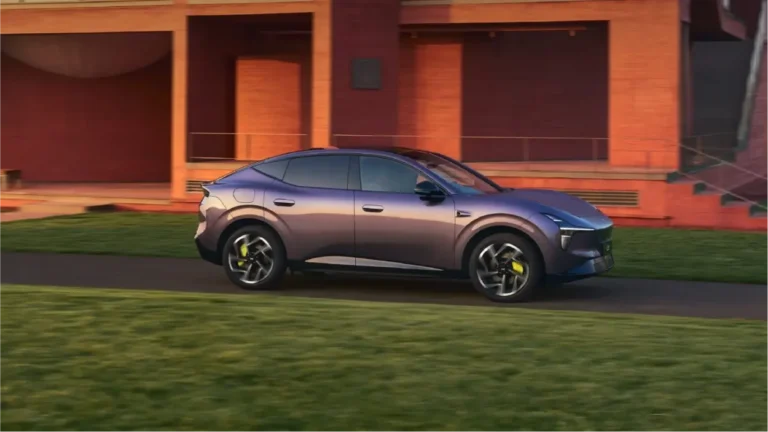
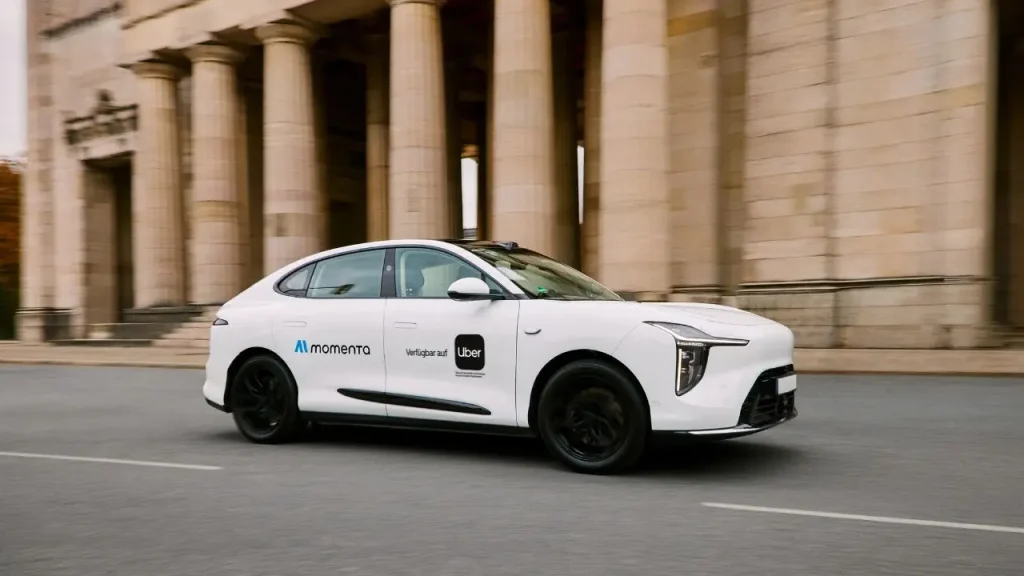
The press release does not name the vehicle. The photograph issued with it shows a second-generation IM LS6, the fastback crossover from SAIC’s IM Motors, according to Car News China’s reading of the image — and the choice is not incidental. SAIC is one of Momenta’s largest investors, the IM L7 was the first production car to carry a Momenta system, and in early November the two set up a joint venture with RMB 300 million of registered capital for assisted-driving development.
The production LS6 ships with IMAD 3.0, co-developed by IM and Momenta, using a 520-line roof-mounted lidar and Nvidia’s Thor system-on-chip at up to 700 TOPS. The car in Munich appears to run a dedicated L4-oriented Momenta stack rather than that customer system — a distinction the companies have not spelled out. Domestically the LS6 has delivered 32,030 units, down 14.4% year on year, and sells for RMB 202,900 to 264,900.
What 1.4 Million Cars Actually Buy
Momenta’s real asset is not the Munich fleet; it is the 1.4 million vehicles already running its assistance systems for Mercedes-Benz, BMW, Audi and Volkswagen. That installed base is the reason a German regulator had something to evaluate, and it is the reason Momenta talks about a “data flywheel” rather than a demo.
But scale it honestly. A German car covers about 12,500 km a year. A robotaxi running two shifts covers perhaps 60,000 — so one robotaxi year is worth about five consumer-car years in distance. At that ratio, even a 100-car Munich fleet would log around 6 million km a year, against roughly 17.5 billion km a year driven by the 1.4 million cars already carrying the system. The pilot is about 0.03% of the fleet’s annual mileage.
Which means the pilot is not a data-volume play. It is a data-domain play: German signage, German lane discipline, Munich winter, European roundabouts and tram tracks — kilometres that a Shenzhen or Shanghai kilometre cannot substitute for. That is a real asset and a small one. Anyone quoting the 1.4 million figure as evidence that the robotaxi is nearly solved is quoting the wrong number.
Two Directions of the Same Trade
Compare this with the arrangement we looked at in August, where Waymo’s robotaxi platform rides on a Zeekr: an American autonomy stack in a Chinese body, facing a tariff question. Munich runs the other way — a Chinese stack in a Chinese body, sold through an American platform, approved by a German regulator. Same three industries, opposite direction of flow.
The difference that matters is who carries the liability. Waymo carries its own. Here, Momenta holds the permit and therefore the responsibility, while Uber supplies demand, brand and the app. That split is why the supervision requirement is so consequential: as long as a trained operator is aboard, the hard question of who answers for a driverless crash in Bavaria stays unanswered — and unanswered questions are cheap to approve.
Author’s Take: The interesting sentence in this announcement is not “first in Germany”. It is “free of charge and non-commercial”, which is a permit condition, not a marketing choice. Read together with “one trained safety operator on board every trip”, it tells you exactly where this programme sits: past the technology demonstration, short of the business.
What Momenta has genuinely won is geography. A Chinese company now holds a German test permit that travels, on a German-built regulatory process, inside the European market where Chinese software has been treated with the most suspicion. That permit is worth more than any number of free rides, and it is the thing to watch — along with the day the operator’s seat becomes optional, which is the only milestone that changes the economics.
The Bottom Line: The Uber robotaxi Munich pilot began on 18 November: supervised autonomous rides across much of northern Munich, free and non-commercial under KBA test permits, with one trained safety operator in every car. Our arithmetic puts the operator alone at about €13 per trip, which is why supervision cannot be a business — the pilot exists to earn the right to remove the human. The permit, not the fleet, is the asset: Momenta already has 1.4 million cars feeding its assistance business, and the Munich kilometres are worth their scarcity in German road conditions, not their volume.
Sources & Further Reading
- Momenta — “Uber and Momenta Launch Supervised Autonomous Vehicle Pilot in Munich” (18 November 2026) — the operating area, the UberX / Electric / Comfort terms, the KBA test permits, the free and non-commercial condition, the safety operator requirement, and the quotations from Samarth Kejriwal and Shuo Xie.
- Momenta — “Uber and Momenta Announce Testing to Begin in Munich in 2026” and “Uber and Momenta Announce Strategic Agreement for Robotaxi Deployment” — the two earlier steps in the same partnership.
- Momenta company disclosure — founded 2016; assistance systems deployed in more than 1.4 million customer vehicles with Mercedes-Benz, BMW, Audi and Volkswagen; Hong Kong listing on 8 July 2026 raising about HK$6.8 billion, with roughly 20% of proceeds earmarked for robotaxi commercialisation; Uber’s additional investment in the listing taking its holding to about 1.19 million shares.
- IM Motors and SAIC — the second-generation IM LS6 as the vehicle shown in the pilot photography; IMAD 3.0 with a 520-line roof lidar and Nvidia Thor at up to 700 TOPS; domestic deliveries of 32,030 units, down 14.4%; Chinese pricing RMB 202,900–264,900; the RMB 300 million assisted-driving joint venture with Momenta formed in early November 2026.
- EVsays — Waymo’s robotaxi on a Zeekr platform — the same trade running in the opposite direction, and the tariff question attached to it.
- EVsays — why BYD puts L3 in 2028, and what L2 certification actually requires — the liability question that supervision defers.
Notes: The pilot terms, the permit basis, the free and non-commercial condition and both quotations are Momenta’s and Uber’s own statements and have not been independently verified; EVsays has not ridden in the service. The operator cost, trips per shift, cost per ride, annual robotaxi mileage and the resulting shares of fleet mileage are our calculations from stated assumptions, not company data. The vehicle identification is Car News China’s reading of the official photograph — neither company named the model in the release — and the description of a dedicated L4-oriented stack is reported, not confirmed. Momenta’s 1.4 million vehicle figure is its own. For how we handle corrections, see our correction policy; for our sourcing standards, our editorial policy.