
Ford has shipped the first Ford LFP battery cells produced at BlueOval Battery Park Michigan, in Marshall, and sent them to its Louisville assembly plant to power prototypes of the Fathom electric pickup. The plant is wholly owned and operated by Ford — but the process inside it is licensed from CATL, the Chinese company that supplies roughly one in three electric-vehicle batteries sold worldwide. With this shipment Ford says it becomes the first company to deliver LFP batteries for mainstream consumer vehicles in the United States. The plant can produce 40 cells a minute, was built for $2 billion and 20 GWh, and — by our arithmetic — has cost Ford the same amount per unit of capacity as the version Washington pressured it to abandon.
What the Ford LFP Battery Plant Actually Is
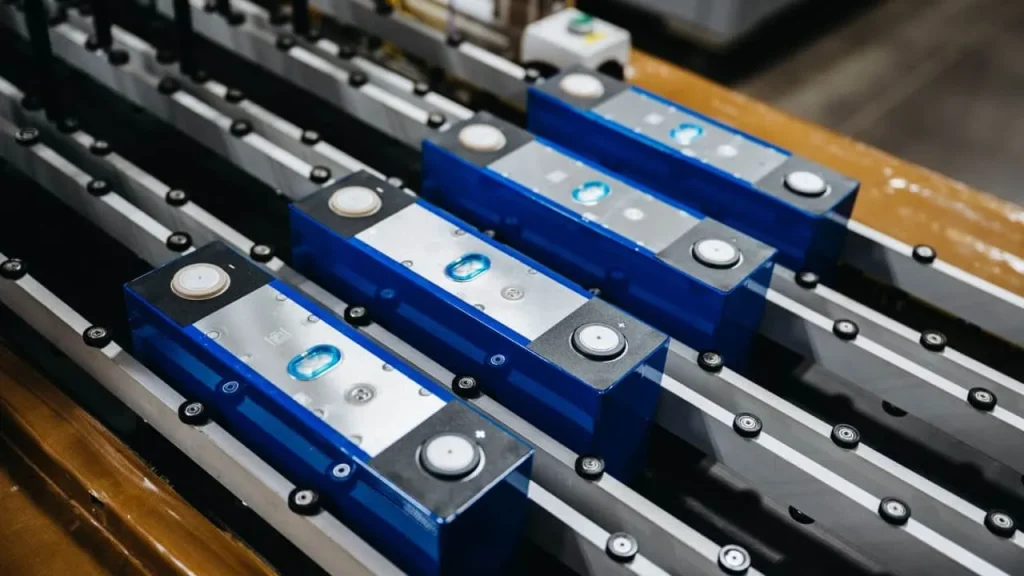
Marshall, Michigan. The cells are prismatic — rectangular, not cylindrical — and Ford’s account of why is unusually candid: prismatic cells fit directly into the chassis, so the pack can serve as a structural component rather than a box bolted underneath. That single decision cascades. Ford combines electrical and sensing connections into a flexible circuit board, integrates compact power electronics into the pack, and says the architecture helps enable what it calls the Universal EV Production System — the platform the Fathom pickup is built on.
The first shipment is not a customer delivery. These cells go to Louisville to power Fathom prototypes, and the pack plant next door in Marshall is not due to run until 2027, ahead of the truck’s launch. So the milestone is real but early: Ford has proved it can make cells at rate, not that it can sell trucks.
| BlueOval Battery Park Michigan | Detail |
|---|---|
| Location | Marshall, Michigan — wholly owned and operated by Ford |
| Capacity | 20 GWh nameplate; Ford says the site has room for more |
| Investment | $2 billion (original plan: $3.5 billion for 35 GWh) |
| Technology | Prismatic LFP, licensed from CATL |
| Line speed | 40 cells per minute; defect targets measured per billion cells |
| First output | Cells to Louisville for Fathom prototype packs |
| Next steps | Marshall pack plant in 2027; Ford Energy storage plant in Glendale, Kentucky in 2027 |
Ford Owns the Plant. CATL Owns the Recipe.
The arrangement dates from February 2023, when Ford announced the plant with CATL providing technology licensing and operational support. US Republican lawmakers then questioned whether federal subsidies could flow indirectly to CATL; the project was paused that year, restarted in November at 20 GWh and $2 billion instead of 35 GWh and $3.5 billion, and has now reached series production.
That sequence is the whole story of Western battery industrial policy in miniature. The tariff wall is real, and CATL does not ship these cells into the United States — it would not make commercial sense at those duty rates. What crosses the border instead is the process: the recipe, the line design, the quality regime. Ford gets a cell it can build and sell as American. CATL gets a royalty and a claim on the largest car market it cannot otherwise serve.
Ford’s own account of the choice is disarmingly plain. Alan Clarke, vice president of advanced development projects, says the team talked to battery companies around the world and wanted something “proven in the field, ready to manufacture at scale.” That led them, in Ford’s words, to “the world’s leading battery manufacturer, CATL.” The release does not disclose the royalty, the term of the licence, or whether it extends to the Kentucky storage plant.
The Cut Was Proportional, Not Leaner
Here is where the arithmetic gets interesting. The original project was $3.5 billion for 35 GWh. The surviving project is $2 billion for 20 GWh. Divide and the number is identical both times: $100 million of capital per gigawatt-hour.
Read that carefully, because it tells you what the political pressure actually cost. Ford did not redesign the plant to be cheaper per unit of output, which would have shown up as a lower cost per GWh. It built fewer gigawatt-hours of the same plant. Fifteen gigawatt-hours of American battery capacity — roughly 43% of the original plan — is what the scrutiny removed. The money that would have been spent on it did not go somewhere more efficient; it did not get spent.
Whether that was a good trade is a policy question, not an engineering one. But the ledger is worth stating precisely, because both supporters and critics of the deal describe it as a compromise on cost. It was not. It was a compromise on volume.
Forty Cells a Minute Means a One-Kilowatt-Hour Cell
Ford’s release gives two numbers that can be worked against each other: 40 cells per minute, and 20 GWh a year. Divide one by the other and you get the size of the thing being made.
Forty cells a minute is 2,400 an hour. Run the plant for 8,000 hours a year — three shifts, most of the calendar — and that is 19.2 million cells. Twenty gigawatt-hours spread across 19.2 million cells is a little over 1 kWh per cell. At a nominal 3.2 volts, that is roughly 320 Ah: a large prismatic, in the same class as the blade cells Chinese manufacturers use.
That matters more than it sounds. A 100 kWh pack built from these needs around 96 cells. The same pack built from small cylindrical cells needs thousands, with a weld, an interconnect and a failure point at every one. Ford’s “the best part is no part” line is a manufacturing philosophy, and this is the number behind it: two orders of magnitude fewer joints in the most expensive assembly in the vehicle.
Twenty gigawatt-hours is also about 200,000 to 250,000 packs a year at 80–100 kWh each. Ford has not published the Fathom’s pack size or its price, which makes that the single most important unknown in the story.
Why LFP, and Why Now
LFP uses no nickel and no cobalt, which is why it costs less per kilowatt-hour than the nickel-rich chemistry American carmakers spent a decade building factories around. It also degrades more slowly, which matters for a feature Ford is pushing hard on the Fathom: AC bidirectional power, letting the truck supply a house.
The timing is not accidental. The United States ended its federal EV tax credit early, in September 2025, and Ford took $19.5 billion of related impairment charges that December. When the subsidy goes, the only way to sell an electric pickup to a diesel buyer is to make it cheaper — and the cheapest lever on an electric vehicle is the battery. Ford kept the LFP project through the writedown and pointed the same manufacturing knowledge at a second business: grid storage at Glendale, Kentucky, due in 2027.
That pivot is the part worth watching. A car factory that can make LFP cells is also a storage factory, and storage does not need a dealer network, a warranty on a truck, or a customer who can charge at home.
What Ford Has Not Said
Five gaps, all material, in the Ford LFP battery case. Price of the Fathom. Pack size, and therefore how many vehicles 20 GWh actually supports. Volume ramp — 40 cells a minute is a line rate, not an output plan. The terms of the CATL licence, including royalty and duration. And whether the LFP cells qualify for anything: the consumer EV credit that once made this arithmetic work no longer exists, so the plant’s economics now rest entirely on cell cost.
Author’s Take: The interesting thing about this shipment is not that Ford can make a battery cell. Volkswagen, GM and Tesla all can, or nearly can. It is that the most consequential battery plant to open in America this decade is a Chinese process running inside an American legal entity — and that this is the model everyone will end up using, because the alternative is not making the cells at all.
The political fight over the plant was fought as though the choice were between Chinese technology and American technology. The actual choice was between Chinese technology assembled in Michigan and no LFP capacity in Michigan. Ford picked the first, halved the size to make it defensible, and will now spend the next three years proving the cells are good. If the Fathom lands at a price that moves people out of petrol pickups, the licence will look cheap. If it does not, the $2 billion will look like the expensive part.
The Bottom Line: Ford’s first Ford LFP battery cells have shipped from Marshall, Michigan — prismatic, structural, built at 40 cells a minute on a line licensed from CATL in a plant Ford wholly owns. The project shrank from $3.5 billion and 35 GWh to $2 billion and 20 GWh under political pressure, at an unchanged $100 million per GWh: the scrutiny cost capacity, not efficiency. Our arithmetic puts each cell near 1 kWh and the plant’s output at 200,000–250,000 packs a year, but Ford has not published the Fathom’s price, its pack size, or the terms of the licence.
Sources & Further Reading
- Ford — “Ford Ships First Battery Cells from Michigan Plant for Fathom Electric Truck; Key Milestone for Ford Energy” (Charles Poon, vice president, hardware engineering) — the shipment, the prismatic structural-pack rationale, the 40-cells-per-minute line rate, the parts-per-billion defect target, the 2027 pack and storage plants, and Alan Clarke’s account of choosing CATL.
- CATL — Dr. Robin Zeng on the “CATL Standard” — the company’s own framing of scale and reliability, and the source Ford cites for the claim that CATL batteries power 30 million vehicles.
- Ford’s original project announcement, February 2023, and subsequent reporting — $3.5 billion and 35 GWh with CATL providing technology licensing and operational support; the pause after US lawmakers questioned whether federal subsidies could reach CATL; the November 2023 restart at $2 billion and 20 GWh.
- Ford’s December 2025 disclosure — $19.5 billion of impairment charges related to its electric vehicle programme after the early termination of the US federal EV tax credit in September 2025.
- EVsays — the Marshall plant when it was still a plan — what the licensing structure looked like before a single cell existed, and the Polestar precedent that shaped it.
- EVsays — CATL’s argument that storage reliability is a system problem — relevant to Ford Energy’s Kentucky plant, which will use the same cell-making knowledge for a different customer.
Notes: The shipment, the line rate, the plant ownership, the 2027 timelines and all quotations are Ford’s own statements published on 19 November 2026; EVsays has not visited the plant or seen cell test data. The cost per GWh, cell size, cells-per-pack and annual pack counts are our calculations from Ford’s published capacity and line-rate figures plus stated assumptions about operating hours and pack size — Ford has published no cell specification. The licensing arrangement with CATL is as announced in 2023 and described in subsequent reporting; Ford’s November release credits CATL’s technology without stating the commercial terms, and the royalty is not public. Ford’s media site blocks automated retrieval, so our link checker returns an error on the source page; it loads normally in a browser. For how we handle corrections, see our correction policy; for our sourcing standards, our editorial policy.