

The Big Picture
- What: World’s first fully autonomous Nürburgring Nordschleife lap by a production car — 10:29.483.
- Vehicle: Xiaomi YU7 GT — dual motor 738 kW (1,003 hp), 897V SiC, 389,900 yuan.
- Why it matters: Tesla’s Track Mode is human-only. Mercedes’ Drive Pilot caps at 60 km/h. Xiaomi just ran a production SUV at racing speeds, hands-off, on the world’s hardest track.
- Series: Second Xiaomi move in two days. Sunday: Sky Nomad N90 (first EREV). Today: first autonomous Green Hell lap.
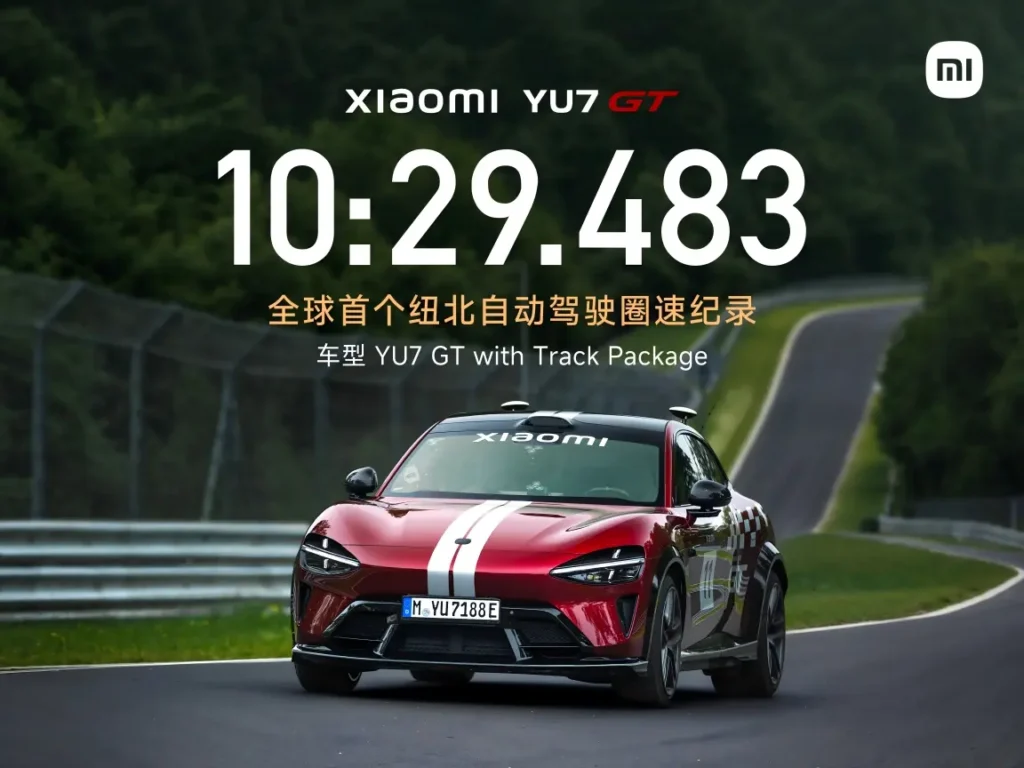
1. The Lap: 10:29.483 Without a Driver
The Nürburgring Nordschleife is not a sanitized test track. It has 73 corners, a 300-meter elevation change, and surfaces that shift from smooth to broken without warning. Racing drivers call it “The Green Hell.” For an autonomous system, it represents the ultimate stress test — continuous high-speed decision-making with zero margin for error.
Key details from Announcement on Xiaomi’s Weibo (reported by CnEVPost and CarNewsChina):
| Metric | Autonomous | Human Driver |
|---|---|---|
| Lap time | 10:29.483 | 7:22.755 |
| Difference | — | +3 min 7 sec (42.3% slower) |
| Vehicle | YU7 GT (Track Package) | YU7 GT (professional driver) |
| Record type | World’s first autonomous production car lap | Nürburgring production SUV record |
The 3-minute-7-second gap between human and machine is not a weakness — it’s the point. A human driver on the limit is pushing the vehicle to its absolute physical boundaries. An autonomous system on the limit is bounded by safety parameters: maximum lateral G, braking thresholds, perception confidence windows. The YU7 GT completed the lap safely. That is the achievement.
Xiaomi described it as “a new starting point rather than an end point,” signaling that the company intends to narrow the gap — and use the Nürburgring as an ongoing benchmark for its autonomous driving development.
2. The Machine: YU7 GT by the Numbers
| Specification | Detail |
|---|---|
| Motors | Dual motor (Super Motor V8s EVO) |
| Peak power | 738 kW (1,003 hp) |
| 0-100 km/h | 2.92 seconds |
| Top speed | 300 km/h |
| Battery | 101.7 kWh ternary lithium |
| CLTC range | 705 km |
| Voltage platform | 897V silicon carbide (SiC) |
| Fast charging | 570 km range in 15 minutes |
| Base price | 389,900 yuan ($57,580) |
| Nürburgring SUV record (human) | 7:22.755 |
The 897V SiC platform is the unsung hero — it enables sustained high-power delivery without thermal throttling, which is exactly what an autonomous system running perception + planning + control algorithms at racing speeds demands.
3. Why the Nürburgring Matters for Autonomy
Running an autonomous vehicle on a closed highway at 120 km/h is one challenge. Running it through the Nürburgring’s consecutive blind crests, off-camber corners, and vanishing apexes is another category entirely.
The Nordschleife forces three autonomous subsystems to their limits simultaneously:
- Perception: Trees, barriers, elevation changes, and worn surfaces degrade sensor confidence. The system must identify track boundaries under conditions designed to confuse cameras and LiDAR.
- Planning: 73 corners means 73 trajectory decisions at speed, many with limited forward visibility. The planner must balance pace against safety parameters continuously.
- Execution: Steady-state 897V power delivery, thermal management, and brake modulation under load — all managed by software.
No other production automaker has publicly attempted this. Tesla’s Track Mode optimizes for human drivers; Mercedes’ Drive Pilot operates under 60 km/h on approved highways. Xiaomi just ran a production SUV at racing speeds, hands-off, on the world’s hardest track.
Author’s Take: Strip away the press release. What Xiaomi actually did is turn the Nürburgring into a training dataset.
Every autonomous lap — the cornering forces, perception dropouts through blind crests, thermal spikes under sustained load — feeds the HAD system. That’s the real asset.
Tesla talks about FSD data from millions of miles of suburban driving. Xiaomi just started collecting data at racing speeds on the hardest track on earth. The lap time will come down. The data advantage is harder to replicate.
4. The Sales Context: A Halo Car for a Struggling Lineup
The YU7 GT’s track credentials arrive as the broader YU7 lineup faces headwinds. May deliveries fell to 8,736 units — the fifth consecutive month of sequential decline (per CPCA data). Xiaomi’s automotive division posted a 3.1 billion yuan operating loss in Q1.
The YU7 GT, priced at 389,900 yuan (moving to 429,900 fully loaded), is not a volume play. It is a halo car — one that elevates the entire YU7 nameplate and generates the kind of brand heat that trickles down to the 233,500-yuan standard variant. The Nürburgring autonomous lap is the halo car’s halo moment.
The Bottom Line
Xiaomi sent a production SUV around the Nürburgring with nobody at the wheel. It took 10 minutes and 29 seconds. It will get faster.
The question is not whether the lap time is impressive. The question is what the lap time buys. Two days after revealing its first EREV, Xiaomi is telling the world — and its investors — that its self-driving software belongs on the same track as its hardware. The YU7 GT is not selling in volume. The YU7 nameplate is sliding. But the data Xiaomi harvested on Monday morning in Germany will outlast both numbers. Lap records are marketing. Training data is a moat.