

This article has been corrected, and the correction matters more than the original claim did. The ten ships we attributed to BYD on September 3 are not BYD’s: shipbroking sources have identified the buyer of that Guangzhou Shipyard International order as Ray Car Carriers. What is actually confirmed about the BYD car carrier fleet is narrower and more interesting — eight ships in service, and a separate ten-ship order that has been reported for months but never acknowledged by the company or the shipyard.
Correction (September 20, 2026): The version of this article published on September 3, 2026 presented the Guangzhou Shipyard International contract for ten 8,200-CEU car carriers as BYD’s second batch of ships, and said it would “more than double” the company’s fleet. That was wrong. Riviera Maritime Media reported that shipbroking and market sources identified Ray Car Carriers as the owner, and Lloyd’s List reported the order as Ray’s. The article below has been rewritten: the Guangzhou order is covered as Ray’s, and BYD’s own position is stated only where the company or the yard has confirmed it. The original error is left visible here rather than quietly edited away.
BYD Car Carrier Fleet: What Is Confirmed
Two things are documented, and everything else in this story is inference.
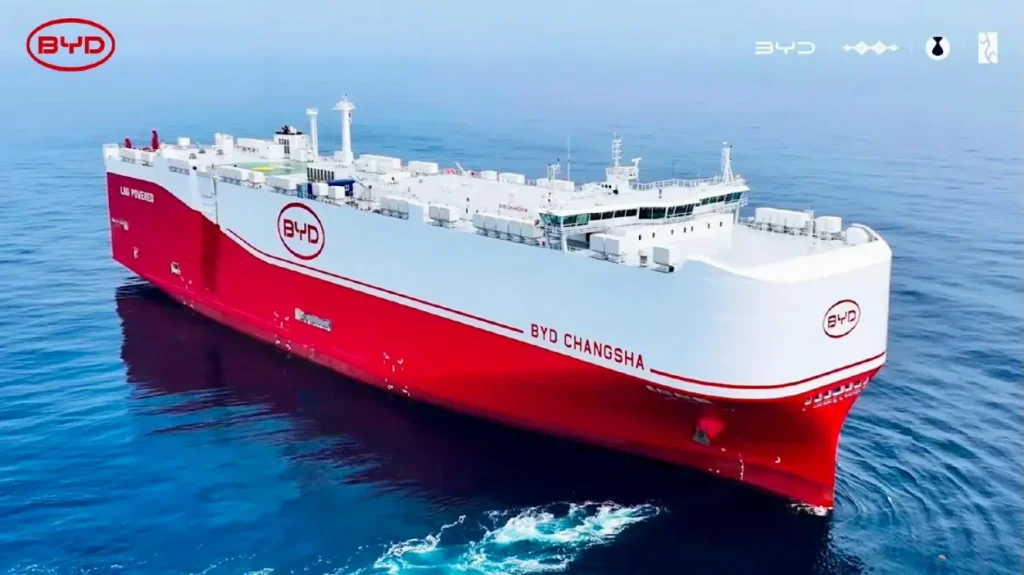
First, BYD operates eight car carriers of its own. That figure now comes from the company rather than from the trade press: BYD’s investor-relations record covering September 18, published on September 20, states that its owned fleet has eight roll-on/roll-off car carriers in operation, alongside plants running in Uzbekistan, Thailand and Brazil.
Second, the Guangzhou Shipyard International contract of September 1 — ten LNG dual-fuel PCTCs at 8,200 CEU each, more than US$1 billion, delivery 2029–2031 — is real and disclosed by the listed parent, China State Shipbuilding Corporation (600150.SH). The buyer’s name was withheld under confidentiality. It is not BYD.
Everything else — whether BYD has ten more ships coming, how many it will own by 2030, whether a 40-to-50-ship programme exists — sits on reports with no announcement behind them. We treat them as such below.
The Eight Ships in Service
BYD’s shipping bet dates to 2022, when it ordered a first batch of LNG dual-fuel carriers for roughly RMB 5 billion (about US$687 million) across Guangzhou Shipyard International, its parent’s yards and Yantai CIMC Raffles. The ships came in two sizes, 7,000 CEU and 9,200 CEU, matched to export routes:
- BYD Explorer No. 1 (7,000 CEU) — delivered January 2024, first sail
- BYD Changzhou (7,000 CEU) — late 2024
- BYD Hefei (7,000 CEU) — January 2025, delivered more than 80 days ahead of schedule
- BYD Shenzhen (9,200 CEU) — April 2025, briefly the largest car carrier in service in the world
- BYD Changsha (9,200 CEU) — 2025
- BYD Xi’an — 2025
- BYD Zhengzhou (7,000 CEU) — June 2026, maiden voyage to Australia
- BYD Jinan — the eighth vessel, in service since 2025
Together they cover Europe, Southeast Asia and South America and carry more than 1 million vehicles a year, moving models such as the BYD Sealion 08 to Australia and Europe. Their significance is not the tonnage. It is that BYD controls the schedule on its most important export routes at a time when third-party RoRo capacity is the binding constraint on Chinese vehicle exports.
The Guangzhou Order Belongs to Ray Car Carriers
This is the part we got wrong, so it is worth setting out properly.
The contract was signed on September 1 and disclosed by China CSSC Holdings on September 3, during the SMM trade fair in Hamburg. It covers ten vessels of 8,200 CEU, valued at more than US$1 billion — more than US$100 million a ship at the disclosed minimum — effective on signing and payable in US dollars, with deliveries in batches between 2029 and 2031.
The buyer was withheld under confidentiality arrangements. Shipbroking and market sources named Ray Car Carriers, the Isle of Man-registered tonnage provider controlled by Abraham Rami Ungar, and Lloyd’s List subsequently reported the order as Ray’s outright. The identification fits a negotiation that had been visible for weeks: in August, shipbuilding sources said Ray was in advanced talks with GSI for between 10 and 14 LNG dual-fuel PCTCs of roughly 8,600 CEU, with the programme then described as effectively finalised. The signed contract settled at ten firm ships of 8,200 CEU.
Why it matters beyond the value: Ray has placed its newbuildings with HD Hyundai for more than two decades, and this is its first newbuilding programme in China. According to Clarksons figures cited by Riviera, Ray operates 66 car carriers with a further 15 ships on order — and its largest existing or contracted units, all Korean-built, top out below 8,000 CEU, which makes the 8,200-CEU GSI ships its biggest yet. This does not mean Ray is leaving Korea: it has five 7,600-CEU ships under construction at HD Hyundai and was linked to two more 7,300-CEU vessels in April. It means a Chinese yard won a programme from an owner with no habit of building in China. GSI, for its part, has already delivered 10,800-CEU vessels this year — among the largest car carriers ever built — and signed a separate contract with SFL Corp during the same fair.
Two details in the coverage of this order should be flagged as unconfirmed: the options. TradeWinds reported that sources believe the contract carries options for up to four more vessels, while the CSSC announcement mentions none. And one wire report’s summary gave a 2028 start to deliveries, which its own body text — and the listed company’s disclosure — put at 2029–2031. On both points we follow the listed company.
The Ten Ships Reported for BYD — Still Not Confirmed
The second ten-ship story does exist, and it is a different programme from the one above. It was reported by the Dubai-based maritime magazine Robban Assafina, citing unnamed industry sources and LinkedIn posts, and relayed by the maritime outlet NewShips: ten 9,200-CEU LNG dual-fuel car carriers, placed with China Merchants Industry’s Jinling and Haimen yards, for delivery in 2027–2029.
That is where it stands. The reporting carries no contract value and no announcement from either BYD or the shipbuilder, and CarNewsChina made the absence of an official statement explicit when it covered the story on September 11. Southern Daily checked the websites of both China Merchants Industry and BYD and found nothing, then asked BYD for comment on September 15; the company had not responded at the time of that report. Chinese shipping trade coverage adds that BYD is genuinely in discussions about a further PCTC programme, but that the ship type — 8,600 or 9,200 CEU — and the number of vessels are not settled.
So the honest position, as of September 20, is this: a ten-ship order reported for BYD is plausible and consistent with everything the company is doing, and there is still no confirmation of it. If it is signed, BYD’s owned fleet would go from eight ships toward eighteen, with combined capacity above 130,000 CEU. Until it is signed, that number belongs to the reports, not to the company.
Why the BYD Car Carrier Fleet Still Has to Grow
The arithmetic behind the speculation is not in doubt, even if the order is. BYD exported 1,046,083 vehicles in 2025. In the first seven months of 2026 it shipped 972,794 — up 78.49% year on year — with July alone at 180,538, a monthly record. In August, overseas sales of passenger vehicles and pickups reached 188,746 units, up 134.6% year on year, taking the January-to-August total to 1,157,954.
Note the basis difference in those numbers: the export figures count vehicles leaving China, while the 1,157,954 in the company’s own disclosure counts overseas sales, including cars built at plants in Thailand, Brazil and Uzbekistan. The two measures are not interchangeable, and BYD’s localisation plans mean the gap between them will widen.
Against either measure, eight owned ships cover only about a quarter to a third of the volume; the rest rides on chartered or third-party tonnage. That gap is the reason a further order keeps being reported. Owning ships also insulates BYD from spot-market freight spikes — after Middle East tensions pushed Europe-bound automotive freight toward RMB 20,000 per vehicle — and protects delivery timelines in markets like Australia, where BYD says its own vessels cut waiting times against an industry norm of 12 to 18 months.
BYD Car Carrier Fleet vs SAIC’s Anji: A Logistics Arms Race
BYD is not alone in this. SAIC’s Anji Logistics runs more than 20 foreign-trade car carriers with roughly 500,000 to 600,000 units of annual capacity and a target of 22 ships by the end of 2026; Chery operates three. Lloyd’s List notes that 61 new vehicle carriers have been contracted since the start of 2026 across the industry, and the reason is the same everywhere: once a carmaker’s export volume clears roughly 100,000 units a year, owning tonnage pays back in about three years while locking in capacity on core routes. Chinese vehicle exports and an ageing global fleet are pushing owners and carmakers to order at the same time.
Sources & Further Reading
- Riviera Maritime Media — “CSSC makes PCTC newbuilding splash at SMM with US$1Bn Ray Car Carriers order” (2026-09-03) — the ten 8,200-CEU ships, the more than US$1bn value, the 2029–2031 delivery window, the identification of Ray Car Carriers by shipbroking and market sources, and Clarksons fleet data.
- Shippax — “GSI secures order for at least 10 PCTCs” (2026-09) — the listed-company disclosure, and what the CSSC announcement does and does not contain.
- 信德海事網 (Xinde Marine News) — GSI’s US$1bn-plus PCTC contract (2026-09) — the August negotiations at 8,600 CEU versus the signed 8,200 CEU, the status of the options, the delivery-date discrepancy in the wire coverage, and the competitive context for Hyundai.
- Lloyd’s List — “Vehicle carrier newbuild boom continues as Ray Car Carriers signs 10-ship order” (2026-09-03) — reported the order as Ray’s; also the figure of 61 vehicle carriers contracted industry-wide since the start of 2026. Listed without a link as it sits behind a subscription.
- CarNewsChina (2026-09-11), Robban Assafina and NewShips — the report of ten 9,200-CEU ships for BYD, which states no contract value and no official announcement; Southern Daily (2026-09-15) — verification attempts with China Merchants Industry and BYD, and the absence of a response from BYD.
- China State Shipbuilding Corporation official Weibo (2026-09-03) — the primary disclosure of the GSI contract, with the buyer unnamed.
- Sina Auto (2026-08-25) — China’s RoRo capacity crunch, freight rates, and the comparison with SAIC and Chery fleets.
- China Water Transport (中国水运报) and Chinese shipping press — the build history of BYD’s eight-ship fleet and the vessel names. Cited by name; the original PDF sits behind a newspaper archive that we do not link to.
- EVsays — related coverage: BYD’s UK delivery milestone, Chinese brands’ European market share and localisation as the alternative to shipping.
Accuracy note: The correction at the top of this article concerns our own reporting, not a change in the underlying facts: the Guangzhou Shipyard International contract was disclosed on September 3 with the buyer unnamed, and we inferred BYD. Shipbroking sources, reported by Riviera Maritime Media and Lloyd’s List, identified Ray Car Carriers. The ten 9,200-CEU ships attributed to BYD are a press report from Robban Assafina and NewShips, relayed by other outlets, with no contract value and no announcement from BYD or China Merchants Industry; Southern Daily reported on September 15 that BYD had not responded to a request for comment, and we found no announcement at the time of writing. The August negotiation figures of 10 to 14 ships at about 8,600 CEU are market reporting, not disclosed terms. The options for up to four further vessels at GSI are market reporting and are absent from the listed company’s announcement. The figure of 61 vehicle carriers contracted since the start of 2026 is Lloyd’s List’s. BYD’s eight-ship fleet is as stated in the company’s investor-relations record dated September 18 and published September 20; the vessel names and delivery dates in the list are drawn from Chinese shipping press, which we have not independently verified ship by ship. Export figures and overseas-sales figures are compiled on different bases and are labelled accordingly in the text.
Sourcing note: This article was rewritten on September 20, 2026, following our own review of the attribution, and the correction is dated and left in place. The primary sources are the listed-company disclosure from China CSSC Holdings and its official Weibo post, shipbroking and market identifications reported by Riviera Maritime Media, Shippax and Lloyd’s List, Chinese shipping trade coverage from Xinde Marine News, and BYD’s own investor-relations record. Where we could not confirm a figure, we have said so in the text rather than rounding it into a fact. The analysis is EVsays’ own. Our standards are set out in our editorial policy, and this correction was made under our correction policy.