
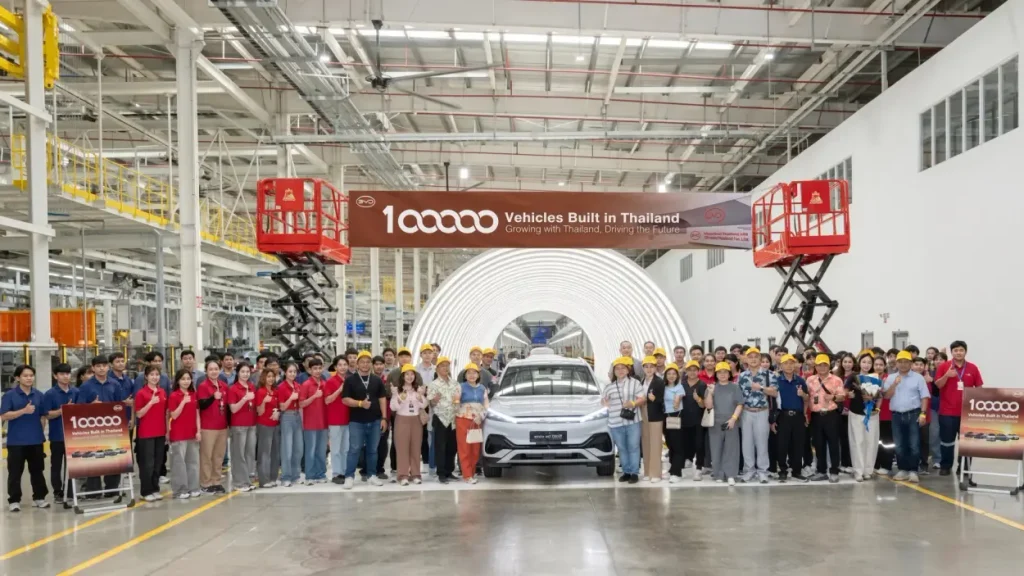
The BYD Thailand plant in Rayong assembled its 100,000th vehicle on September 21 — a white Atto 3, the model the brand used to enter the Thai market in 2022 — roughly 26 months after the factory began production in July 2024. The company marked the milestone this week, putting the emphasis on localisation: a workforce that is now about 95% Thai, roughly half of procurement sourced locally, and five models certified as Made in Thailand. The production record, read as a series, says something the milestone statement does not: the plant’s build rate has been falling since late 2025, and the reason is a change in Thai policy rather than in demand for Chinese cars.
What BYD Announced
The milestone was reported by MarkLines on September 22 and confirmed by the company the following day. Rayong is BYD’s first wholly owned passenger-vehicle plant outside China, in the WHA Industrial Estate in Rayong province, with a designed annual capacity of 150,000 vehicles. It assembles five models — Dolphin, Atto 3, Seal 5 DM-i, Sealion 5 DM-i and Sealion 6 DM-i — all of which hold Made in Thailand certification from the Federation of Thai Industries.
The localisation numbers are the substance of the announcement: more than 6,000 employees, about 95% of them Thai (up from about 93% in July, with the weld shop at about 98% and the harness plant at about 99.3%), approximately 50% local content, partnerships with 266 Thai suppliers of which 125 make materials or components domestically, and more than 1,090 parts certified to Thai standards. BYD and Denza together operate 171 showrooms and service centres in the country.
The Number Behind the Milestone
BYD has published three production landmarks at Rayong, and taken together they trace a curve that has already peaked:
| Milestone | Date | Added since previous | Implied run rate |
|---|---|---|---|
| 10,000th vehicle | November 2024 | — | ~2,500 a month over the first four months |
| 70,000th vehicle | November 2025 | +60,000 in 12 months | ~5,000 a month |
| 100,000th vehicle | 21 September 2026 | +30,000 in about 10 months | ~3,000 a month |
Against nameplate capacity of 150,000 vehicles a year — 12,500 a month — the plant is running at roughly 24% utilisation, on our calculation. The equipment is not the constraint. The weld shop covers about 70,000 square metres with 20 lines, 200 workstations and around 520 robots, and can build up to 45 vehicles an hour while flexing across as many as 10 models; the stamping shop runs a 7,900-tonne press and ships about 6,000 body sets a month. A plant built to that specification is waiting for volume, not for machines.
It is worth reading alongside the same milestone at BYD’s plant in Brazil: two overseas bases, two 100,000-vehicle plaques, and in both cases the question that matters is what comes after the plaque.
Thailand Changed the Deal
The slowdown lines up almost exactly with a policy switch. Thailand’s EV3.0 incentive scheme expired at the end of 2025 and was replaced by EV3.5 in February 2026. Under the new terms, the cash subsidy per vehicle was cut from a maximum of THB 150,000 to THB 50,000 (about $1,540 at THB 32.5 per USD), the special consumption tax on imported electric vehicles was restored from 2% to 10%, and the subsidy was made available only for vehicles assembled in Thailand.
The market reaction was immediate and extreme. Chinese brands held 47.3% of Thailand’s new-vehicle market in January 2026; in February that share fell to roughly 11.7%. BYD’s monthly volume in Thailand dropped from about 12,800 vehicles to 295 — a fall of 97.7% — before recovering above 2,000 in March.
Two qualifications belong with those numbers. Part of the January peak was buyers pulling purchases forward before the subsidy expired, so the February trough exaggerates the underlying decline; and the market has since rebuilt. Battery-electric vehicles reached 28.5% penetration in the first half of 2026, and between January and July Chinese brands sold more than 130,000 vehicles in Thailand for a 30.4% share — the first time above 30% — while Japanese brands slipped to 61.7%, a record low.
What did not recover is the economics of importing finished cars. That is the part of the policy that matters to a factory.
The Quota Is Why the Plant Exists
Thailand’s incentive scheme was never only a subsidy. It is a trade: market access in exchange for industrial capacity. Companies taking part must offset imports with local production — two vehicles built in Thailand for every one imported in 2026, rising to three for one in 2027 — with a rising localisation requirement attached, and with subsidy clawbacks and tax penalties if the targets are missed. Neta Auto was ordered to repay about THB 2 billion after falling short, which is what enforcement looks like.
Seen that way, the Rayong milestone is not primarily a commercial achievement. It is the cost of doing business in Thailand, and BYD is paying it at scale: the company says it has invested more than THB 30 billion in the country. Across the industry, seven Chinese automakers have announced more than 600,000 vehicles of Thai capacity and over $3 billion of investment, Changan has set a 70% localisation target for 2027, and both CATL and Gotion have moved into Rayong. Nobody is retreating; the model has simply shifted from shipping cars to building supply chains.
What the BYD Thailand Plant Actually Localised
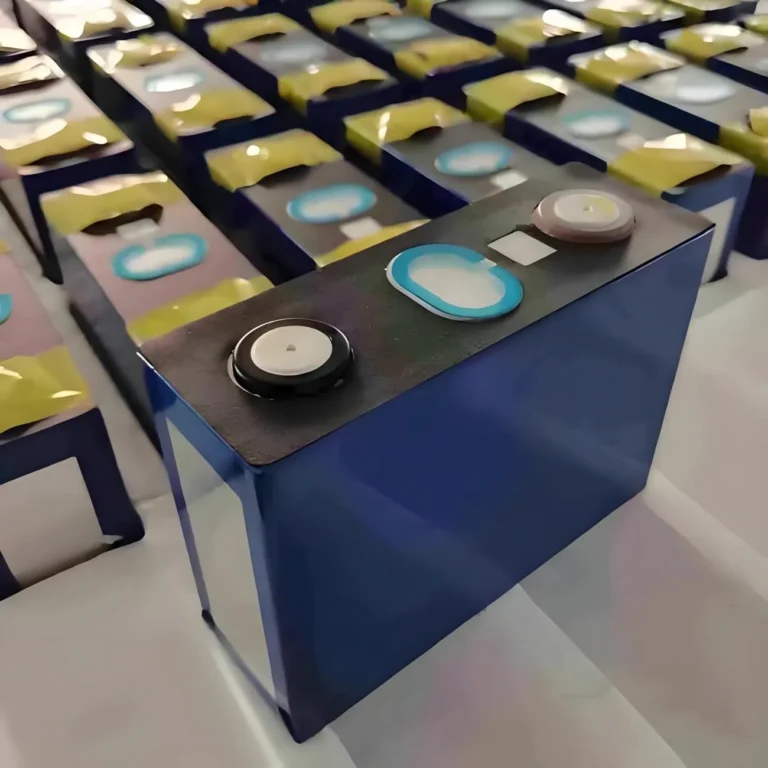
The most consequential piece of Rayong is not the assembly line. BYD’s battery pack plant in Rayong is its first Blade Battery pack base outside China, with three lines and capacity for up to 150,000 packs a year — sized to match the vehicle plant’s nameplate. A harness plant has been running since September 2024 at about 6,500 sets a month, expandable to 10,000, with a workforce that is 99.3% Thai.
Local content of roughly 50% is the figure to hold onto, because it is the one the quota’s rising localisation requirement will test. Assembly is easy to localise; cells, electronics and quality systems are not.
Exports Are the Release Valve — and a Tariff Gap
With Thai demand capped by policy and by household credit conditions, exports carry the growth. In the first half of 2026, exports accounted for about 40% of Rayong’s output, and cumulative exports have passed 24,000 vehicles to markets across ASEAN, South Asia, Australia and Europe. The first European shipment left in August 2025: more than 900 Dolphins bound for the United Kingdom, Germany and Belgium.
That last route is the strategically interesting one. The European Union’s countervailing duties on battery electric vehicles apply to vehicles produced in China — BYD’s rate is 17%. A car built in Rayong is not Chinese production, so it does not carry that duty. The EU has no free trade agreement with Thailand, so the standard most-favoured-nation tariff still applies, but the countervailing duty does not. For a manufacturer facing tariffs on both cars and, potentially, batteries, that difference is worth more than any Thai subsidy — and it explains why the plant’s export share, not its domestic share, is the number to watch. We looked at the wider build-out in BYD’s European manufacturing plan, and at the logistics in the fleet of car carriers it is assembling.
Author’s Take
The plaque is real, but the story is the slope. A plant with 150,000 units of nameplate capacity that added 30,000 vehicles in ten months is not being held back by its robots — it is being held back by a subsidy regime that now rewards local production over imports, and by a Thai car market that cannot absorb the output on its own. The milestone that would actually mean something is not the 100,000th vehicle; it is the first month above 5,000 again, or the quarter in which exports pass half of production. Until then, Rayong is a compliance asset with a growth option attached, and BYD’s footprint in Thailand is best measured in supplier contracts and certified parts rather than in vehicles.
The Bottom Line: BYD’s Thai plant hit 100,000 vehicles in 26 months, with about 95% local staff and roughly 50% local content — a genuine industrial build-out, and the reason Bangkok granted the market access in the first place. But the build rate has fallen from about 5,000 vehicles a month in the year to November 2025 to about 3,000 since, around a quarter of nameplate capacity, after Thailand cut EV subsidies and restored import taxes in February. The plant’s future now runs through the quota in Bangkok and the tariff gap in Europe, not through Thai showrooms.
Accuracy note: EVsays did not attend and did not receive the company’s materials; the milestone, the model mix, the workforce and localisation figures, the supplier and certification counts and the showroom number are as reported by MarkLines on 22 September 2026 and by the company through Thai media, and the production landmark dates of November 2024, November 2025 and 21 September 2026 come from those reports. The monthly run rates and the utilisation figure are our calculations from those dates and the 150,000-unit nameplate capacity; they describe average output, not any single month, and a nameplate is not a ceiling — the plant’s equipment is rated well above current volume. The EV3.5 subsidy cap of THB 50,000, the restoration of the 10% import consumption tax and the restriction of subsidies to locally assembled vehicles are as reported by trade and Thai media drawing on the Federation of Thai Industries and government statements; we have not read the scheme document itself, and neither have we seen a Thai government text for the 1:2 and 1:3 import-to-production ratios or for Neta’s THB 2 billion clawback, which come from Chinese trade compilations. Two figures in circulation conflict: BYD’s Thai investment is reported as more than THB 30 billion by Thai media and more than THB 35.9 billion by Chinese media, and cumulative exports are given as more than 24,000 units by MarkLines and Thai outlets against about 27,000 units in a quotation attributed to the general manager of BYD Auto Thailand. We use the lower figures and flag the discrepancy rather than average it. Baht conversions use THB 32.5 per USD and are approximate. The countervailing duty rate of 17% applied to BYD vehicles produced in China is from the European Commission’s implementing regulation; our statement that Thai-built vehicles fall outside that duty follows from its scope and is our reading, not a published ruling on Thai-built BYD cars.
Sourcing note: The primary source is BYD’s announcement of the Rayong milestone as reported by MarkLines and by Thai outlets including Khaosod, with production and localisation detail from the company’s statements to Thai media. The Thai incentive shift and its market effect are taken from trade media reporting on Federation of Thai Industries data and from the Thai and Chinese press; the European duty rate is from the Commission’s regulation. The analysis, the run-rate and utilisation calculations, and the comparison between the quota and the tariff gap are EVsays’ own. Our editorial standards are published in our editorial policy, and errors are handled under our correction policy.
Sources & Further Reading
- MarkLines — “BYD highlights Rayong plant status as assembly reaches 100,000 vehicles” (reported 2026-09-22) — the milestone, the five locally assembled models and the plant’s status.
- CnEVPost — “BYD Thailand plant tops 100,000 vehicles just over 2 years after opening” (2026-09-23) — the 26-month timeline, the workforce at about 95% Thai, about 50% local procurement, the five Made in Thailand certifications and the 24,000-plus cumulative exports.
- Thai media — Khaosod and Thais.com reports of the 23 September factory event — the production landmark dates, the plant-by-plant detail (battery pack, harness, stamping, weld shop), the supplier and certification counts and the general manager’s remarks.
- Just Auto — “Thai vehicle sales fall 2% in February” — the end of the EV3.0 programme, its replacement by EV3.5 with lower incentives, and the resulting fall in battery-electric sales.
- Chinese trade reporting on the EV3.5 switch and the production-for-import quota — the 47.3% January share and February collapse, the 1:2 and 1:3 ratios and the Neta clawback — used for context and attributed, not treated as government sources.
- European Commission Implementing Regulation (EU) 2024/2754, as amended — the countervailing duties on battery electric vehicles produced in China, including BYD’s 17% rate.
- EVsays — related coverage: BYD’s Brazil plant at 100,000 vehicles; BYD’s European manufacturing plan; the car carrier fleet; Chinese brands in Europe.