

CATL nudged two storage cells up on September 21 — the mainstream 314 Ah by 2.0%, the legacy 280 Ah by 1.1% — and cut the 587 Ah cell it has spent a year pushing to about $57.2/kWh (RMB 0.415/Wh), down from roughly $60.0/kWh (RMB 0.435/Wh) on September 15. Energy storage cell prices in China spent two years falling and are now moving the other way. The complication is that the prices CATL publishes are not the prices most of the market is paying.
What CATL Actually Listed
CATL repriced the three main cells in its online store on September 21. Asked about it, company staff told Chinese media the move was routine repricing, something CATL does periodically in response to market conditions. The numbers, as published by the store and reported by outlets including state-owned China Securities Journal, are these:
| Cell | Order threshold | Price, 21 Sep | Earlier price | Change |
|---|---|---|---|---|
| 280 Ah (1P), legacy format | 100 MWh+ | $64.8/kWh | $64.1/kWh (early Sep) | +1.1% |
| 314 Ah, the volume mainstream | 100 MWh+ | $55.6/kWh | $54.5/kWh (early Sep) | +2.0% |
| 587 Ah, new large format | 100 MWh+ | $57.2/kWh | $60.0/kWh (15 Sep) | −4.6% |
The store prices in RMB: RMB 0.470/Wh, RMB 0.403/Wh and RMB 0.415/Wh for the three cells, against RMB 0.465/Wh, RMB 0.395/Wh and RMB 0.435/Wh before. We convert at RMB 7.25 per USD across our coverage, which is why our dollar figures differ from outlets using a different rate — CarNewsChina put the 587 Ah at $65/kWh on 15 September on a rate near 6.7. All dollar prices here exclude freight, duties, integration and the converter’s margin.
The store is part of the story. CATL opened CATL Mall on June 26, on its own website and as a WeChat mini-programme, listing three cells — 100 Ah, 280 Ah and 314 Ah — with a minimum order of three boxes, a five-year warranty and delivery in three to five days. A 587 Ah product page existed from the start, but the cell could not be ordered. Until then, smaller integrators bought CATL cells through traders; the store gave them the factory, and by August the company said more than 1,800 firms had signed on. The 587 Ah became an orderable product on September 15, as CarNewsChina reported from its own account on the platform. One restriction matters for buyers outside China: ordering requires a valid Chinese business licence, so overseas customers still buy through a domestic broker or a mainland subsidiary. CATL describes the channel as supplementary — long-tail demand, with small-batch pricing that differs from long-term contract rates, while large projects stay on negotiated contracts.
Why These Energy Storage Cell Prices Are Not the Market Price
The most important detail in the Chinese coverage is easy to miss: the online store exists for small and mid-sized buyers, and it quotes spot prices on small volumes. Utility-scale buyers sign long-term agreements at volumes and prices that are not disclosed. The published figure is a list price for the tail of the market, not the clearing price for most of it.
The tender data makes that gap concrete. The weighted average clearing price for storage cells in Chinese tenders in September was $52.6/kWh (RMB 0.3814/Wh) — down 0.4% from August, though still up 38.3% year on year, according to tender data compiled by the Chinese trade outlet Guangdong Battery and cited by Sina Finance. That is 5.4% below CATL’s listed 314 Ah price of $55.6/kWh, and the industry average for the 314 Ah cell is lower still, at roughly $50.3/kWh (RMB 0.365/Wh) in September according to Chinese financial media.
So the honest reading of “CATL raises storage cell prices” is narrower than the headline. CATL raised its published spot price for small orders by one to two percent. The contracts that set the cost of a 400 MWh project did not rise last month; on the weighted average, they drifted down. What did change is that any buyer can now see, every day, what the largest cell maker in the world is willing to sell at — which is a structural change in transparency that will outlast this repricing. We covered the earlier stage of the reversal in our August report on Chinese storage cell prices turning.
The Tax Is Doing More of This Than the Lithium Price
Chinese financial coverage has largely explained the increase as a raw-material story, pointing at lithium carbonate. The materials matter — but the lithium line does not support the current explanation. Lithium carbonate did fall below RMB 60,000/t in mid-2025, and it did rebound to more than RMB 210,000/t in June 2026. It has since come back down to around RMB 131,000/t in late September, per SMM data cited in Chinese trade reports, and it was falling week on week through the second half of the month. A cell maker raising list prices while its single largest input drifts lower is not following lithium.
What CATL is following is a tax change. On September 1, a joint announcement from China’s Ministry of Finance, General Administration of Customs and State Taxation Administration ended a decade-long exemption and began taxing mature battery chemistries, in two steps, while leaving newer ones exempt:
| Category | Rate and timing |
|---|---|
| Lithium-ion, lithium primary, NiMH, mercury-free primary, all-vanadium flow | 2% from 1 Sep 2026; 4% from 1 Sep 2027 |
| Solar cells (perovskite, tandem and gallium arsenide excluded) | 2% from 1 Apr 2027; 4% from 1 Apr 2028 |
| Sodium-ion, solid-state, fuel cells, perovskite / tandem / GaAs solar | Exempt until 31 Dec 2028 |
The tax wedge is small per cell — 2% of the 314 Ah list price is about $1.1/kWh — but it is larger than the one-to-two percent list increases themselves, and the store quotes its totals as tax-inclusive and excluding logistics, so the listed rate already carries it, and it works differently on different parts of the chain. The State Taxation Administration’s own follow-up guidance clarifies that a company buying cells and assembling them into a battery cluster is liable for consumption tax, with credit for tax already paid on the cells, whereas a finished energy storage system — cells plus electrical, thermal, fire-suppression and control systems — is not an assessable battery product and is not taxed. Cells moved into battery-swap leasing are taxed at the point of transfer. Exported batteries remain exempt, or refunded, as before.
Two things follow, and both matter more than the one-percent headline. First, the tax tilts value up the chain, toward system integration and away from selling bare cells — which is precisely where CATL’s own customers, the integrators, sit. Second, because the tax exempts sodium-ion and solid-state until the end of 2028 while charging lithium-ion 2% now and 4% next September, it prices a chemical head start into the tax code. That is a live factor in the sodium-ion build-out we have tracked, from HiTHIUM’s 4 MWh sodium-ion container to CATL’s own sodium lines, and it is one reason the exemption list reads like a technology roadmap. We first looked at the mechanics of this tax in our earlier report on China’s battery consumption tax.
What $57.2/kWh Tells You About the 587 Ah Push
The most informative number in the whole list is not the 2% increase. It is that CATL raised the two older cells and cut the newest one, leaving a price ladder that runs, per Wh:
280 Ah (legacy) $64.8/kWh > 587 Ah (new) $57.2/kWh > 314 Ah (mainstream) $55.6/kWh
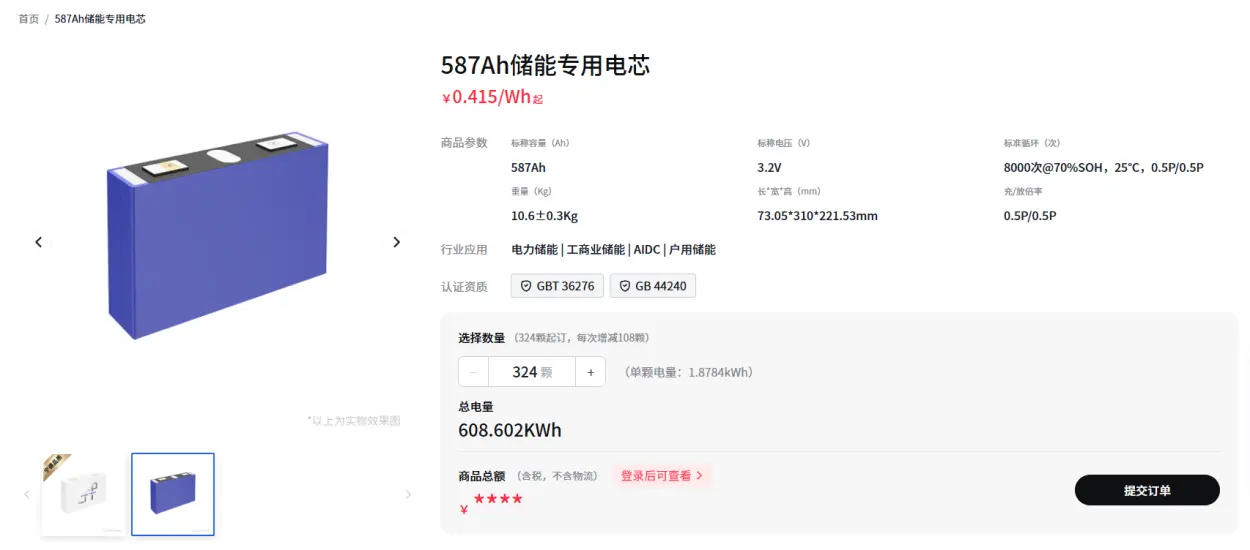
CATL’s newest and largest cell is now priced below its oldest one per unit of energy, within 3% of the mainstream 314 Ah — and it is the only one of the three whose price moved down in this round. That is a pricing decision, not a cost one: large-format cells are cheaper to make per Wh because they use less casing, fewer tabs and less processing per unit of capacity, and CATL is passing part of that through to pull buyers up the capacity curve. The cell is a 1.8784 kWh unit rated at 0.5P — the C-rate convention’s 0.5C, storage only, not EV use — with CATL quoting 8,000 cycles to 70% state of health at 25°C, 379 Wh/L and a five-year warranty. Its store page names four applications: grid storage, commercial and industrial, AIDC — the AI data-centre segment — and residential, and cites certification to GB/T 36276 and GB 44240. The minimum order is 324 cells: about 608 kWh, or roughly $36,600 (RMB 265,000), small enough for a mid-sized integrator to test the format without committing to a full project.
This is the same argument BYD has been making with its storage blocks, and it is the direction the whole industry has been moving: fewer, larger cells, fewer parts per MWh, lower balance-of-system cost. Cutting the 587 Ah while raising the 314 Ah is how CATL turns that argument into a comparison a procurement team can put in a spreadsheet. It also takes the ceiling off the 314 Ah — still the volume mainstream — which no longer has to be defended against a premium large cell.
What It Means Outside China
Chinese list prices are the reference floor for storage procurement worldwide, including for projects in the United States and Europe that never buy a Chinese cell directly, because they set the level every non-Chinese supplier is compared with. After two years of deflation, that reference has stopped falling.
Two caveats belong here. The tax is levied on domestic sales — exports keep their exemption and refund — so the direct tax effect does not land on overseas buyers; what lands on them is the general repricing that follows, and the risk that a 4% domestic rate from September 2027 narrows the incentive to sell at home rather than abroad. And the demand side has not changed: the customers driving growth in this market are utilities and data-centre developers, which is why financing on operating batteries and behind-the-meter capacity are the two ends of the market worth watching alongside cell prices. Our recent reporting on Jupiter Power’s $1.4bn of storage financing and on EVE Energy’s 206 GWh framework with Fluence covers that side.
Author’s Take
Two percent on a list price is not news. What is news is that the world’s largest cell maker has started publishing prices at all, and that the market’s attention is on the wrong number. The tender average fell last month while the list price rose, and the biggest new cost in the chain is a tax that doubles eleven months from now and does not touch sodium-ion or solid-state. Read together, those three facts describe a market where the headline direction is up, the contract reality is flat, and policy is quietly deciding which chemistries get to compete on price.
The Bottom Line: CATL raised its listed 280 Ah and 314 Ah prices by 1–2%, and cut the 587 Ah from about $60/kWh to $57.2/kWh — below the legacy 280 Ah per unit of energy, which is a nudge toward large formats rather than a market-wide increase. The number to model for a real project is still the tender average, which eased to $52.6/kWh in September. The cost that is genuinely rising is the consumption tax: 2% now, 4% from September 2027, with sodium-ion and solid-state exempt until the end of 2028.
Accuracy note: CATL does not publish these prices in English, and we do not hold an account on CATL Mall — opening one requires a Chinese business licence; all three figures, the 100 MWh threshold, the 324-cell minimum order and the previous prices are as published on CATL’s Chinese online store and reported by Chinese outlets, principally Cailianshe and China Securities Journal, both of which say they obtained them from the store or from the company. The September 15 price for the 587 Ah cell, RMB 0.435/Wh, comes from CarNewsChina, which holds its own account on the platform and published the figure on 15 September; taken together the two prices imply a 4.6% cut, but Chinese outlets described the September 21 listing as the cell’s first publicly posted price, so the size of the 587 Ah move should be treated as unresolved. The 1.88 kWh capacity, the 0.5C rating, the 8,000-cycle life, the 379 Wh/L density, the five-year warranty and the 324-cell minimum order are as listed on the store and as reported. The 608 kWh order size and the RMB 265,000 figure are our calculations from those numbers, and both are corroborated by the store page reproduced above, which shows 1.8784 kWh per cell and 608.602 kWh for the 324-cell minimum order. The company’s characterisation of the move as routine repricing is reported, not independently verified. The September tender average and the industry average for the 314 Ah cell are third-party compilations by Chinese trade media, not official statistics, and we have not audited their methodology. The lithium carbonate price path — below RMB 60,000/t in mid-2025, above RMB 210,000/t in June 2026, around RMB 131,000/t in late September — comes from SMM data cited in Chinese trade reports; we have not verified it against the SMM terminal. The estimate that each RMB 10,000/t move in lithium translates to roughly 0.6–0.7 fen per Wh of cell cost is an industry rule of thumb reported by Chinese media, not a figure we calculated or verified. The tax rates, effective dates and exemption list are as set out in the joint announcement of China’s Ministry of Finance, General Administration of Customs and State Taxation Administration (No. 20 of 2026) and the State Taxation Administration’s subsequent guidance. Currency conversions use RMB 7.25 per USD for consistency with our other coverage.
Sourcing note: The primary source is CATL’s Chinese online store pricing as reported on September 21 and 22, 2026 by Cailianshe and China Securities Journal, with the store’s launch date, its initial product line-up and the September 15 listing of the 587 Ah cell from CarNewsChina, which holds an account on the platform, and the company’s response from Jiemian News. The tax framework is taken from the State Taxation Administration’s published guidance and the joint announcement of July 2026. English-language coverage of the earlier stages of this price reversal by Energy-Storage.news was used for context, and the analysis, framing and comparisons in this article are EVsays’ own. Our editorial standards are published in our editorial policy, and errors are handled under our correction policy.
Sources & Further Reading
- Cailianshe (财联社) — “CATL’s online store raises storage cell prices” (2026-09-21) — the repricing, the three list prices, the 100 MWh threshold and the company’s “routine adjustment” response.
- China Securities Journal (中国证券报) — “CATL’s online store adjusts storage cell prices” (2026-09-21) — the previous prices: 280 Ah at RMB 0.465/Wh and 314 Ah at RMB 0.395/Wh, which produce the 1.1% and 2.0% changes; the first public listing for the 587 Ah.
- State Taxation Administration (国家税务总局) — “Consumption tax policy Q&A, part three” — the treatment of battery clusters versus integrated energy storage systems, and the tax point for cells used in battery-swap leasing.
- Ministry of Finance, General Administration of Customs and State Taxation Administration — Announcement No. 20 of 2026 on adjusting consumption tax policy for certain battery products (issued 16 July 2026, effective 1 September 2026) — the 2% to 4% step-up, the solar timetable and the exemption list running to 31 December 2028.
- Energy-Storage.news — “CATL, EVE Energy lead Chinese manufacturers’ battery storage cell price hikes” — English-language coverage of the earlier stage of the reversal.
- CarNewsChina — “CATL begins direct online sales of giant 587 Ah LFP cells at 65 USD/kWh” (2026-09-15) — the September 15 listing at RMB 435/kWh, the 324-cell minimum order, the 1.88 kWh capacity and 0.5C rating, the Chinese-business-licence requirement and the market-share context.
- CarNewsChina — “CATL launches online store for direct sales of energy storage cells to small and medium customers” (2026-06-26) — the store’s launch date, its initial three cells (100 Ah, 280 Ah, 314 Ah) and the 587 Ah page listed as unavailable.
- CATL — official site and storage product pages (catl.com) — company background, the 587 Ah cell’s GWh-scale delivery and its positioning for utility-scale projects.
- EVsays — related coverage: China’s storage cell price reversal; the battery consumption tax explained; EVE Energy and Fluence; HiTHIUM’s sodium-ion container; Jupiter Power’s financing.