

The Big Picture
- June’s factory sweep: China automakers overseas factories accelerated dramatically this month. XPeng activated its Malaysia CKD line on June 5. Then between June 22-23, three more followed: Chery’s new Barcelona production line, Leapmotor’s Spain battery workshop, and confirmation that BYD, Chery and Geely are exploring Canadian joint ventures.
- From export to embed: BYD, Chery, Geely, SAIC, XPeng, Leapmotor, Changan, GWM, Dongfeng, and Li Auto are all building or acquiring overseas production capacity. The playbook has shifted.
- Why now: Domestic passenger car sales are down 20% year-to-date; exports are up 68%. Foreign automakers like Stellantis (€22.3B loss) and Nissan have idle factories — and China’s carmakers are moving in.
1. China Automakers Overseas Factories: Three Weeks in June That Rewrote the Map
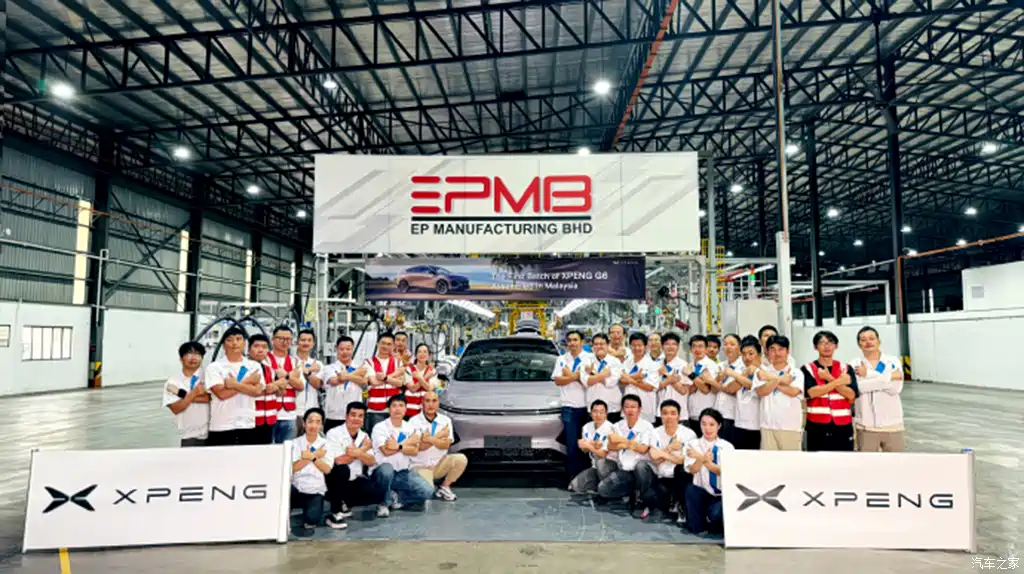
China automakers overseas factories kicked into overdrive this month. On June 5, XPeng announced on X that its third global production base — in Malacca, Malaysia — had begun assembling G6 SUVs at EPMB’s facility. Then between June 22-23, the pace quickened sharply. Chery’s joint venture with Spain’s Ebro Motors activated a new M1 production line at the former Nissan plant in Barcelona’s Zona Franca. Leapmotor International opened a battery assembly workshop in Mallen, Spain — next door to the Stellantis-CATL gigafactory. And Canadian Industry Minister Mélanie Joly confirmed that BYD, Chery, and Geely are all exploring joint-venture auto assembly plants on Canadian soil.
Four separate events. Three continents. Three weeks
2. The Global Factory Map: Who’s Building Where
June’s cluster of announcements is not an isolated burst. It’s the latest — and loudest — chapter in a year-long campaign by Chinese automakers to put production lines on every habitable continent. This follows the broader wave of overseas factory acquisitions we analyzed earlier this month.
What’s notable isn’t the number of deals. It’s the diversity of entry modes: contract manufacturing (Chery-Nissan), joint ventures (Dongfeng-Stellantis), greenfield investment (SAIC Spain), acquisition (XPeng Indonesia), and CKD assembly (XPeng Malaysia). Chinese automakers aren’t using one playbook — they’re using all of them at once.
3. Why Now: A Perfect Storm of Push and Pull
The push side is straightforward. China’s domestic market is contracting. January-May 2026 passenger car retail fell 20% year-on-year to just over 8 million units, according to the China Passenger Car Association (CPCA). NEV retail penetration keeps climbing — 63.8% in the first three weeks of June — but NEV sales themselves are down 14% year-to-date. The pie is shrinking.
Export data tells the other half of the story. In the January-May period, Chery exported 743,789 passenger vehicles (+69.3% YoY), BYD exported 598,433 NEVs (+67.6%), and Geely exported 370,362 units, according to CPCA figures published June 10. Geely’s growth rate is the most dramatic: +574.7% year-on-year for NEV exports alone.
But the pull side is more interesting. Foreign automakers are in trouble — and their empty factories are China’s opportunity.
Stellantis posted a €22.3 billion net loss for 2025 (approximately $24.4 billion), its first annual loss since the merger. Nissan’s 2025 operating profit fell 16.9%. Mercedes-Benz’s net profit dropped 48.8%. These companies have plants running at well below capacity. Nissan’s Sunderland facility, Britain’s largest car factory, operated at 45.5% utilization in 2025, according to MarkLines data.
An idle assembly line costs money every day it sits empty — depreciation, maintenance, labor costs that don’t disappear when volume does. For Nissan, letting Chery pay to use Line 1 at Sunderland turns a liability into an asset. For Chery, it cuts the time-to-production from five years (greenfield) to roughly 12 months.
4. The Export Surge: By the Numbers
Source: CPCA via CnEVPost, June 10, 2026. Numbers are overall passenger vehicle exports unless noted.
BYD’s chairman Wang Chuanfu told the company’s annual shareholder meeting that 2026 overseas sales will exceed the original 1.5 million target. Through May, the company has already delivered 41% of that goal.
Author’s Take: The factory sweep isn’t a PR campaign. It’s the predictable second act of an export boom. When you’re shipping 180,000 vehicles a month — as Chery is — you hit the wall of shipping costs, tariffs, and port congestion. The logical next step isn’t to export more ships. It’s to build the car where the customer is.
The brilliant part is who pays for it. China’s automakers aren’t greenfielding billion-dollar factories in Europe. They’re moving into Nissan’s empty line at Sunderland. They’re taking over Stellantis’ idle capacity in Spain. They’re acquiring an Indonesian assembly plant for what is almost certainly a fraction of new-build cost. The distressed assets of a contracting global auto industry are becoming the launch pads for its Chinese successors.
The Canada talks are the wildcard. If BYD, Chery, or Geely land a joint venture on North American soil — with political cover from a G7 government actively courting them — the geography of the global auto industry shifts. USMCA rules mean Canadian-made vehicles can enter the US market. That’s not an export strategy. That’s a Trojan horse.
The Bottom Line
Chinese automakers exported 3.4 million vehicles in the first five months of 2026. But the era of pure export is ending. Tariffs are rising. Shipping is expensive. And the factories of struggling foreign automakers are sitting half-empty.
The next phase of China’s auto globalization won’t be measured in export statistics. It will be measured in production lines — in Sunderland, in Barcelona, in Melaka, in Anápolis, and maybe in Ontario. The Chinese auto industry isn’t just selling cars to the world anymore. It’s moving in.