

1.Massive Shipments to Australia Amid Fuel Price Spikes: Shaking Up 28 Years of Japanese Dominance
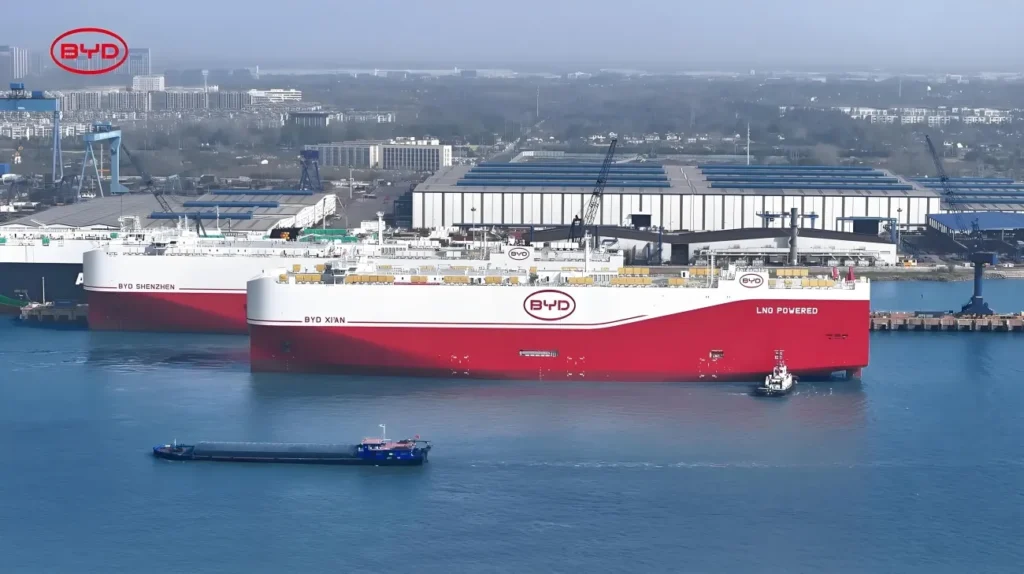
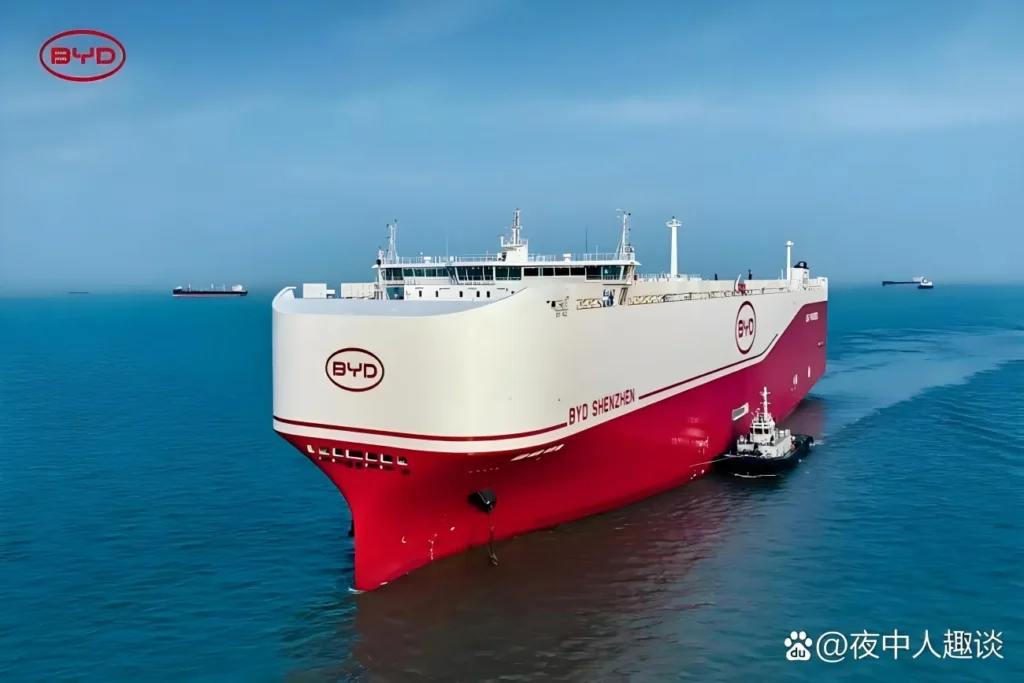
As one of BYD’s self-operated roll-on/roll-off (RoRo) car carriers, the Zhengzhou departed from Shanghai port packed with approximately 5,000 new energy vehicles (NEVs). This voyage marks the vessel’s maiden deployment on the Australian route and initiates BYD’s aggressive plan to inject an additional 30,000 NEVs into the Australian market over the coming months. Wang revealed that vehicle delivery times across Australia currently average six to eight weeks, and local buyers are tracking inbound shipping schedules with intense anticipation.
This massive shipment is a microcosm of China’s broader automotive export boom. From January to April 2026, China’s total auto exports reached a record 3.28 million units, a 52% year-on-year surge, putting the full-year target of 10 million units firmly within reach. This explosive trajectory mirrors the 1970s energy crisis, when fuel-efficient Japanese cars permanently disrupted the global automotive landscape.
More importantly, a profound structural shift is underway as China’s “Big Three” exporters establish clear market dominance:
- Chery Automobile: Led the pack with 393,000 units exported in Q1, up 53.9% year-on-year.
- SAIC Group: Secured second place with 325,000 units, growing 48.3%.
- BYD: Exported 319,000 units, leading the trio with a stellar 55% growth rate.
The Australian Front: Skyrocketing Fuel Prices Are the Ultimate Marketing Tool
In Australia, Japanese automakers—who held the crown for 28 consecutive years—are losing ground to Chinese manufacturing. In February 2026, China officially surpassed Japan as Australia’s largest source of new vehicles, selling 25,800 units against Japan’s 21,700.
In the pure battery-electric vehicle (BEV) segment, China’s dominance is absolute. By March, EVs accounted for 14.6% of the Australian market, with Chinese-made models (including those from Tesla’s Shanghai Gigafactory) capturing an astonishing 80% share. BYD’s monthly sales also cracked the local top three for the first time, surging 50% to hit 7,217 units.
“The energy crisis has acted as a massive catalyst,” Wang told reporters. Between late February and late March, local gasoline prices in Australia spiked by nearly 40%, while diesel jumped by over 60%. “Operating a pure EV cuts running costs by 30% to 40% compared to an ICE car. With high home-charging penetration in cities like Sydney and Melbourne, widespread commercial fast-charging, and households utilizing solar-plus-storage setups, range and charging anxieties are virtually non-existent. Consumers who were on the fence are making the switch instantly.”
Wang revealed that his dealership recorded a historic milestone in March, closing a record-breaking 51
Domestic Oversupply Redirected: The Battle Rages in Central Asia
The export pressure is also felt intensely in neighboring Central Asia. Following geopolitical conflicts in the Middle East that disrupted traditional trade routes, Chinese original equipment manufacturers (OEMs) swiftly pivoted toward Uzbekistan—the most populous nation in Central Asia.
Li Wei, a local distributor for Chery’s Jetour sub-brand in Uzbekistan, noted the sudden influx of Chinese corporate visitors: “If someone walks into the dealership wearing a backpack, there’s a 90% chance they are on a corporate market-scouting mission. Right now, running a business hospitality service might actually be more lucrative than selling cars.”
Boosted by Uzbekistan’s 30-day visa-free policy for Chinese citizens enacted in 2025, bilateral trade has skyrocketed. In 2025, Chinese brands captured roughly 70,000 units of Uzbekistan’s 450,000-vehicle market, and auto exports to the country grew by another 22% in Q1 2026.
In the capital city of Tashkent, where the charging infrastructure has expanded to over 10,000 stations, EV penetration is rising fast. Li noted that models like the Jetour Shanhai T1 plug-in hybrid (PHEV) and Shanhai T2 are rapidly taking market share from the long-dominant local joint venture, UzAuto Motors (Chevrolet), whose monolithic market share has eroded from over 90% down to roughly 70%.
2. Moving Away from Middlemen: The High-Stakes Pivot to Direct-Control Channels
Despite soaring sales figures, Chinese automakers face significant hurdles overseas: low brand awareness and fragmented after-sales networks.
“Locally, consumers are becoming familiar with BYD, but brands like Geely and Changan are often lumped together under the generic umbrella of ‘Chinese cars,'” Li pointed out. Even SAIC’s success with MG in Europe relies heavily on the historical equity of the brand’s original British heritage.
The more pressing vulnerability lies in after-sales support. Previously, a flood of “parallel import” vehicles—imported via unauthorized third-party trading companies—entered overseas markets. These traders focused entirely on moving inventory with zero infrastructure for maintenance, leaving overseas buyers stranded when mechanical issues arose and severely damaging the reputation of Chinese vehicles.
In response, Chinese OEMs are fundamentally reshaping their overseas strategies, shifting from a B2B trading mindset to a direct-to-consumer (D2C) infrastructure model.
- Implementing the Standard 4S Dealership Model: Brands like Jetour are moving away from short-term local distributors who prioritize quick profits over brand equity. Instead, OEMs are setting up direct subsidiaries to establish traditional “sales, service, spare parts, and survey” (4S) centers with fully certified maintenance bays.
- Xpeng’s Shift to Direct Operations in Australia: Following the financial collapse and administration of Xpeng’s local distribution partner TrueEV earlier this year, Xpeng restructured its strategy. Moving away from traditional wholesale dealer loading, Xpeng Australia transitioned to direct management of local distribution, customer service networks, and factory-integrated logistics.
- BYD Reclaims Exclusive Distribution Rights: When entering the Australian market in 2022, BYD initially granted exclusive import and distribution rights to local dealership giant Eagers Automotive. However, by 2025, BYD restructured this contract, reclaiming its “exclusive” tag and relegating Eagers to one of several non-exclusive retail partners. Analysts note that this trend of “direct control” allows Chinese OEMs to retain ultimate pricing power and brand integrity overseas.
However, direct operations come with steep operational and cross-cultural management costs. “Operating a direct storefront here means hiring multiple translators, with monthly salaries easily exceeding 10,000 RMB per person,” Li admitted. “Navigating local language barriers and retail security takes time and comes with a learning curve.”
3. Tariffs and Triumphs: Asset-Light Assembly and Localized Manufacturing
While direct channels secure the customer experience, localized overseas manufacturing has become the ultimate battleground for long-term survival.
The playbook for Chinese automotive expansion is evolving rapidly: it starts with basic vehicle trade, progresses to establishing marketing subsidiaries, and has now entered a capital-intensive era of direct investment in production lines and local supply chains.
Bypassing Tariff Walls via “Asset-Light Co-Manufacturing”
The primary driver for local manufacturing is the sudden wall of trade barriers. Mexico, a primary destination for Chinese auto exports, raised its import tariffs on Chinese vehicles from 20% to 50% effective January 1, 2026. This follows the European Union’s implementation of definitive countervailing duties on Chinese-made EVs in late 2024.
“Europe is a premium, high-potential market that can build a brand while delivering massive volume. In any market exceeding one million units annually, localized investment is mandatory for long-term survival,” an executive from a major Chinese automaker noted.
Faced with the immense capital requirements and lengthy timelines of building new factories from scratch, Chinese OEMs are moving with notable commercial agility: leveraging global legacy capacity instead of buying land and building new plants.
Currently, legacy auto giant Stellantis is actively looking to divest or lease capacity across four of its European factories due to severe underutilization (with utilization rates hovering around 50%). In early May, BYD Executive Vice President Stella Li confirmed the company is in talks with Stellantis and other partners to utilize idle European capacity. This follows a successful blueprint set by Leapmotor, which partnered with Stellantis’s Opel brand to share assembly lines at the Figueruelas plant in Spain to build a new electric SUV, effectively bypassing EU tariff walls via a joint-venture model.
The Math Behind CKD Assembly in Emerging Markets
Even in smaller markets with total volumes under one million units, such as Southeast Asia and Central Asia, aggressive domestic industrial policies are forcing a shift toward Completely Knocked-Down (CKD) assembly.
In Uzbekistan, steep import and scrappage taxes mean a Chinese EV lands at a dealer cost 1.5 times higher than its domestic Chinese retail price (and 1.7 times higher for ICE vehicles). For instance, a Jetour Shanhai T2 that retails for roughly 30,000 USD in China commands over 42,000 USD in Tashkent. In a country where average monthly salaries range between 200 and 300 USD, this premium limits market expansion to the wealthy elite.
“Transitioning to CKD assembly is the only viable way to scale,” Li Wei explained. While shipping disassembled components does not reduce ocean freight costs, components enjoy significantly lower tariff rates and qualify for higher import quotas. By assembling vehicles locally in Uzbekistan, the per-vehicle cost drops by approximately 2,000 USD.
Much like China’s own automotive trajectory post-WTO—where high tariffs were used to protect local industries, forcing foreign brands to start with CKD kits before gradually increasing localized sourcing—emerging market governments are using policy leverage to compel Chinese OEMs to export their supply chains, create local jobs, and upgrade local manufacturing capabilities.