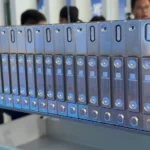


[Washington D.C. — Breaking Automotive News] The U.S. Department of Defense (DoD) has officially updated its statutory list of “Chinese Military Companies” operating directly or indirectly in the United States under Section 1260H of the National Defense Authorization Act (NDAA). In a move that has sent shockwaves through the global automotive and clean energy sectors, the Pentagon has formally designated the world’s leading electric vehicle manufacturer, BYD Company Limited, onto the military-defense procurement blacklist.
1. What the Section 1260H Designation Means for BYD
For global EV consumers and automotive investors, it is critical to separate legal facts from geopolitical rhetoric. A Section 1260H designation managed by the Pentagon does not impose immediate financial fines, asset freezes, or retail sales bans like traditional economic sanctions from the U.S. Treasury’s OFAC.
Instead, the enforcement operates strictly as a federal institutional procurement barrier under Section 805 of the NDAA:
- Direct DoD Ban (June 30, 2026): The U.S. military is strictly prohibited from entering into or renewing defense contracts directly with BYD or its subsidiaries.
- Indirect Supply Chain Ban (June 30, 2027): The Pentagon is barred from procuring third-party commercial systems, logistics fleets, or equipment that embed BYD-manufactured products, notably its advanced battery packs or energy storage solutions.
2. Industry Analysis: Target on EV Supply Chain Dominance
The inclusion of BYD—a company completely focused on consumer transportation and civilian renewable energy—highlights Washington’s tightening scrutiny over Chinese electric vehicle supply chains. As the undisputed titan of the global New Energy Vehicle (NEV) sector, BYD commands unparalleled vertical integration, manufacturing its own proprietary battery packs, electric drive systems, and power semiconductors in-house.
Automotive industry analysts emphasize that the Pentagon’s move appears to target China’s structural lead in dual-use automotive technologies rather than addressing genuine military overlap. BYD has consistently maintained that it holds zero defense-grade portfolios or military contracts. Furthermore, a review of corporate financial metrics shows that U.S. federal government procurement is statistically nonexistent, accounting for a negligible fraction of the group’s multi-billion-dollar global annual revenues.
Furthermore, historical defense documentation reveals that the Department of Defense frequently updates these lists without providing targeted automotive manufacturers prior administrative warnings, hearings, or granular evidentiary justifications.
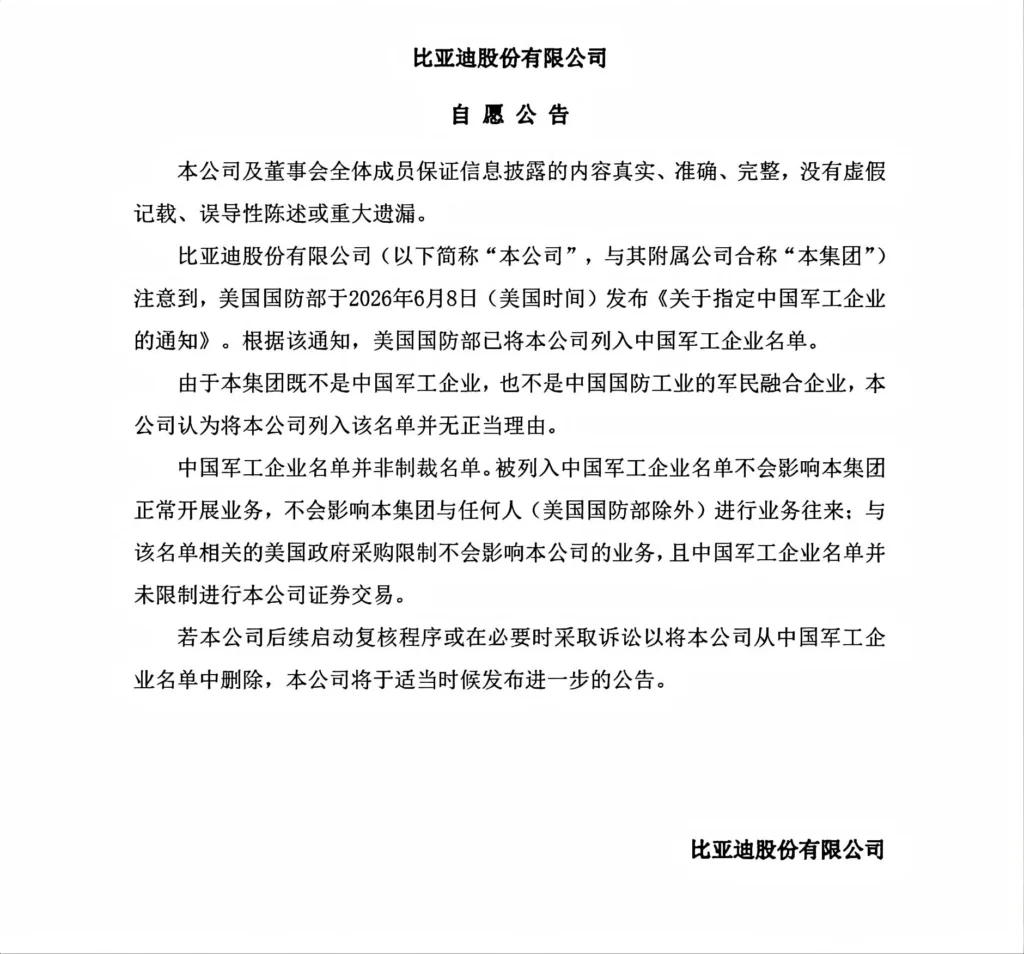
3. Corporate Response: BYD Formally Clarifies Operational Security
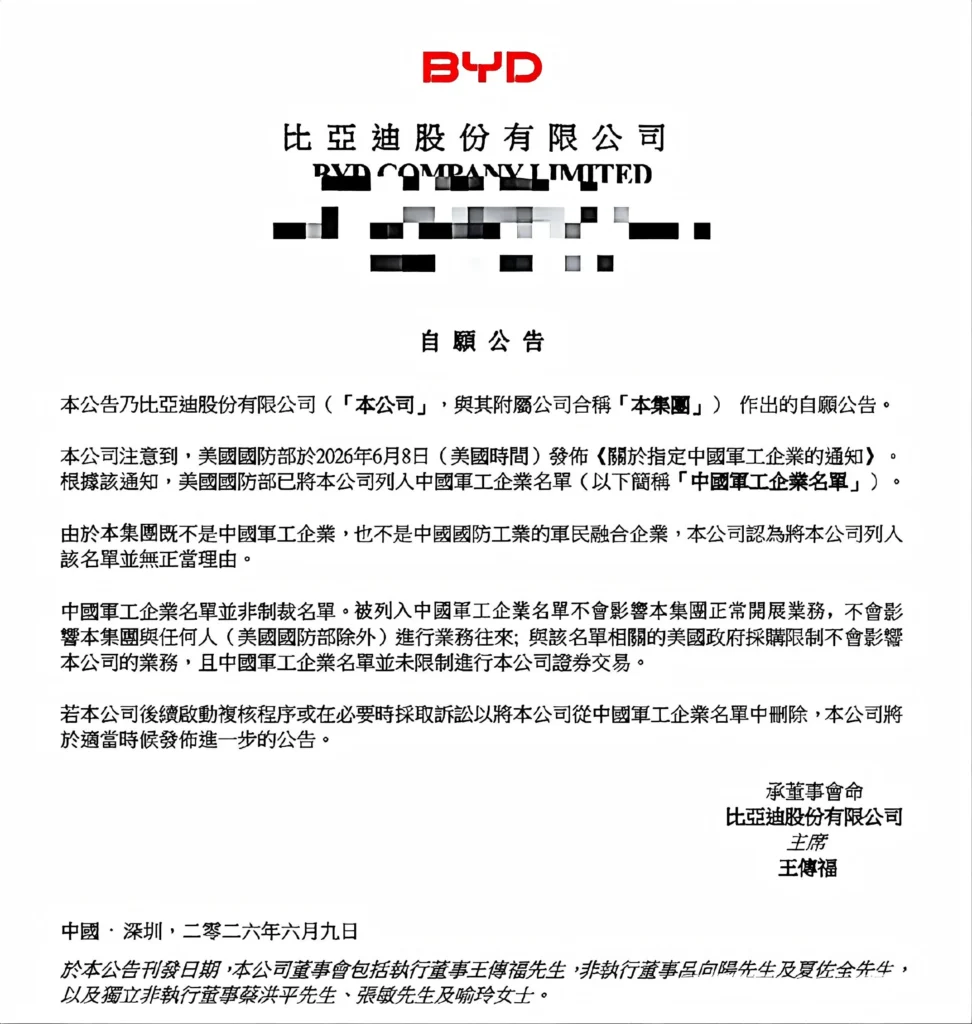
Following the Pentagon’s announcement, BYD issued an official corporate statement to clarify its operational status and assure global markets of its business continuity:
Official Statement from BYD Company Limited: “On June 8, 2026 (U.S. time), the U.S. Department of Defense issued the ‘Notice on Designating Chinese Military Companies.’ According to the notice, the U.S. Department of Defense has included the Company on the list of Chinese Military Companies.
As the Group is neither a Chinese military company nor a military-civil fusion enterprise of the Chinese defense industry, the Company believes there is no legitimate justification for its inclusion on this list. The Chinese Military Companies List is not a sanctions blacklist; therefore, being placed on this list will not impact the Group’s ability to conduct its normal day-to-day business operations.”
BYD executives have reiterated that because their overseas growth matrix is heavily rooted in consumer passenger cars, localized public transit bus contracts, and commercial grid energy storage, the U.S. military procurement ban carries no material threat to its broader international sales networks.
4. [FAQ] BYD Pentagon Blacklist Guide
- Q1: Does the 1260H designation mean Americans can no longer buy BYD electric cars?
- A: No. The Section 1260H list is solely a U.S. military procurement restriction. It only prevents the U.S. military from buying BYD products. It does not freeze corporate assets, impact consumer car sales, or restrict civilian dealership operations.
- Q2: Why was an electric vehicle maker like BYD added to a military list?
- A: Trade experts view the inclusion as part of a broader U.S. strategy to limit China’s global dominance in clean energy and EV supply chains, leveraging military procurement bans to scrutinize high-tech automotive components.
- Q3: Will this ruling disrupt BYD’s global automotive business?
- A: According to BYD’s official corporate statement, the designation carries no direct economic sanctions. Since BYD does not rely on U.S. defense contracts for revenue, it will not impact the company’s normal daily global business operations.