
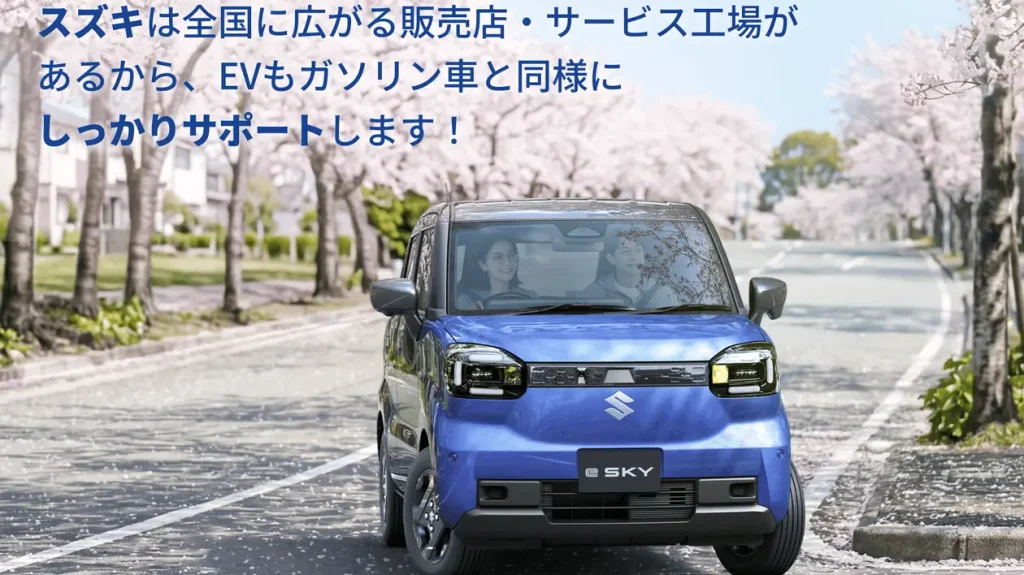
Suzuki announced on 6 October that the Suzuki e-Sky, its first passenger electric kei car, goes on sale in Japan on 16 November from ¥2,120,000 including tax — a figure the company and most of the coverage are calling the cheapest mini EV in Japan, and roughly ¥25,000 below the BYD Racco. Two details blunt that. The ¥2.12 million car is built to order and has no fast charging, and the car Suzuki expects to actually sell in volume starts at ¥2,390,000, which is ¥245,000 more than the Racco. Reported industry sourcing puts the pack’s cell supply inside BYD’s FinDreams battery unit, and Suzuki has put FinDreams cells in a production car before — an Indian-market one.
What the Suzuki e-Sky Actually Is
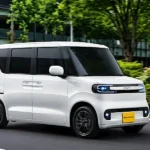
The car is a kei-class mini EV built on a dedicated electric platform Suzuki calls HEARTECT-e, with the pack laid flat under the floor. Three trims are offered in Japan, all front-wheel drive and all on the same 26 kWh battery, so range and efficiency are identical across the range.
| Trim | Price (incl. 10% tax) | Fast charging | Notes |
|---|---|---|---|
| A | ¥2,120,000 | None | Build-to-order; no large centre screen |
| G | ¥2,390,000 | 50 kW DC | Volume trim; centre screen optional |
| X | ¥2,790,000 | 50 kW DC | Screen, 360° camera and Suzuki Connect standard |
The drivetrain is Suzuki’s own: an oil-cooled eAxle integrating motor, inverter and reduction gear, rated at 47 kW (64 PS) and 133 N·m, at the kei class’s regulatory power ceiling. Body dimensions are textbook kei — 3,395 mm long, 1,475 mm wide, 1,625 mm tall, 2,460 mm wheelbase — with a 4.4 m minimum turning radius and a kerb weight of 1,030 kg. DC charging on the G and X takes the pack to 80% in about 25 minutes at 50 kW; AC charging is 3 kW over roughly eight hours or 6 kW over about four and a half. Suzuki’s product concept is “Easy to Switch” and its stated monthly target is 1,000 units.
Suzuki has also put equipment into the car that is unusual at this price: a direct heat pump with an electric heater to protect cold-weather range, vehicle-to-load output, and a one-pedal driving mode it calls Easy Drive Pedal. Production is at Suzuki’s Shizuoka plant southwest of Tokyo. The production car’s 310 km also represents a real gain over the Vision e-Sky concept shown earlier, which targeted more than 270 km.
The Cheapest Trim Is the One You Cannot Order Normally
Suzuki’s own materials describe the A grade as uketuke seisan — build-to-order, produced against a customer order rather than stocked. It also omits DC fast charging entirely, along with the large centre display. Japanese coverage treats the G and the X as the volume models, which is consistent with the way Suzuki has priced them: the gap from A to G is ¥270,000, and the gap from A to the top trim is ¥670,000.
This is not a criticism of the A grade. It is a statement about what the ¥2.12 million figure is for. A price that only exists on a car with no fast charging and no dealer stock is a marketing number — it sets the entry point in the pricing tables and in the headlines — while the product most buyers will actually be quoted is the G at ¥2,390,000. The Suzuki e-Sky’s cheapest configuration is its least buyable one.
Against the BYD Racco, the Headline Price Disappears
The comparison that matters is not A against Racco. It is G against Racco.
| Comparison | Suzuki e-Sky A | Suzuki e-Sky G | BYD Racco |
|---|---|---|---|
| Price incl. tax | ¥2,120,000 | ¥2,390,000 | ¥2,145,000 |
| Difference vs Racco | −¥25,000 (−1.2%) | +¥245,000 (+11.4%) | — |
| Fast charging | None | 50 kW DC | Yes |
| WLTC range | 310 km | 310 km | 320 km (top trim) |
| Rear doors | Conventional | Conventional | Power sliding |
On the entry trim, Suzuki beats BYD by ¥25,000, which is about 1.2%. That is the entire margin by which Japan’s largest maker of mini vehicles undercuts the Chinese company that entered the same segment in July. On the trim Suzuki says is the volume model, the e-Sky is ¥245,000 more expensive, and the Racco still offers fast charging, a longer advertised range and sliding rear doors that are genuinely useful in the narrow parking spaces kei cars are built for.
The volume picture makes the pricing look less like momentum and more like a defensive move. BYD has sold 648 Racco units since launch through the end of September — roughly 216 a month. Suzuki is targeting 1,000 a month, a run rate about 4.6 times what BYD has actually achieved. Suzuki held 34% of Japan’s mini vehicle market in 2025, and it has been losing ground in exactly the segment where its share is largest.
And the Battery Comes From BYD’s Battery Unit
This is where the story stops being a price list. The e-Sky’s 26 kWh pack is lithium iron phosphate, and the sourcing points at FinDreams — BYD’s wholly owned battery subsidiary, the unit that makes BYD’s own cells. Nikkei Asia reported in August that the cells were expected to come from “BYD’s corporate network,” which pointed to LFP chemistry; Chinese-language trade coverage since has named FinDreams Battery directly, and Chinese automotive media have attributed the cell supply to FinDreams Power.
That is sourcing, not a company statement. Suzuki’s own materials describe the chemistry and the geometry and do not name a supplier, and neither Suzuki nor BYD has confirmed it publicly. What makes it more than a rumour is the precedent: Suzuki already uses FinDreams cells in the e Vitara it sells in India. A maker that has qualified a supplier once does not usually build a second supply chain for the same chemistry in the same product family.
Read together with the price table, the position is awkward. Japan’s answer to a Chinese EV price attack uses China’s largest battery maker — not a Chinese-branded car, but the Chinese component that sets the cost. And it wins less on cost than the marketing implies. That is not an accident of this one car. It is what happens when a maker with a 34% share of a 1.7-million-unit-a-year segment decides it must electrify that segment quickly, and the fastest way is to buy the most competitive cells in the world rather than build a rival supply chain first.
It also puts the e-Sky on the same side of the ledger as the wider Japanese industry. As Nikkei’s own reporting has framed it, Chinese battery manufacturers are running several positions ahead of their Japanese counterparts, and Japanese automakers are having to change approach rather than out-develop the gap.
The e-Sky Is Going to Europe in 2027
For readers outside Japan, the more consequential part of this launch is what Suzuki plans to do with it next. Nikkei Asia reported in August that Suzuki intends to sell the car in selected European markets in 2027, with the United Kingdom and Italy under consideration as the first, at a UK price expected to be under £20,000. That would put it alongside the coming Renault Twingo EV at the bottom of the European market, and it would be the first time Suzuki has exported a kei car to Europe essentially unchanged from the Japanese version.
The commercial logic is not hard to read. Suzuki’s European sales fell 15% in the fiscal year to March 2026, to 187,000 vehicles. A light, cheap, small-battery electric car is the one product Suzuki is unusually well equipped to build, and European demand has been shifting in exactly that direction: sub-€25,000 models are the fastest-growing part of the EU electric market, and the number of them on sale is on track to double this year.
Whether a kei car works in Europe is a separate question. The category exists because of Japanese tax and parking rules and has no direct European equivalent; the e-Sky is narrow, tall and slow by European standards, and its 4.4 m turning circle is its chief selling point in exactly the cities where a European buyer would also be looking at a Twingo or a Citroën ë-C3.
Decoding the 310 km and the 97 Wh/km
Two efficiency numbers are circulating for this car and they are not interchangeable, which is worth separating because the difference is where the honesty lives.
11.92 km/kWh is the battery-to-wheel figure: 310 km divided by the 26 kWh pack. 97 Wh/km is described as AC electricity consumption — what the car draws at the wall, including charging losses. Multiply the range by the wall figure and you get 30.07 kWh of energy drawn to cover 310 km, against a 26 kWh battery. The gap implies a charging efficiency of about 86.5%, which is a normal number for AC charging and the reason both figures can be true at once.
If you are comparing this car to anything else, use the wall number, because that is what you pay for. Suzuki claims the 97 Wh/km result is the best in the kei EV class as of October 2026, which is a claim about efficiency rather than about battery capacity — and it is the efficiency that explains how a 26 kWh pack posts a 310 km WLTC range when a Nissan Sakura needs 20 kWh for 180 km. Suzuki got 1.72 times the range from 1.3 times the battery.
What This Does Not Tell You
Suzuki has not published a real-world range figure, and WLTC kei results are measured on a cycle that flatters low-speed urban driving — which is exactly the use case Suzuki is targeting, so the number is likely to hold up better in daily use than a highway figure would. Highway consumption is a separate number and a much worse one.
The subsidised price is also not a single number. Japanese reporting has the e-Sky falling to about ¥1,552,000 with a ¥568,000 state subsidy applied. Some Chinese-language coverage used a ¥268,000 subsidy figure instead, which does not produce the ¥1,552,000 price; the ¥568,000 figure is the one consistent with it. Whichever applies, the effective price depends on the buyer’s municipality and on the subsidy budget, and the comparison with BYD is further complicated because the Racco, as an imported vehicle, is also eligible for Japanese subsidies — so the two subsidised prices are not necessarily the gap the list prices suggest.
What is missing entirely is any delivery schedule beyond the 1,000-a-month target, any indication of whether Suzuki intends to sell the car outside Japan, and any confirmation of the battery supplier from Suzuki itself.
The Bottom Line: The Suzuki e-Sky launches in Japan on 16 November from ¥2,120,000, undercutting the BYD Racco by ¥25,000 — but that trim is build-to-order with no fast charging, and the volume G trim at ¥2,390,000 costs ¥245,000 more than the Racco. It carries a 26 kWh LFP pack with cell supply reported to come from BYD’s FinDreams unit, delivers 310 km WLTC on claimed best-in-class kei efficiency of 97 Wh/km at the wall, and carries a monthly target of 1,000 units against the roughly 216 a month BYD has actually managed since July. Suzuki wins the price list and loses the product comparison, using its competitor’s battery to do it — and it plans to bring the same car to the UK and Italy in 2027 at under £20,000.
Notes: Range, efficiency, charging times, power, weight and dimensions are Suzuki’s homologation and manufacturer figures and have not been independently tested by EVsays. The ¥25,000 and ¥245,000 price gaps, the 11.92 versus 10.31 km/kWh comparison, the implied 86.5% charging efficiency, the 4.6x run-rate comparison and the 1.72x range figure are our calculations from published prices and specifications rather than disclosed figures. Cell sourcing is attributed to Nikkei Asia and Chinese-language trade reporting naming BYD’s FinDreams unit; neither Suzuki nor BYD has confirmed it, and Suzuki’s own materials do not name a supplier — the e Vitara precedent is the strongest supporting evidence rather than proof. The ¥568,000 subsidy figure comes from Japanese wire reporting and the effective price depends on the buyer’s municipality; Chinese-language reports used a different subsidy figure. BYD unit data covers July to end-September 2026. European plans are as reported by Nikkei Asia in August 2026 and are not a Suzuki commitment. EVsays did not attend Suzuki’s announcement, has not driven the e-Sky and has no relationship with Suzuki or BYD. See our editorial policy and correction policy.
Sources & Further Reading
- Suzuki — e-Sky official product page (スズキ e SKY) — the manufacturer’s own page for the model, including the Japanese-market trim line-up and pricing. Suzuki’s release index is at suzuki.co.jp/release.
- The Star / Japan Now — “Suzuki to launch Japan’s cheapest mini EV in November” (6 October 2026) — the ¥2.12 million starting price including tax, the 310 km range described as the longest among Japanese mini cars, the 11.92 km/kWh efficiency claim, the approximately ¥1.55 million subsidised price, more than ¥300,000 below the Nissan Sakura, and the 1,000-unit monthly target.
- Nation Thailand / Jiji Press — “Suzuki’s first mini EV to launch in Japan at lowest starting price” (6 October 2026) — the ¥568,000 state subsidy figure, the ¥1,552,000 effective price, BYD’s 648 Racco deliveries through the end of September, the ¥2.14 million Racco list price, and the planned 2027 entry of the Chery-backed EMT joint venture.
- BigGo Finance — “Suzuki to Launch e-Sky Mini EV in November at ¥2.12 Million, Undercutting BYD” (6 October 2026) — Suzuki’s 34% share of the Japanese mini vehicle market in 2025, the ¥2,145,000 Racco price, and the framing of the launch as an attempt to stimulate domestic EV demand.
- Japanese and Chinese trade coverage of the 6 October announcement, including Asahi Shimbun via 旅日侨網 and the detail that the A grade is build-to-order with reduced equipment — the basis for the trim table and the build-to-order point.
- electrive — “Suzuki to bring electric kei car to Europe in 2027” (24 August 2026) — citing Nikkei Asia: the reported plan to sell the car in Europe in 2027 with the UK and Italy under consideration, the expected sub-£20,000 UK price, production southwest of Tokyo, LFP cells expected from BYD’s corporate network, and Suzuki’s European sales falling 15% to 187,000 vehicles in the year to March.
- Chinese automotive trade coverage naming FinDreams (弗迪) Battery as the cell supplier — including 车迷之家 citing Autohome and 快科技 / ZAKER citing supply-chain sources — plus the precedent that Suzuki’s India-market e Vitara already uses FinDreams cells. Neither Suzuki nor BYD has confirmed the e-Sky sourcing.
- Nikkei / Nikkei Asia reporting on Japanese automakers’ dependence on Chinese batteries and the competitive position of Chinese cell makers, referenced above.