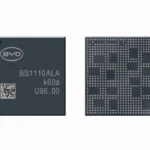


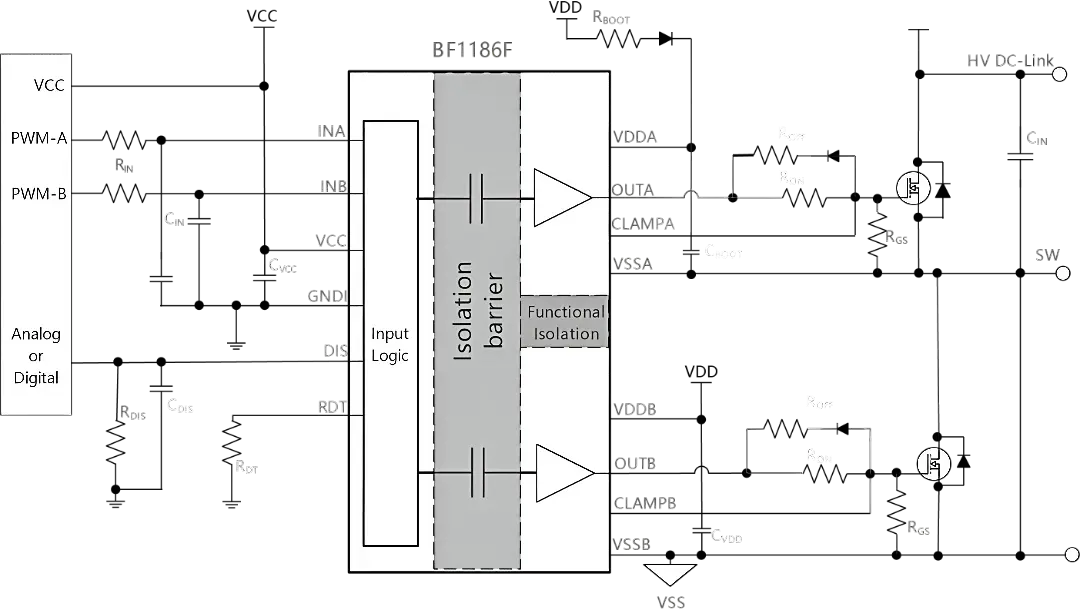
BYD Semiconductor disclosed this week that its BYD gate driver chip family — the isolated drivers that switch every IGBT and silicon-carbide device in an electric car — has passed 50 million units shipped and is in full mass production. The family runs to four parts — single-channel BF1181C and BF1190, dual-channel BF1186AQA and BF1186-F — all AEC-Q100 qualified, and all aimed at the same problem: the industry is moving from 400 V to 1,000 V and from IGBT to SiC, and the chip that has to sit across that isolation barrier is getting harder to buy.
What the BYD Gate Driver Chip Family Contains
The disclosure came through BYD Semiconductor’s own channels rather than at an event, and it reads as a product brief with a shipment number attached. Four parts, one architecture:
| BF1181C | BF1190 | BF1186AQA | BF1186-F | |
|---|---|---|---|---|
| Channels | Single | Single | Dual | Dual |
| Switches driven | IGBT | IGBT / SiC | IGBT / SiC | IGBT / SiC |
| Peak drive current | ±8 A | ±10 A | 4 A / 6 A sink and source | ±10 A |
| Isolation withstand (min) | 4.5 kVrms | 5.7 kVrms | 5.7 kVrms | 5.7 kVrms |
| CMTI (min) | 100 kV/µs | 150 kV/µs | 100 kV/µs | 100 kV/µs |
| Miller clamp | Yes | Yes | No | Yes |
| Package | SOW16 | SOW16 | SOW16 | SOW18 |
| Qualification | AEC-Q100 | AEC-Q100 | AEC-Q100 | AEC-Q100 |
The matrix is the most useful thing in the disclosure, because it shows the family is not one product sold four ways. Only three of the four parts are specified for silicon carbide: the entry BF1181C drives IGBTs only, at a lower 4.5 kVrms isolation rating and ±8 A. The dual-channel BF1186AQA drops the Miller clamp and splits its drive current between sink and source. In practice a 1,000 V SiC inverter has one candidate in this catalogue, and it is not the cheapest one.
The Three Improvements, and What Each One Buys
BYD’s disclosure is organised around three numbers. Each one answers a specific failure mode rather than a specification-sheet talking point.
Secondary-side tolerance: 40 V, up about 30%
When a high-power module turns off, it can drag the driver’s reference below ground by roughly 20 V. Conventional drivers are specified close to that line. BYD rates this family’s secondary supply at 40 V, which it puts about 30% above the conventional figure. The headroom does not make the transient disappear — it decides whether the transient is survived or becomes an overvoltage failure.
Common-mode transient immunity: 200 V/ns measured, up about 50%
The driver has to carry a low-voltage control signal across an isolation barrier while the switch on the other side generates precisely the kind of fast voltage step that corrupts it. BYD quotes a minimum of 100 to 150 V/ns depending on the part, and a measured peak of 200 V/ns. Exceeding that limit does not degrade the signal gracefully; it produces a false turn-on, and across a half bridge a false turn-on is a shoot-through.
Drive current: ±10 A peak, up about 60%
The two flagship parts deliver ±10 A, which BYD puts more than 60% above conventional designs. The consequence that matters is not a number on a datasheet: the parts drive IGBT and silicon-carbide gates directly, without an external buffer or gate amplifier. That removes components around every switch and lets one driver design carry both device technologies — which is the whole bill-of-materials argument, stated as a current rating.
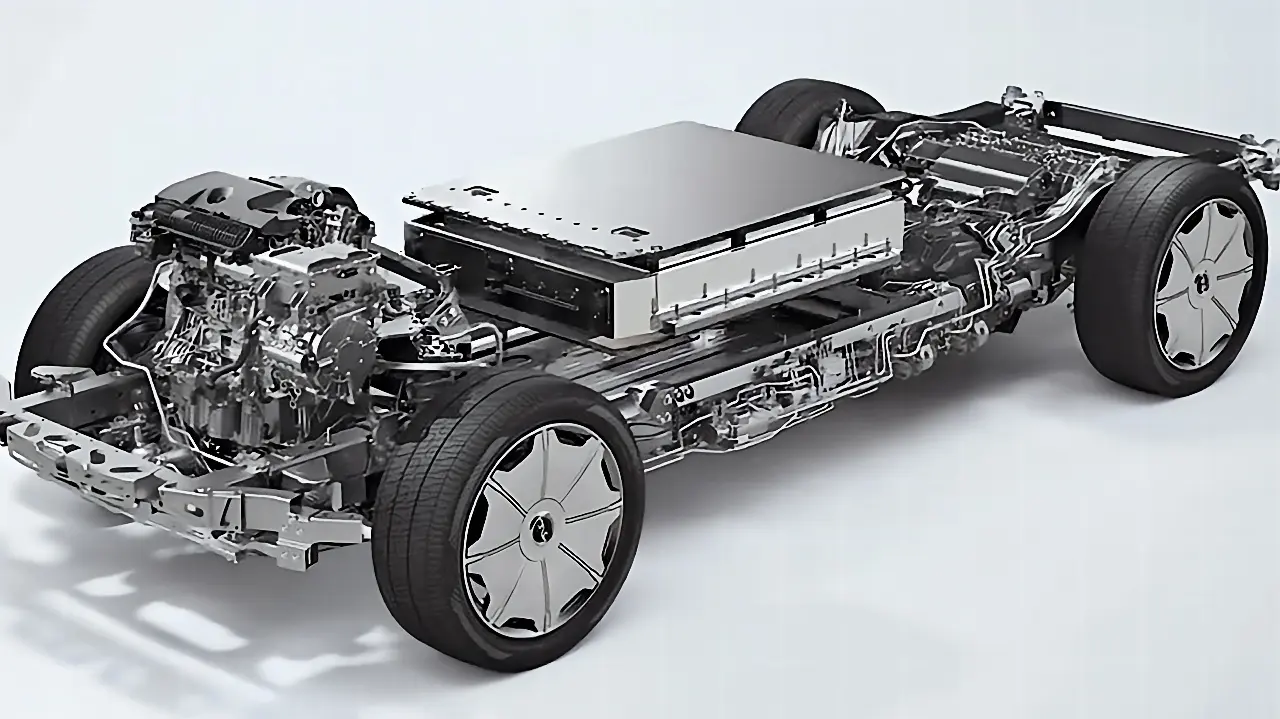
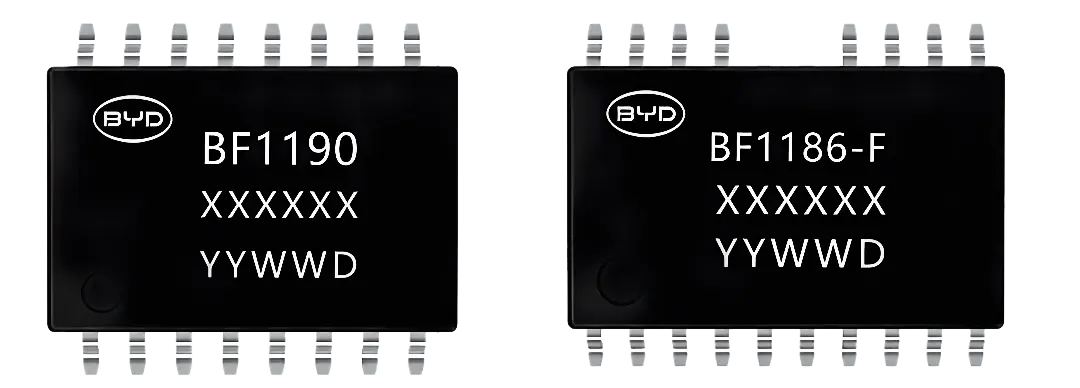
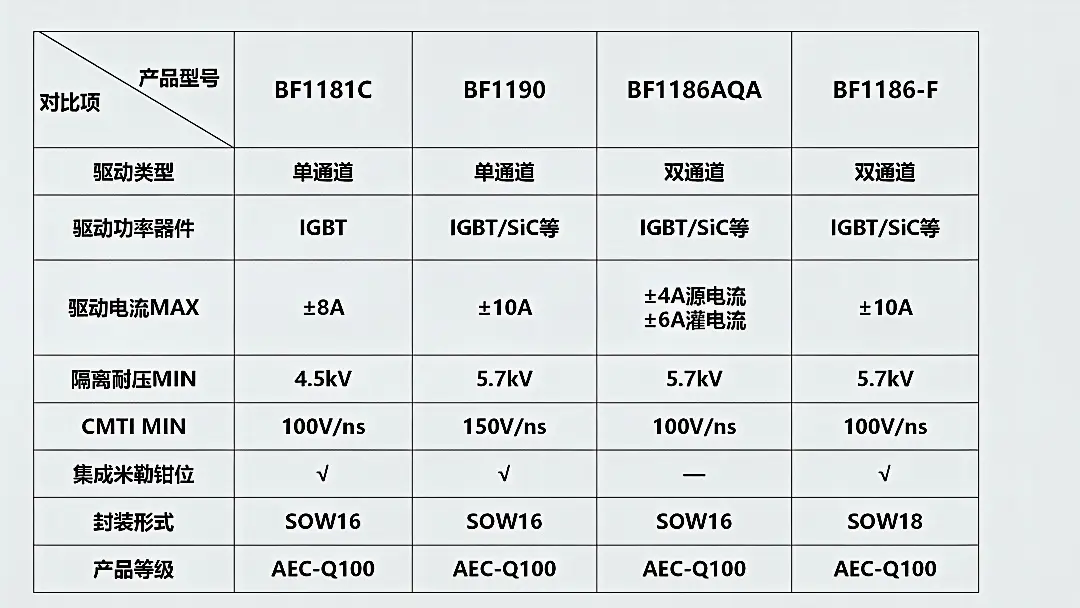
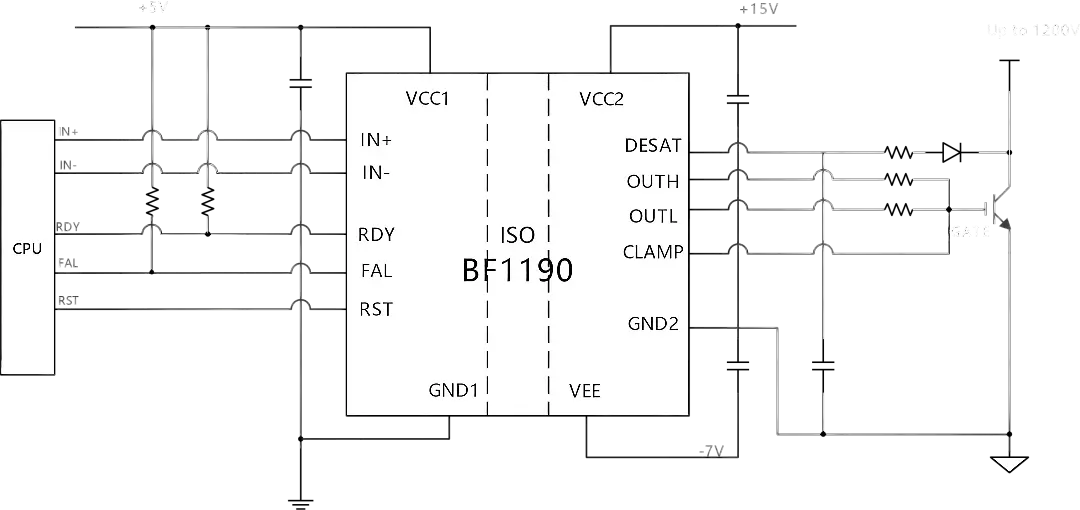
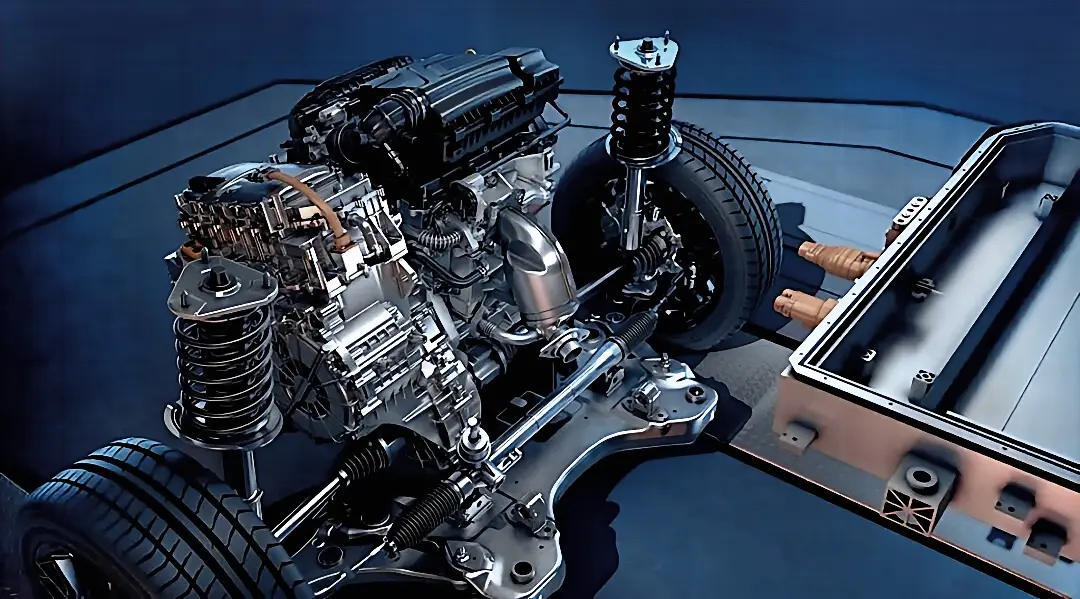
The application list is broader than a car. Traction inverter, on-board charger and DC-DC converter, electric compressor and PTC heater on one side; industrial solar and storage inverters, and AI server power supplies, on the other.
Why 1,000 Volts and Silicon Carbide Raise the Bar
Raising the platform from 400 V to 1,000 V and swapping IGBTs for SiC makes both sides of that barrier harder. Switching frequencies rise, so the transients arrive more often; SiC switches faster, so each one is steeper. The silicon-carbide module takes the attention. The chip on its gate is what decides whether it survives a fault.
It is also why this part matters commercially. Every inverter needs several of them, in every vehicle, and for most of the last decade it was one of the reliably imported components inside a Chinese electric car.
Fifty Million Units Is the Number That Matters
Cumulative shipment is the only hard figure in the disclosure, and it is worth converting once. A three-phase traction inverter has six switches, and a typical design uses one isolated driver per switch — or three dual-channel parts. At six per vehicle, 50 million units is enough for roughly 8.3 million traction inverters. That is an upper bound, not an installed-base figure, because the same parts also go into on-board chargers, compressors, solar inverters and power supplies. It is our calculation.
The context that makes the number mean something is the company behind it. In its investor relations record of 9 July 2026, BYD describes BYD Semiconductor as a power-semiconductor IDM with chip design, wafer fabrication and packaging in-house, and as China’s largest automotive-grade chip company. The same document says its battery-management chips are the only complete domestic solution and are already in volume production inside several leading automakers’ supply chains.
Read together, the BYD gate driver chip is one more layer in a stack that now runs from the cell, through the IGBT or SiC module, to the MCU, the driver, the sensor and the power-management part. Every layer brought in-house turns a purchase order into a margin line — and into a supply-risk item that no longer belongs to someone else.
What the Disclosure Does Not Say
Who buys it. No customer is named. We cannot tell whether the 50 million units went entirely into BYD group vehicles or whether any went to outside automakers, which is the difference between an internal cost centre and a merchant semiconductor business.
Over what period. There is no date range, so there is no run rate. Fifty million units is impressive as a cumulative figure and uninformative as a rate.
What it costs. No pricing, and no comparison against the imported parts it replaces.
Whether the AI power claim is real. The post says the parts are suitable for AI server power supplies. That is an applicability statement, not a design win, and nothing in the disclosure says a single server power supply uses one.
And whether the numbers hold up independently. CMTI, isolation withstand and drive current are vendor measurements. AEC-Q100 is an automotive qualification; industrial use has its own requirements.
Author’s Take: The gate driver is the least glamorous chip in an electric car and, for most of the last decade, one of the most reliably imported — this is a category where Infineon, Texas Instruments and Broadcom have had the design slots. Fifty million units is the first hard number suggesting that layer is now being in-sourced at volume by a Chinese carmaker, and it fits a pattern that runs through BYD’s whole chip story: the company does not announce a part, it announces a shipment. The frustration is that the disclosure stops exactly where the interesting questions start. Without a date range we cannot compute a run rate; without named customers we cannot tell whether this is an internal programme with a marketing budget or a supplier winning sockets. Watch for the second one. The day BYD Semiconductor quotes a gate-driver design win outside its own group is the day this stops being a vertical-integration footnote and becomes a competitor to the European and American analogue houses — and that is a much bigger story than 50 million units.
The Bottom Line: The BYD gate driver chip family — four AEC-Q100 parts running from the single-channel BF1181C to the dual-channel BF1186-F, with the top three specified for silicon carbide — has passed 50 million cumulative units and is in full mass production, the company says. At six drivers per traction inverter that is enough for roughly 8.3 million vehicles’ worth as an upper bound, and the parts also target on-board chargers, compressors, solar and storage inverters and AI power supplies. The strategic weight is that BYD now supplies the one chip in the inverter it used to buy. What is missing is everything that would make it a business story: a date range, a price, and a customer that is not BYD.
Notes: All specifications — the ±10 A drive current, the greater-than-150 and greater-than-100 kV/µs CMTI figures, the 200 V/ns measured peak, the 5.7 kVrms isolation withstand, the 40 V secondary supply rating and the percentage improvements over what the company calls conventional designs — are BYD Semiconductor’s own claims, published on its channels and in the product comparison matrix issued with the same disclosure. That matrix is also the only source for the BF1181C and BF1186AQA figures in the table above; both parts are documented in the matrix but not described in the body text, and EVsays has not tested any part or seen a third-party qualification report. The 50 million unit figure is a cumulative shipment number with no disclosed date range. The 8.3 million-vehicle figure is our calculation from six drivers per three-phase inverter and is an upper bound, since the same parts serve non-automotive applications. The claim that BYD Semiconductor is China’s largest automotive-grade chip company and operates as a power-semiconductor IDM is the company’s own description in its investor relations record; we have not independently verified market position. The AI server power supply reference is an application claim, not a disclosed design win. No customer names, prices or production start dates were disclosed. See our editorial policy and correction policy.
Sources & Further Reading
- BYD Semiconductor — “出货5000万颗,车规隔离驱动BF1190/1186全系适配IGBT/SiC功率器件” (23 October 2026) — the company’s own disclosure: the 50 million unit figure, both part numbers and their specifications, the protection features, the AEC-Q100 qualification, the application list and the framing against the 400 V to 1,000 V and IGBT-to-SiC transition.
- BYD Semiconductor — official site, IICIE 2026 exhibition release — the company’s self-description as a power-semiconductor, intelligent-control IC, sensor and optoelectronics supplier with in-house packaging and wafer fabrication, and the claim to be China’s largest automotive-grade chip company.
- BYD Company — investor relations activity record, 9 July 2026 (Shenzhen Stock Exchange disclosure) — the power-semiconductor IDM description, the list of self-developed automotive chip categories including driver chips, and the statement that its BMS chips are the only complete domestic solution and are in volume production with several leading automakers.
- EVsays — BYD’s 1,000 V SiC module — the switch side of the same architecture, and why the gate driver’s isolation requirements rise with the platform voltage.
- EVsays — BYD’s 4D radar chip — another layer of the same in-house chip stack.
- EVsays — BYD’s L3 timeline — the compute side of BYD’s semiconductor programme, and the gap between silicon capability and product readiness.
- Imagery: all six photographs and diagrams in the gallery above are BYD Semiconductor’s own product and application material, published with the same disclosure on 23 October 2026 and reproduced here unmodified.