

When you witness a sleek, silent electric vehicle (EV) accelerate effortlessly past a traditional gasoline car, it is natural to wonder: how do electric vehicles run? While many mistakenly perceive electric cars as oversized remote-controlled toys, the engineering governing their operation is a masterpiece of modern physics. By integrating advanced battery chemistry, solid-state power electronics, and electromagnetic propulsion, EVs deliver a driving experience that fundamentally redefines automotive efficiency.
This comprehensive guide breaks down the core mechanics, structural components, and scientific principles behind how pure electric vehicles function, revealing why they are systematically outperforming the internal combustion engine (ICE).
1. The Structural Architecture of Pure EVs: Simplicity Over Complexity
From a mechanical perspective, the construction and working principle of an electric vehicle are significantly simpler than those of a conventional gasoline-powered vehicle. a Battery Electric Vehicle (BEV) relies entirely on electrical energy stored in a pack of cells. It eliminates hundreds of moving parts—including pistons, spark plugs, catalytic converters, and complex multi-speed transmissions—replacing them with an elegant tri-component ecosystem known as the “Three-Core Electrical System” (Battery, Motor, and Electronic Control).
- Chassis and Body Design: While early EVs were adapted from legacy internal combustion platforms, modern EVs utilize native “skateboard” architectures. Because the heavy battery pack is mounted flat along the floorboard, native EVs feature a lower center of gravity but are often designed slightly taller to maximize cabin space without sacrificing ground clearance.
- Powertrain and Transmission: High-RPM electric motors fully replace the internal combustion engine. Remarkably, EVs do not require complex, multi-gear transmissions. The motor’s rotational speed and torque output are modulated instantaneously by power electronics, routing drive power through a single-speed reduction gear and differential straight to the axles.
- Steering and Suspension: Modern EVs utilize Electric Power Steering (EPS) and advanced independent suspension configurations, operating identically to high-end ICE platforms but benefiting from optimal front-to-rear weight distribution.
- Braking Infrastructure: Traditional cars leverage engine vacuum to assist mechanical braking. Because electric cars lack an internal combustion engine, they are equipped with a dedicated electric vacuum pump. This pump continuously replenishes the vacuum brake booster, ensuring highly responsive, reliable mechanical stopping power alongside regenerative braking.

2. High-Voltage vs. Low-Voltage Safety: Decoding Cable Color Codes
To safely manage power, electric vehicles run separate electrical networks divided by voltage levels. For the safety of vehicle occupants and emergency first responders, automotive engineers employ strict, globally standardized color-coding systems for wiring harnesses:
| Cable Color | Voltage Classification | Primary Application | Safety and Risk Assessment |
| Black / Red | 2V Low-Voltage | Infotainment, headlights, dashboard, airbags, and auxiliary electronics. | Completely safe to human touch; standard automotive standard. |
| Blue / Yellow | 42V Intermediate-Voltage | Electric power steering motors, advanced auxiliary actuators. | Safe to touch under normal conditions; minimal risk of electrical arcing. |
| Orange | 144V – 600V+ High-Voltage | Main traction lines linking the battery, inverter, and electric motor. | Extremely Hazardous. Contact can be fatal. Strict professional safety gear required. |
3. The Core Propulsion Heart: How Electric Motors Generate Motion
The translation of electricity into kinetic force occurs inside the traction motor. The automotive industry primarily relies on two major categories of electric motors: AC Induction (Asynchronous) Motors and Permanent Magnet Synchronous Motors (PMSM).
A. AC Induction Motors: The Asynchronous Stator-Rotor Relationship
An AC induction motor consists of two main elements: a stationary outer cylinder called the stator and an internal rotating assembly called the rotor. Crucially, there is no physical electrical connection or contact between the stator and the rotor; they are separated entirely by a microscopic air gap ranging from 0.2mm to 2mm.
When three-phase alternating current (AC) passes through the stator windings, it creates a continuously rotating magnetic field. According to Faraday’s Law of Electromagnetic Induction and Lenz’s Law, this moving magnetic field induces an electric current inside the closed conductors of the rotor. The induced current generates its own opposing magnetic field, causing the rotor to physically “chase” the stator’s rotating field.
Because the rotor must continuously cut through magnetic flux lines to maintain its induced current, the rotor’s rotational speed is always slightly slower than the speed of the stator’s magnetic field (typically by 2% to 6%). This inherent lag is why it is classified as an asynchronous motor. These motors are highly durable and capable of extreme rotational velocities (12,000 to 15,000 RPM), though their power electronic controls are highly sophisticated.

B. Permanent Magnet Synchronous Motors (PMSM): Synchronized Rotational Motion
In a synchronous motor, the rotor does not need to induce a magnetic field; instead, powerful permanent magnets (often made of rare-earth elements like neodymium) are embedded directly into the rotor structure. Operating on the fundamental rule of magnetism—where opposite poles attract and like poles repel—the stator’s rotating magnetic field locks onto the rotor’s permanent magnetic field. As a result, the rotor turns at the exact same frequency as the magnetic field, running completely in sync.

4. The Brain of the EV: How Inverters and Electronic Controllers Command Speed
Since electric vehicles skip multi-speed gearboxes, how do they control vehicle speed and driving force? The responsibility rests entirely upon the Motor Controller (Inverter).
The inverter acts as the operational brain of the propulsion system. It takes direct current (DC) from the high-voltage battery pack and transforms it into variable three-phase alternating current (AC) using a power electronics technique called Pulse Width Modulation (PWM).
- Modulating Frequency Regulates RPM: The frequency of the alternating current pulses dictates the rotational velocity of the motor’s magnetic field. By adjusting this frequency, the controller changes vehicle speed.
- Modulating Amplitude Regulates Torque: The voltage amplitude of the AC wave determines the strength of the magnetic field, controlling the motor’s output torque (pulling power).
📝 Core Speed Formula :
- Where N represents the motor speed in RPM.
- f is the electrical frequency output by the inverter in Hertz (Hz).
- P is the number of motor pole pairs.(Note: For Asynchronous Induction Motors, the actual speed is multiplied by (1 – s), where s is the slip rate, usually between 2% and 6%).
For example, if the motor has 2 pole pairs and the inverter outputs a frequency of 66.67 Hz, the motor spins precisely at 2,000 RPM. When the inverter scales the frequency up to 166.67 Hz, the motor speed increases instantly to 5,000 RPM, accelerating the vehicle linearly without gear shifts.

5. Replacing the Gearbox: The Mechanical Single-Speed Reducer
Because an electric motor delivers its maximum torque starting right at 0 RPM, it does not require a multi-gear transmission to stay within an optimal power band. However, because electric motors easily spin up to 15,000 RPM—far too fast for car wheels to rotate safely—the vehicle must reduce this speed while amplifying torque.
This is accomplished via a compact, highly efficient single-speed reduction gearbox (Reducer):
- Dual-Stage Reduction Gears: The most prevalent layout utilizes a small drive gear on the motor shaft spinning a larger intermediate gear, which subsequently turns the main differential gear. This step-down process smoothly trades high RPMs for raw driving torque.
- Planetary Gear Reduction Systems: Premium electric vehicles often leverage planetary gear sets. Though more expensive to manufacture, planetary systems offer exceptional mechanical efficiency, quiet operation, and extreme compactness, easily achieving reduction ratios around 9.2:1 (reducing 9,200 motor RPM down to a smooth 1,000 wheel RPM).

6. Step-by-Step Breakdown: The 6 Stages of EV Motion
To fully grasp how an electric vehicle runs during daily operation, we can map out the entire energy transmission sequence into six distinct mechanical stages:
- System Initialization (Power On): When the driver presses the Start button, the vehicle completes a high-voltage safety self-check. At this point, the traction motor is static, and only the 12V auxiliary system is active.
- Signal Transduction: As the driver depresses the accelerator pedal, a specialized dual-channel position sensor reads the exact angle of displacement, transmitting a micro-second demand signal to the electronic controller.
- DC to AC Conversion: The inverter instantly draws high-voltage DC from the battery packs, deploying solid-state switches to output the requested frequency and voltage of three-phase AC power to the motor.
- Electromagnetic Propulsion: The stator windings receive the AC power, projecting a rotating magnetic field that forces the rotor to spin, generating instantaneous mechanical torque.
- Torque Multiplication: The high-speed rotation of the motor shaft enters the single-speed reduction gearbox, stepping down the velocity while multiplying the torque sent to the drive wheels.
- Regenerative Braking (Energy Recovery): The moment the driver lifts their foot off the accelerator, the power flow reverses. The vehicle’s forward momentum spins the motor, turning it into an alternator. This creates magnetic resistance that slows the car down while capturing kinetic energy, turning it back into DC electricity to recharge the battery.

7. The Physics of Acceleration: Why EVs Instantaneously Defeat ICE Cars
Drivers shifting from internal combustion cars to electric cars are consistently shocked by the violent, instantaneous throttle response. This performance disparity is explained entirely by the fundamental differences in their respective torque curves.
A conventional internal combustion engine is a complex thermodynamic machine filled with heavy reciprocating masses (pistons, connecting rods, crankshafts, and heavy flywheels). An engine must fight internal friction and structural inertia, meaning it must build rotational speed (often requiring 2,000 to 4,000 RPM) before reaching its optimal torque peak.
Conversely, because the rotor of an electric motor sits completely suspended within an electromagnetic field with zero physical friction points, it experiences virtually no mechanical startup resistance. An electric motor delivers 100% of its maximum rated torque at exactly 0 RPM. The instant current flows, full mechanical force is deployed, giving EVs their characteristic, lag-free acceleration profile from a complete stop.

8. The Chemical Reservoir: The “Rocking-Chair” Mechanism of Lithium-Ion Batteries
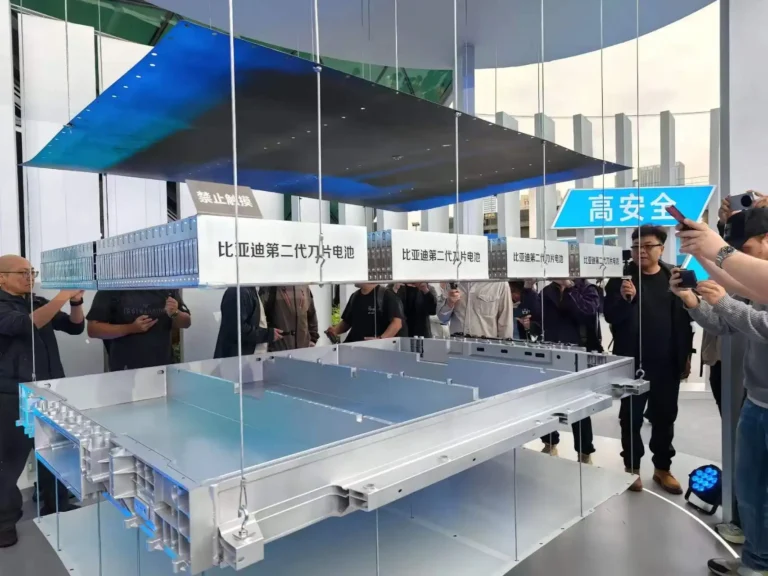
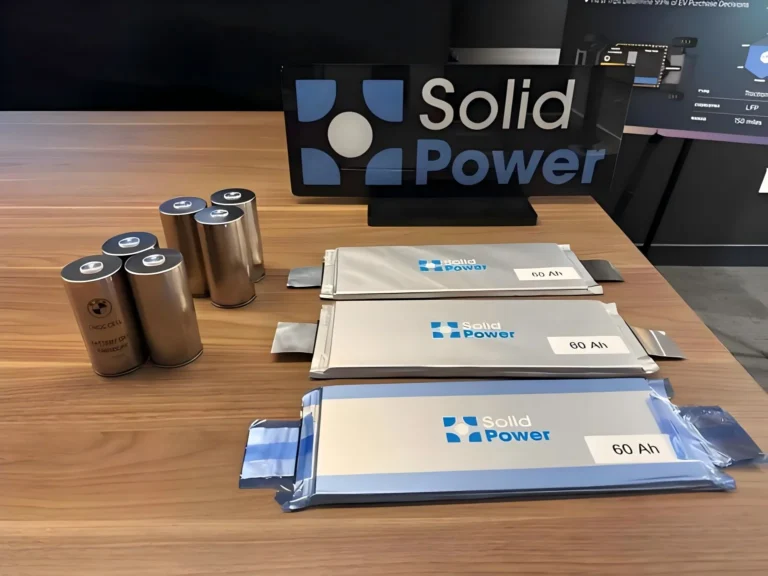
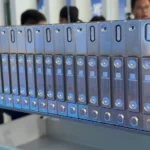
The entire propulsion network relies on the chemical storage capacity of the under-floor lithium-ion battery pack. Most modern EVs deploy chemistries utilizing Lithium Iron Phosphate (LFP) or Nickel Manganese Cobalt (NMC) as the positive electrode (cathode), graphite as the negative electrode (anode), and an organic electrolyte solution.
The movement of power within these cells is known as the “Rocking-Chair Battery” mechanism:
- During Recharging: External electrical energy forces lithium ions to leave the cathode, swim through the liquid electrolyte, and embed themselves within the microscopic pores of the graphite anode, storing potential energy.
- During Discharging (Driving): When you step on the accelerator to run the car, the chemical balance shifts. The lithium ions break free from the anode, traveling rapidly back to the cathode. This migration releases a steady stream of free electrons, generating the high-voltage DC current that powers the inverter and drives the vehicle forward.

Conclusion
Modern electric vehicles run on an interconnected grid of electrochemistry and electromagnetic forces. By removing the thermal and friction overhead of internal combustion, they convert over 85% of electrical energy directly into road propulsion, compared to a mere 20% efficiency in traditional gasoline platforms.