

The Big Picture
- CATL heavy truck battery swap landed its second major fleet: J&T Express, 5,000+ trucks. STO signed in April. Two of China’s largest courier companies are now on CATL’s swap network.
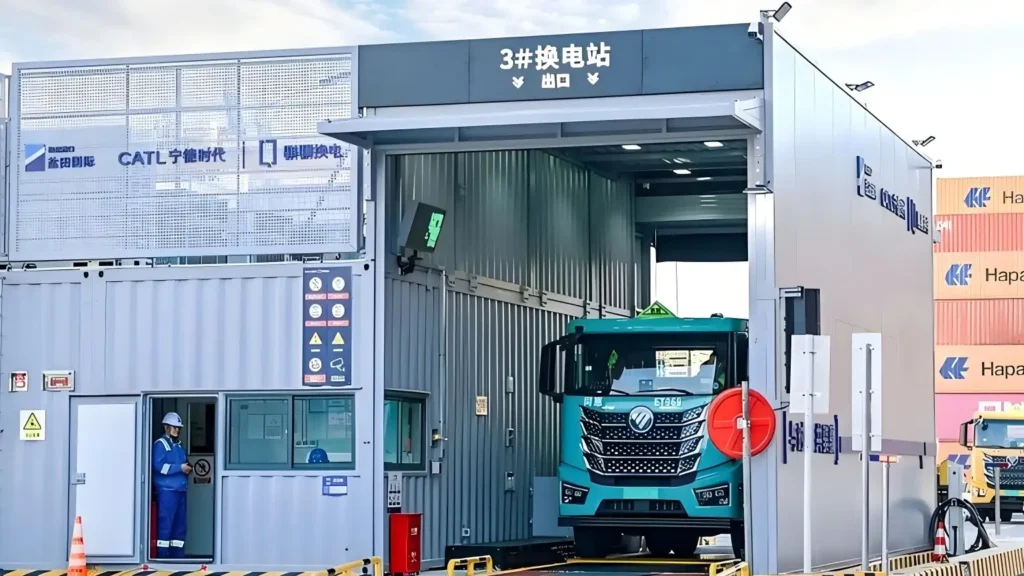
- 3-5 minutes per swap — faster than diesel refueling. For trunk-line logistics where downtime costs money, that’s the only math that matters.
- CATL chairman Robin Zeng predicted heavy truck electrification could hit 50% within three years. CATL is building the infrastructure — and locking in the customers.
1. The J&T Deal
CATL heavy truck battery swap signed its biggest commercial fleet win: 5,000+ J&T Express heavy-duty trucks — batteries, swap station equipment, operations and maintenance. Beyond trucks: light-duty vehicles, electric forklifts, and energy storage for logistics parks. J&T has already deployed 1,000+ unmanned logistics vehicles.
This is not a battery sale. It’s an infrastructure partnership embedding CATL into J&T’s entire logistics operation.
2. Why Heavy Trucks Are the Killer App
Heavy trucks run 12-18 hours a day. Every hour charging is lost revenue. CATL swaps in 3-5 minutes — faster than diesel.
China has ~8 million heavy trucks. Electrification rate: single digits. Robin Zeng predicted “explosive growth” with rates reaching 50%. If he’s right: ~4 million trucks, 2 swaps/day = 8 million daily transactions. That’s a utility.
CATL launched Qiji Energy in 2023 and a 1,250-km swap corridor in 2025. Now it’s populating that corridor with customers.
3. Lock In Fleets, Build the Network
The playbook: standardized pack → swap corridor → sign largest fleets → use guaranteed demand to justify expansion.
STO Express first (April). J&T Express second. 5,000 trucks × 2 swaps/day = 10,000 daily transactions. Recurring, predictable revenue.
This is fundamentally different from passenger swap. Fleet swap is known routes, known volumes, known schedules — more like a toll road than a gas station.
The deal ties into CATL’s wider swap ecosystem: Hong Kong taxis, global battery standards alliance, Octopus Energy European heavy truck JV. No other company is attempting this breadth.
Author’s Take: Most coverage focuses on Choco passenger swap. That misses the point. Heavy truck swap is where the money is — and CATL has no competition. To serve 5,000-truck fleets, you need standardized batteries, deployed corridors, 99%+ uptime. CATL spent three years building that. By the time anyone else does, CATL will have signed the next three fleets. This is a land grab disguised as a battery deal.
The Bottom Line
CATL heavy truck battery swap moved from pilot to commercial scale. Two of China’s largest courier companies are on the network. Heavy truck electrification is in single digits — CATL’s chairman sees 50% in three years. The company that controls swap infrastructure for China’s logistics backbone won’t just be the world’s largest battery maker. It will be the electricity utility for an industry that moves everything.