

The Big Picture
- CATL Hong Kong battery swap is now operational: two Choco-SEB stations running, first batch of right-hand-drive Hongqi E-QM5 taxis on the road.
- 36 stations by 2030, covering core hubs across all districts of Hong Kong — a city that is mountainous, dense, and starved of charging space.
- Hong Kong is the proof of concept. CATL has 1,650 stations across 127 mainland Chinese cities and aims for 3,000 by year-end. If swap works in Hong Kong’s tight urban geography, it works anywhere.
1. CATL Hong Kong Battery Swap: What’s Live Right Now
CATL Hong Kong battery swap entered commercial operation this week. Two Choco-SEB stations are now live, and the first fleet of battery-swap taxis is carrying passengers. The vehicle is a right-hand-drive Hongqi E-QM5 built on CATL’s Choco-SEB platform. A full battery swap takes 99 seconds — faster than filling a tank of petrol. AP News first reported on CATL’s battery swap ambitions back in December 2024; what was a blueprint then is now physical infrastructure.
The target is 36 stations by the end of 2030, CATL confirmed today. The network will serve high-frequency commercial vehicles — taxis and logistics vans — before expanding. Hong Kong currently has about 18,000 taxis, nearly all running on LPG. Even a 20% conversion rate would mean roughly 3,600 vehicles swapping daily.
2. Why Hong Kong Matters
Hong Kong is CATL’s first international battery swap deployment — and the choice of city is deliberate. It follows a year in which Chinese automakers have aggressively built overseas factories on every continent — CATL is now doing the same with infrastructure.
Hong Kong is mountainous, with some of the highest population density on earth. Land is scarce. Installing thousands of EV chargers in residential car parks is politically and logistically difficult. Battery swap stations, by contrast, occupy roughly four parking spaces and can service hundreds of vehicles per day.
It’s also right-hand drive — the standard for roughly 30% of the world’s auto markets, including the UK, Japan, Australia, India, and much of Southeast Asia. A working right-hand-drive swap taxi fleet in Hong Kong is a template for Singapore, London, Tokyo, and Sydney.
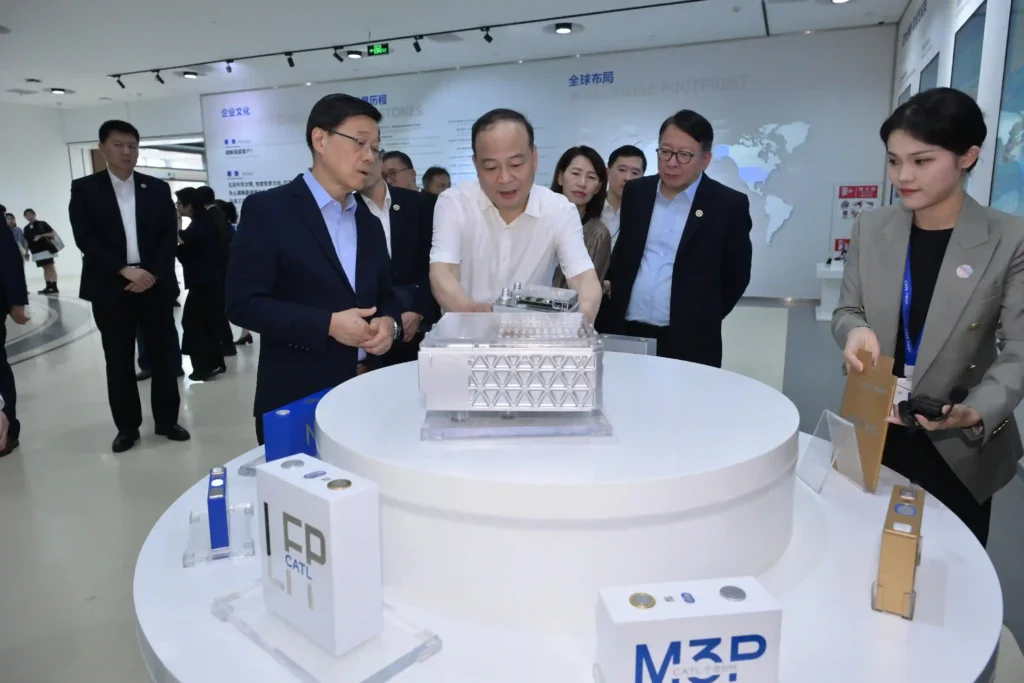
The political signal is equally important. Hong Kong Chief Executive John Lee Ka-chiu visited CATL on June 24. He toured the swap stations, rode in a swap taxi, and said Hong Kong “continues to advance the new energy industry.” CATL broke ground on its first Hong Kong swap station in January 2025. Eighteen months later, the city’s top official is in the passenger seat. That is not the timeline of a government that sees Chinese battery technology as a threat.
3. The Mainland Engine Behind It
Hong Kong is the showcase. The mainland is the factory.
| Metric | Current | Year-End 2026 Target |
|---|---|---|
| Swap stations | 1,650 | 3,000 |
| Cities covered | 127 | ~190 |
| Cities with 50+ stations | 3 (Chongqing, Guangzhou, Beijing) | Expanding |
CATL’s swap network has more than doubled in the past six months. At this pace, it will overtake Nio’s 9,000+ stations — which serve a single brand — in total swap volume within two years, because CATL’s standard is open to any automaker that adopts Choco-SEB. This is the same playbook we’ve seen across China’s auto industry globalization: build the platform, let others plug into it.
That’s the strategic distinction. Nio’s swap network is a product feature. CATL’s is infrastructure — like a petrol station chain that happens to swap batteries instead of pumping fuel. It doesn’t matter who made the car.
4. The Playbook: Prove It in Hong Kong, Export It Everywhere
CATL said explicitly that Hong Kong’s “high-density urban swap solution could become a replicable reference” for more international cities. Translation: Hong Kong is the beta test for global roll-out.
The model is elegant. CATL provides the standard battery pack (Choco-SEB) and the swap station hardware. Local partners — taxi fleets, logistics companies, municipal governments — provide the vehicles and operations. The pack is the platform. The city is the customer.
This also fits neatly into China’s new five-year energy plan, unveiled today, which for the first time designates EVs as a regulating resource for the national power grid. A network of swap stations isn’t just a refueling system — it’s distributed energy storage that can charge when power is cheap and discharge when it’s needed. While the industry debates whether solid-state batteries will render today’s tech obsolete, CATL is busy building the refueling infrastructure for the batteries that exist right now.
Author’s Take: CATL is playing a longer game than most observers realize. The battery swap business is currently a cost center — each station costs money, utilization rates are low, and taxi fleets won’t convert overnight. But that’s not the point yet.
The point is to establish Choco-SEB as the de facto global standard for swappable EV batteries — before anyone else does. If CATL’s packs are in the taxis of Hong Kong, the ride-hail cars of Guangzhou, and eventually the delivery vans of London, then CATL isn’t just selling batteries anymore. It’s selling the infrastructure that batteries require. That is a fundamentally different business — and a fundamentally larger addressable market — than being a supplier to automakers.
The Bottom Line
Two swap stations in Hong Kong don’t move the needle on CATL’s revenue. But they prove something that matters more: that battery swap works outside mainland China, in a right-hand-drive market, with government support, in one of the world’s most challenging urban environments.
If CATL can make swap work in Hong Kong — and then in Singapore, and then in London — it won’t just be the world’s largest battery maker. It will own the rails those batteries run on.