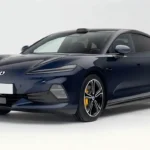

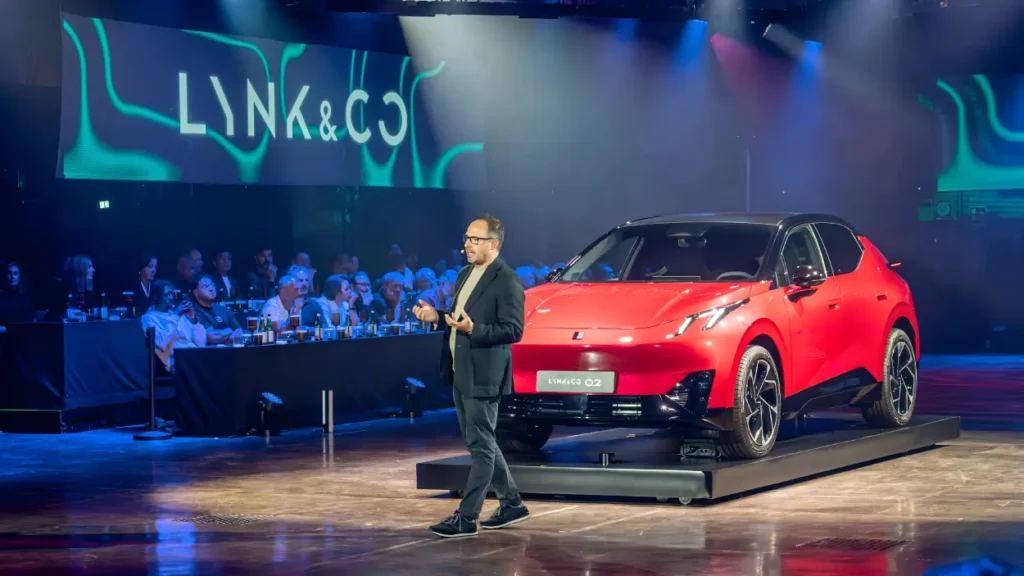
Lynk & Co has spent six years trying to sell cars in Europe differently: no dealerships, no showrooms, just a monthly subscription, a city-centre “club” and an app. On September 10, 2026, that experiment formally ended. Geely Auto Group and Volvo Cars reached a final agreement making Volvo the exclusive distributor for Lynk & Co in Europe from January 2027, with full responsibility for the brand’s commercial and brand operations across the region. The Chinese brand that once pitched itself as the anti-dealer is now renting one of Europe’s most established dealer networks.
The move caps a reversal that has been underway since 2024, and it says something uncomfortable about how Chinese automakers scale in mature markets: the product can be competitive long before the retail system is.
Lynk & Co Europe Deal: Volvo Becomes Exclusive Distributor
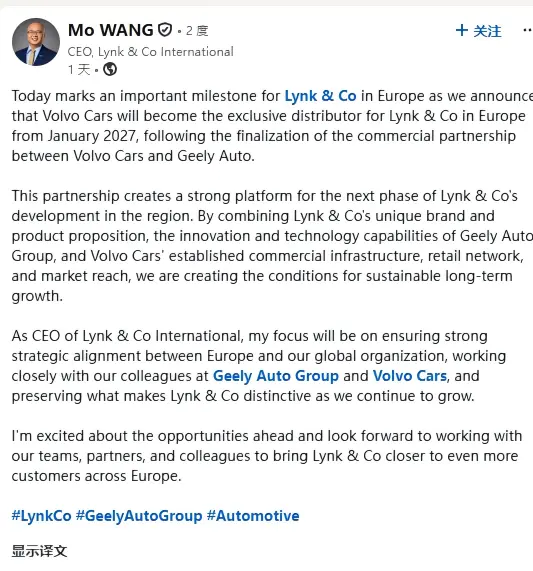
The agreement was confirmed in a Volvo Cars press release and announced by Lynk & Co in China on the same day. Under it, Volvo takes over Lynk & Co’s commercial operations in Europe, selling through Volvo retailers and servicing through Volvo’s network.
“This agreement enables Volvo Cars and our retail partners to reach more customers with a broader and differentiated portfolio of cars,” said Erik Severinson, Volvo’s chief commercial officer. Mo Wang, CEO of Lynk & Co International, framed it as combining “Volvo Cars’ established commercial infrastructure and Lynk & Co’s distinctive brand and product proposition.” The Lynk & Co business inside Volvo will be led by Martin Persson, reporting to Severinson.
Two boundaries matter. First, the deal involves no change to the ownership structure — Geely Auto Group continues to lead Lynk & Co’s global product design, R&D, regulatory certification and overall brand strategy. Second, Volvo runs the European sales and marketing, not the brand: Lynk & Co keeps its “trendy, vibrant, personal” positioning and its own product pipeline. All three current European models — the 01 and 08 plug-in hybrids and the electric 02 — are built in China.
What Lynk & Co Europe Changes: From Subscriptions to a 350-Workshop Network
Lynk & Co’s European story has moved through three distinct models in six years, and the direction has been consistently toward the conventional:
- 2020 — subscriptions. A monthly plan at €550 including servicing and insurance, cancellable after one month, with the first European “club” opening in Amsterdam in October 2020. By the first half of 2024 the brand had 12 clubs across seven European countries and more than 230,000 subscription members.
- 2024 — dealers return. Subscription acquisition costs stayed high and repeat rates low, and actual new-car volumes missed expectations. Retail partnerships with Volvo began in seven markets (Sweden, Germany, the Netherlands, Belgium, France, Spain, Italy), and the launch of the Z20 at the end of 2024 marked the end of the subscription-only model. The formal step came in March 2026, when the two companies signed a non-binding memorandum of understanding — converted into September’s binding agreement.
- 2026 — the network is rented. By H1 2026 Lynk & Co reached 25 European markets and 121 sales points. The final agreement now hands the whole European commercial operation to Volvo, whose European footprint includes more than 350 authorised workshops and 125-plus retail points.
Lynk & Co’s own commercial chief in China, Lin Jie, had already acknowledged the logic: subscriptions worked to build awareness early, but long-term growth “requires a mature and stable dealer system, standardised service network and a scalable retail model” — something a single subscription format could not deliver.
Why Lynk & Co Europe Leans on Plug-In Hybrids
The product mix under the agreement is not accidental. The electric 02 carries the EU’s countervailing duty on Chinese-built EVs at Geely’s rate of 18.8%, on top of the 10% standard tariff — 28.8% all-in. The 01 and 08 plug-in hybrids pay only the standard 10%, which is precisely why the 08 has become the brand’s lead product in Europe, marketed with a claimed 200 km of electric range. German pricing for the three-car line-up runs from about €35,995 to €55,995.
It is the same tariff arithmetic that has reshaped Chinese product strategies across the continent — a gap EVsays examined when Brussels began closing the plug-in hybrid loophole. In effect, Europe’s tariff structure, not consumer preference, decides what a Chinese brand puts on the boat.
Lynk & Co Europe and the “Geely Pattern”
Seen from the group level, the deal follows a template. In the space of a year, this is the third case of a Geely Holding brand selling Chinese-built cars through a Western-badged network the group already owns: Lotus put its Wuhan-built Eletre into Canada through Lotus dealers in July; Polestar reintroduced its China-built Polestar 2 to Canada in June; now Lynk & Co hands Europe to Volvo. The Geely–Ford joint venture in Spain points the same way — use existing industrial and retail assets rather than build from zero.
The contrast with new entrants is sharp. When Xiaomi signed memorandums of understanding with eight German dealer groups in September, it was a newcomer buying its way onto forecourts one group at a time — a strategy we covered in detail. Lynk & Co, six years and 25 markets in, has concluded the opposite: rather than manage hundreds of dealer relationships itself, it pays a sister company to run them. Both answers reflect the same underlying problem — in Europe, distribution is the hard part, not the car.
The timing is also a group-level statement. Under Geely Holding’s “One Geely” strategy and its 2030 goal of more than 6.5 million annual sales with over a third from overseas, brands are being pushed to share infrastructure. China’s passenger vehicle exports passed 6.2 million units in the first eight months of 2026 — already more than all of 2025 — with August exports up 77.5% and new-energy passenger vehicle exports up 154.7%, according to China Daily. That volume makes retail and after-sales capacity the binding constraint.
The Bottom Line. From January 2027, Volvo Cars becomes the exclusive distributor for Lynk & Co in Europe, taking over commercial and brand operations while Geely Auto Group keeps global product design, certification and brand strategy. It closes a six-year arc from subscription pioneer to network renter, and it is the third time in a year that a Geely brand has sold Chinese-built cars through a Western network the group already owns. For Chinese automakers generally, the lesson is unglamorous but decisive: in Europe, the product is the easy half.
Sources & Further Reading
- Volvo Cars (official) — “Volvo Cars to become distributor for Lynk & Co in Europe from January 2027” — primary source: exclusive distributor from January 2027, Severinson and Mo Wang statements, Martin Persson appointment.
- China Daily — “Volvo to sell Lynk & Co cars in Europe” (2026-09-11) — Chinese export context (6.2m passenger vehicles in eight months), “One Geely” strategy and 2030 targets.
- Lynk & Co (official, 领克官网) — announcement of the final agreement (2026-09-10) — Chinese-language confirmation that the deal involves no equity change and that Geely Auto retains global brand strategy.
- eletric-vehicles.com — “Volvo to Distribute Lynk & Co in Europe From January 2027” — platform kinship (CMA/SEA2/CMA Evo), the 2025 Volvo-to-Zeekr stake sale, tariff arithmetic on the 02 versus the hybrids, German pricing, the “Geely pattern”.
- Volvo Cars (official) — MoU announcement, “Volvo Cars intends to become importer of Lynk & Co cars in Europe” (2026-03-30) — the March memorandum this final agreement implements.
Sourcing note: The final agreement was confirmed in Volvo Cars’ official English press release and by Lynk & Co’s parent company in China on September 10, 2026; both were used as primary sources. Background detail — the 2020 subscription terms, the path to 25 markets and 121 sales points, the 2025 sale of Volvo’s 30% Lynk & Co stake to Zeekr, platform sharing and the Euro-denominated price range — draws on industry reporting (eletric-vehicles.com) and Chinese business media; the equity-stake and platform details were not independently verified beyond that reporting. Volvo’s European network figures (350-plus workshops, 125-plus retail points) are as of end-2025. Lynk & Co’s 5,624-unit H1 2026 figure covers 18 European markets. The subscription monthly fee cited (€550) was the programme’s 2020 launch pricing. Tariff rates follow the EU’s published countervailing duties on Chinese-built BEVs. Analysis and interpretation are original to EVsays.