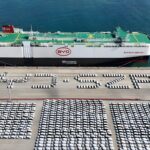



The XPeng Middle East roll-out reached eleven countries across the region on 2 November, with the company’s two largest SUVs going on sale and pre-orders opening from a launch event in Dubai. The GX — a 5.27-metre six-seat flagship — carries a UAE sticker of AED 299,000, or about USD 81,410. At then-current rates that is roughly 590,000 yuan, against a Chinese guide price of 359,800: a premium of 64% for the same vehicle. And the version going on sale there is not the pure electric one. It is the range extender — a 1.5-litre engine, a battery, and a combined range claim that XPeng puts at 1,210 km. The same week, the company named a former Volvo Korea executive to run a new South Korean subsidiary.
What Went on Sale, and Where
The two models are the GX and the G9L, both flagship SUVs, each launched in eleven markets. Ten are shared: the UAE, Qatar, Morocco, Tunisia, Kuwait, Bahrain, Oman, Lebanon, Jordan and Nigeria. The GX adds Egypt; the G9L adds Ghana. Orders are open, but XPeng did not give delivery dates.
The regional order book is not trivial. XPeng says the GX collected more than 4,000 orders across the region before first deliveries, including 800 in the UAE. For scale, that is about 30% of everything XPeng shipped overseas in October.
| Item | Detail |
|---|---|
| Models | GX (six-seat flagship SUV), G9L (three-row family SUV) |
| UAE pricing | GX Flagship Edition AED 299,000; G9L pre-sales from AED 259,000 |
| Powertrain | Kunpeng range extender, 800 V, 5C charging, 10–80% in 10.7 minutes |
| Range claim | up to 1,210 km combined, NEDC |
| Network | all six GCC markets by end-2026; more than 20 countries and 100 outlets by 2027 |
| Product cadence | six more models for the Middle East over the next 12 months, launched in step with China |
XPeng is also building the unglamorous parts. It signed distribution agreements in Kuwait and Oman, says it now has cross-regional warranty coverage across the GCC and the Levant with North Africa to follow in 2027, and runs a central spare-parts warehouse in Dubai that it claims can reach service centres within 24 hours. That last detail is the difference between a launch and a business.
Why the XPeng Middle East Push Is Range-Extender Led
This is the part worth pausing on. XPeng built its reputation on 800 V pure-electric platforms, silicon-carbide inverters and its own driver-assistance stack — a company that argued, loudly, that battery-electric was the answer. In the Gulf it is leading with a car that carries a petrol engine.
The Kunpeng system pairs a battery with a 1.5-litre turbocharged generator. In the Chinese GX, the electric-only range is 430 km on the CLTC cycle and the combined figure is 1,585 km. XPeng’s regional materials quote a maximum combined NEDC range of 1,210 km for the two models. Those two numbers are not directly comparable — NEDC is normally the more generous cycle, which makes a lower NEDC figure against a higher CLTC one unusual, and XPeng has not explained the difference.
The commercial logic, though, is not in dispute. Gulf markets have long inter-city distances, extreme heat and charging infrastructure that thins out fast outside the big cities. A range extender removes the two questions a buyer there actually asks: how far, and where do I plug it in. XPeng says as much in its own release, describing the powertrain as designed for exactly those conditions.
Note the asymmetry with Europe. The G9L went on sale in Europe at the Paris show on 12 October as a battery-electric vehicle. In Hong Kong on 2 November it arrived as an extended-range all-wheel drive. In the Gulf it is the range extender. XPeng is not exporting one product. It is exporting whichever powertrain the market will pay for — and charging infrastructure, not engineering capability, is what draws the line.
The Premium, and What Is Inside It
A 64% premium sounds like margin. Some of it is not.
| Measure | Value |
|---|---|
| GX Flagship, China guide price | 359,800 yuan |
| GX Flagship Edition, UAE | AED 299,000 = USD 81,410 |
| Converted at 7.25 CNY/USD | about 590,200 yuan |
| Premium over China | +64% (about +69% against the 349,800 launch price) |
The UAE applies a 5% customs duty on imported cars and 5% VAT, so roughly a tenth of that gap is tax before anyone earns anything. Shipping, homologation, a distributor’s margin and the cost of holding parts for a 24-hour service promise account for more. What remains is the reason Chinese carmakers are willing to spend years building these networks: the export price is set by the destination market, not by the factory gate.
That is also why the launch matters more than the volume. Four thousand orders is a rounding error against XPeng’s monthly output. But every one of them is booked at a price roughly two-thirds above the domestic one, in a market where Chinese brands are not yet in a price war with each other — which is the whole point of the XPeng Middle East bet.
At Home, the Number Is Going the Other Way
XPeng delivered a record 50,237 vehicles in October, up 19.57% year on year and past 50,000 for the first time. Overseas accounted for a record 13,326 of them, up 166% and 26.5% of the total.
Strip the export channel out and the domestic picture is different. For January to October, XPeng delivered 334,604 vehicles, down 5.80%. Overseas was 72,805 of that, up 109.68%. Which leaves roughly 261,800 in China, against about 320,500 in the same period last year — a decline of 18.3%, on our arithmetic from the disclosed totals and growth rates.
Overseas share of the business has more than doubled in a year, from about 9.8% to 21.8%. That is not a company expanding from strength. It is a company expanding because the home market is contracting, and doing it fast enough that the headline number still looks like growth.
Korea Will Be Harder
On 3 November XPeng confirmed it will enter South Korea and named Lee Man-sik as managing director of XPeng Motors Korea from 1 December. Lee spent more than 30 years in the industry and joined Volvo Cars Korea in 2003, where he worked on brand positioning, product planning, sales, marketing and dealer network expansion. XPeng did not announce a launch date, an initial model line-up or a local partner.
Korea is a different proposition from the Gulf. It is a mature, highly competitive market dominated by Hyundai and Kia, with its own safety and emissions certification, a strong domestic preference for local brands, and — unlike the GCC — no obvious gap in charging infrastructure for a range extender to fill. BYD has already gone in with the Sealion 6 plug-in hybrid; XPeng would be the second Chinese challenger to test whether a hybrid is the right entry ticket.
Hiring a 30-year Volvo veteran rather than promoting from inside is itself the signal. It says XPeng expects the constraint in Korea to be distribution and brand trust, not product.
Author’s Take: The interesting thing about this expansion is how little of it is about electric cars. XPeng’s pitch abroad has quietly become “whatever powertrain the infrastructure supports” — pure electric in Europe, extended-range in Hong Kong and the Gulf — and the price it charges in Dubai is two-thirds higher than at home. Neither of those facts fits the story XPeng tells about itself, but both are rational. The domestic market is shrinking 18% and the export market is paying a premium. That is the whole strategy in one sentence, and it will hold until either Chinese brands start undercutting each other in the Gulf, or Korea proves that a strong dealer network cannot overcome a home-market advantage. Korea is the real test: it is the first market XPeng has entered where the incumbent is not asleep and the charging network is not the obstacle.
The Bottom Line: XPeng launched the GX and G9L in eleven Middle East and Africa markets on 2 November, took more than 4,000 GX orders before delivery, and priced the flagship GX at the equivalent of about 590,000 yuan in the UAE — 64% above its Chinese guide price. The XPeng Middle East roll-out is led by range-extender versions, not the pure-electric cars the brand is known for. Overseas is now 21.8% of deliveries and growing 110%, while China is down 18.3% this year. Korea, announced the next day, is where that formula meets a market that will not hand it a premium.
Sources & Further Reading
- XPeng statement of 3 November 2026 on the Middle East and Africa launch — the eleven markets per model, UAE pricing for the GX Flagship Edition (AED 299,000) and the G9L (from AED 259,000), the Kunpeng range-extender specification, the more-than-4,000 GX regional orders including 800 in the UAE, the 2026 and 2027 network targets, the six additional regional models, warranty coverage and the Dubai parts warehouse.
- XPeng — “用科技重新定义旗舰:小鹏GX正式上市,限时权益价26.98万元起” (20 May 2026) — the Chinese launch of the GX: eight configurations, guide prices from 279,800 to 359,800 yuan, the 1.5T extended-range powertrain with 430 km of electric-only CLTC range and 1,585 km combined, dimensions of 5,265×1,999×1,800 mm on a 3,115 mm wheelbase, and the 800 V / 5C architecture.
- XPeng statement of 3 November 2026 on South Korea — the appointment of Lee Man-sik as managing director of XPeng Motors Korea effective 1 December 2026, his background at Volvo Cars Korea from 2003, and the absence of a launch date, model line-up or partner.
- XPeng October 2026 delivery figures — 50,237 vehicles in total, a first month above 50,000; 13,326 overseas, up 166%; and 334,604 for January to October including 72,805 overseas. The China-only split in this article is our calculation from those totals and growth rates, not a disclosed figure.
- Qichezhiwang — GX cumulative deliveries passing 30,000 units on 21 October 2026, roughly five months after the 20 May launch, with more than 80% of orders taken on the flagship trim.
- EVsays — BYD Sealion 6 in Korea — the Chinese plug-in hybrid already testing Hyundai’s home market.
- EVsays — Volkswagen weighs the Xpeng co-developed architecture for Europe — the other half of XPeng’s international story, and a very different kind of export.
- EVsays — China’s EV export strategy and Chinese EVs’ European market share — the wider export picture these numbers sit inside.
Notes: Prices, specifications and order figures are XPeng’s own, from statements and its Chinese launch release; EVsays has not driven the GX or G9L and has not verified Gulf market pricing independently. The 64% premium is our arithmetic: the UAE price was converted at a fixed 7.25 CNY/USD rate for consistency across our coverage, so it will move with the dirham. It includes UAE customs duty and VAT plus distributor margin, and is not a measure of XPeng’s profitability on the car. The China-only delivery split is also our calculation, derived from disclosed totals and year-on-year rates rather than published directly. XPeng quotes 10.7 minutes for a 10–80% charge in its regional materials and 11.7 minutes in its Chinese GX release; we have used the regional figure and flag the difference rather than reconcile it. No delivery dates have been announced for the Middle East. Follow our correction policy for amendments, and our editorial policy for sourcing standards.